Leong Merrin Man Long, Lung Maria Li
Division of Infectious Diseases, Department of Medicine, Brigham and Women's Hospital, Harvard Medical School, Boston, MA, United States.
Department of Microbiology, Harvard Medical School, Harvard University, Boston, MA, United States.
Front Oncol. 2021 Feb 25;11:629780. doi: 10.3389/fonc.2021.629780. eCollection 2021.
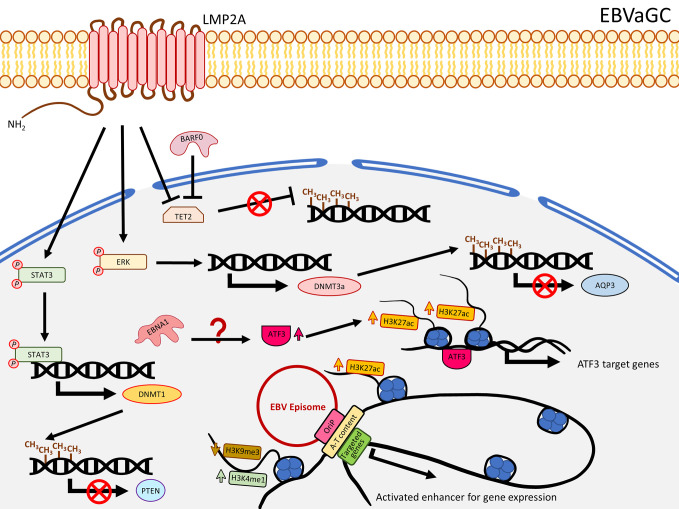
Epstein-Barr virus (EBV) infection is associated with a variety of malignancies including Burkitt's lymphoma (BL), Hodgkin's disease, T cell lymphoma, nasopharyngeal carcinoma (NPC), and ∼10% of cases of gastric cancer (EBVaGC). Disruption of epigenetic regulation in the expression of tumor suppressor genes or oncogenes has been considered as one of the important mechanisms for carcinogenesis. Global hypermethylation is a distinct feature in NPC and EBVaGC, whereas global reduction of H3K27me3 is more prevalent in EBVaGC and EBV-transformed lymphoblastoid cells. In BL, EBV may even usurp the host factors to epigenetically regulate its own viral gene expression to restrict latency and lytic switch, resulting in evasion of immunosurveillance. Furthermore, in BL and EBVaGC, the interaction between the EBV episome and the host genome is evident with respectively unique epigenetic features. While the interaction is associated with suppression of gene expression in BL, the corresponding activity in EBVaGC is linked to activation of gene expression. As EBV establishes a unique latency program in these cancer types, it is possible that EBV utilizes different latency proteins to hijack the epigenetic modulators in the host cells for pathogenesis. Since epigenetic regulation of gene expression is reversible, understanding the precise mechanisms about how EBV dysregulates the epigenetic mechanisms enables us to identify the potential targets for epigenetic therapies. This review summarizes the currently available epigenetic profiles of several well-studied EBV-associated cancers and the relevant distinct mechanisms leading to aberrant epigenetic signatures due to EBV.
爱泼斯坦-巴尔病毒(EBV)感染与多种恶性肿瘤相关,包括伯基特淋巴瘤(BL)、霍奇金病、T细胞淋巴瘤、鼻咽癌(NPC)以及约10%的胃癌病例(EBVaGC)。肿瘤抑制基因或癌基因表达中的表观遗传调控紊乱被认为是致癌的重要机制之一。全基因组高甲基化是NPC和EBVaGC的一个显著特征,而H3K27me3的全基因组减少在EBVaGC和EBV转化的淋巴母细胞中更为普遍。在BL中,EBV甚至可能篡夺宿主因子以表观遗传方式调节其自身的病毒基因表达,从而限制潜伏期和裂解转换,导致免疫监视逃避。此外,在BL和EBVaGC中,EBV附加体与宿主基因组之间的相互作用很明显,分别具有独特的表观遗传特征。虽然这种相互作用在BL中与基因表达抑制相关,但在EBVaGC中的相应活性与基因表达激活有关。由于EBV在这些癌症类型中建立了独特的潜伏程序,EBV有可能利用不同的潜伏蛋白劫持宿主细胞中的表观遗传调节剂以引发疾病。由于基因表达的表观遗传调控是可逆的,了解EBV如何失调表观遗传机制的精确机制使我们能够确定表观遗传治疗的潜在靶点。本综述总结了几种已充分研究的EBV相关癌症目前可用的表观遗传谱以及由于EBV导致异常表观遗传特征的相关独特机制。