Laboratory of Applied Microbiology, Faculty of Dentistry, Department of Dental Materials and Prosthodontics, São Paulo State University (Unesp), Araraquara, Brazil.
Laboratory of Molecular and Cell Biology, School of Pharmaceutical Sciences, Department of Clinical Analysis, São Paulo State University (Unesp), Araraquara, Brazil.
Front Cell Infect Microbiol. 2021 Feb 25;11:627043. doi: 10.3389/fcimb.2021.627043. eCollection 2021.
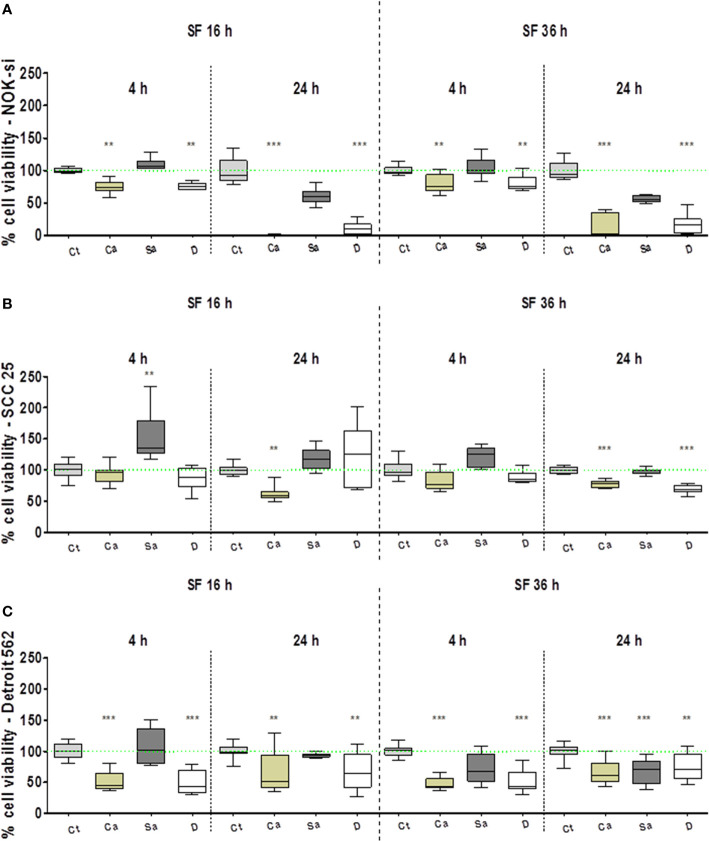
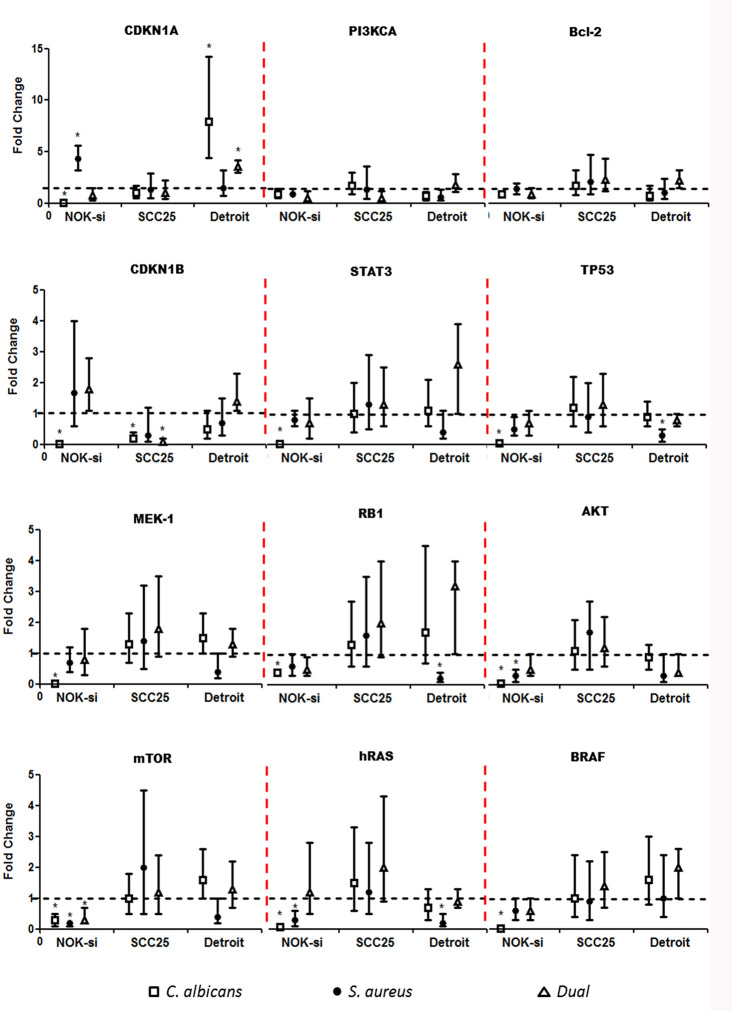
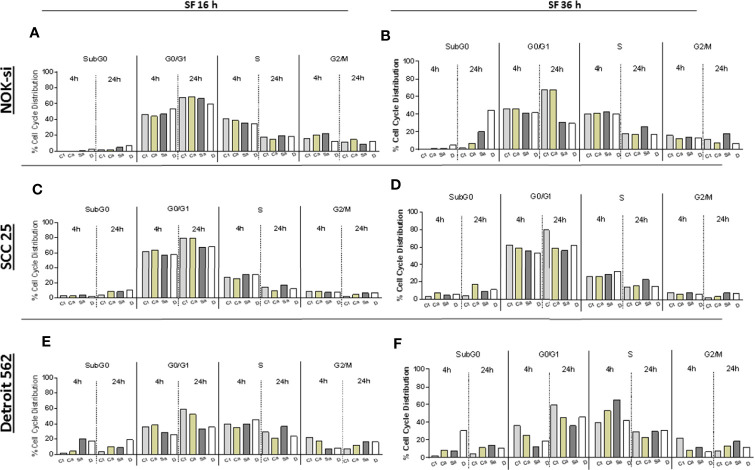
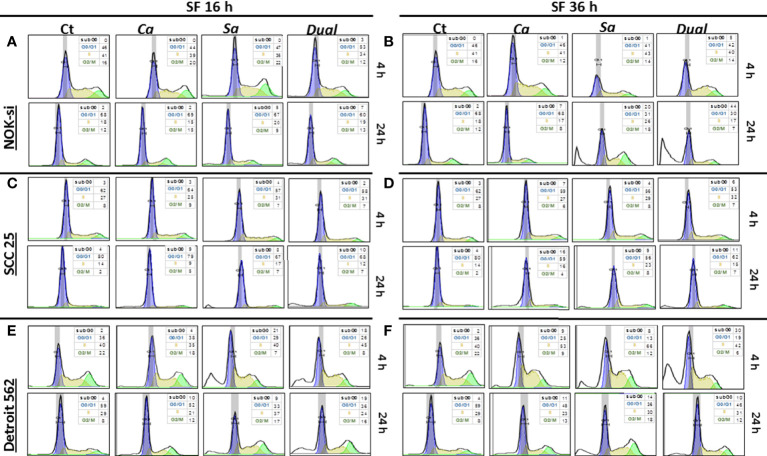
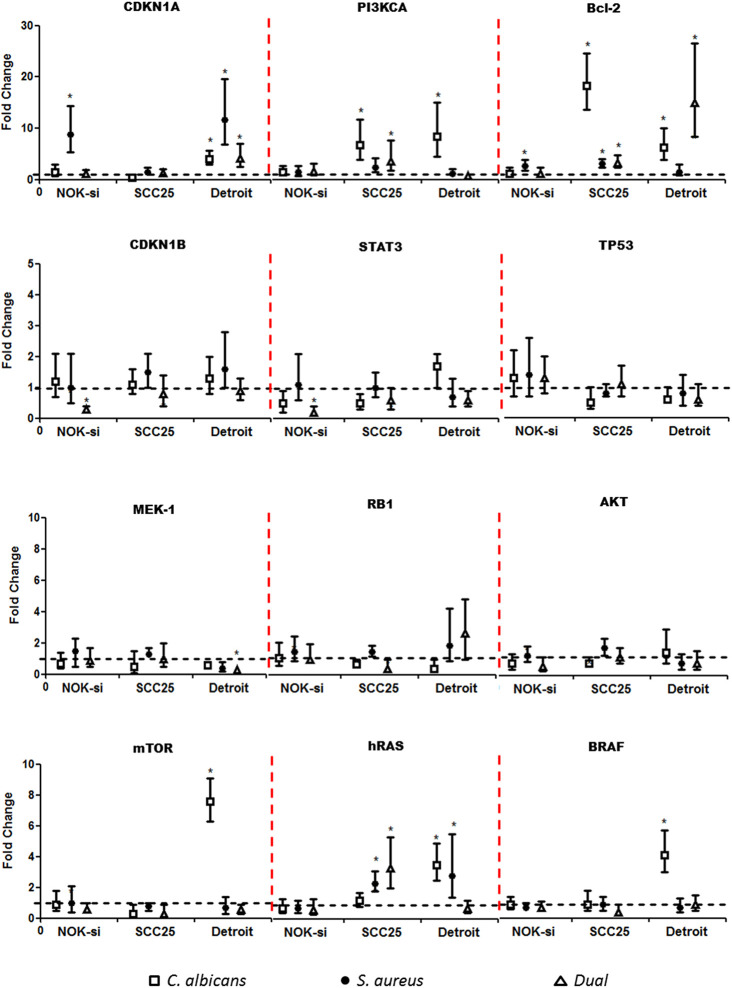
This study was aimed at analyzing proto-oncogenic signaling pathway activation in normal oral keratinocytes (NOK-si) and neoplastic cell lines (SCC 25 and Detroit 562) stimulated with metabolites (soluble factors) from single and dual biofilms of and . Soluble factors (SF) from early (16-h) and mature (36-h) biofilms of and were collected and incubated with cell cultures, which were subsequently evaluated using gene expression via RT-qPCR, cell viability via AlamarBlue, and flow cytometry cell cycle analysis. In general, exposure to the SF of early and mature biofilms from and dual species caused a major reduction in NOK-si cell viability and enhanced the sub G0 phase. This led to a decrease in gene expression. However, in this cell line, SF of biofilms upregulated the gene followed by the maintenance of cell viability and a significant increase in the G2/M population. For tumor cells, SCC 25 and Detroit 562, the stimuli of SF biofilms upregulated oncogenes such as and , as well as and . SCC 25 and Detroit 562 cells could survive even after 24 h of stimuli from both SF (early and mature). This occurred without significant changes taking place in the cell cycle progression for SCC 25, and with a significant tendency to increase the G2/M phase for Detroit 562. These results point to the fact that metabolites from prevalent clinical fungal and bacterial biofilms, and , can disrupt the homeostasis of normal and neoplastic oral epithelial cells. This changes proto-oncogenes' expression, specifically , , , , and cell cycle genes and , thus causing a disturbance in cell viability, survival, and the cell cycle profile.
本研究旨在分析在被 和 单种和双种生物膜的代谢物(可溶性因子)刺激后,正常口腔角质细胞(NOK-si)和肿瘤细胞系(SCC 25 和 Detroit 562)中原癌信号通路的激活情况。收集 和 早期(16 小时)和成熟(36 小时)生物膜的可溶性因子(SF),并与细胞培养物孵育,随后通过 RT-qPCR 评估基因表达、AlamarBlue 评估细胞活力以及流式细胞术细胞周期分析。总的来说,暴露于 和 单种和双种生物膜的早期和成熟生物膜 SF 会导致 NOK-si 细胞活力显著降低,并增强亚 G0 期。这导致基因表达下降。然而,在这种细胞系中, 生物膜 SF 上调了 基因,随后维持了细胞活力,并使 G2/M 群体显著增加。对于肿瘤细胞 SCC 25 和 Detroit 562,SF 生物膜刺激物上调了原癌基因,如 、 和 、 。即使在 SCC 25 和 Detroit 562 细胞受到 SF(早期和成熟)的刺激 24 小时后,它们仍然可以存活。这并没有显著改变 SCC 25 的细胞周期进程,而是使 Detroit 562 细胞向 G2/M 期显著增加。这些结果表明,来自常见临床真菌和细菌生物膜 和 的代谢物可以破坏正常和肿瘤口腔上皮细胞的内稳态。这改变了原癌基因的表达,特别是 、 、 、 ,以及细胞周期基因 和 ,从而导致细胞活力、存活和细胞周期谱的紊乱。