Karpiński Tomasz M
Department of Medical Microbiology, Poznań University of Medical Sciences, Wieniawskiego 3, 61-712 Poznań, Poland.
Microorganisms. 2019 Jan 13;7(1):20. doi: 10.3390/microorganisms7010020.
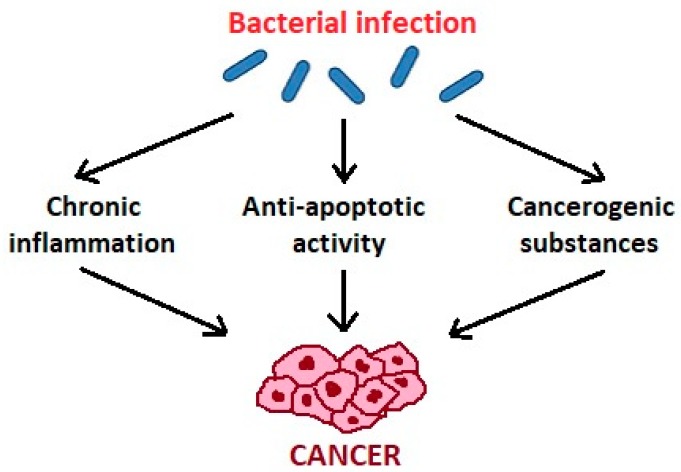
Nowadays cancer is the second main cause of death in the world. The most known bacterial carcinogen is . Pathogens that can have an impact on cancer development in the gastrointestinal tract are also found in the oral cavity. Some specific species have been identified that correlate strongly with oral cancer, such as sp., sp., sp., sp., , and . Many works have also shown that the oral periopathogens and play an important role in the development of colorectal and pancreatic cancer. Three mechanisms of action have been suggested in regard to the role of oral microbiota in the pathogenesis of cancer. The first is bacterial stimulation of chronic inflammation. Inflammatory mediators produced in this process cause or facilitate cell proliferation, mutagenesis, oncogene activation, and angiogenesis. The second mechanism attributed to bacteria that may influence the pathogenesis of cancers by affecting cell proliferation is the activation of NF-κB and inhibition of cellular apoptosis. In the third mechanism, bacteria produce some substances that act in a carcinogenic manner. This review presents potentially oncogenic oral bacteria and possible mechanisms of their action on the carcinogenesis of human cells.
如今,癌症是全球第二大主要死因。最知名的细菌致癌物是 。在口腔中也发现了可影响胃肠道癌症发展的病原体。已鉴定出一些与口腔癌密切相关的特定物种,如 菌属、 菌属、 菌属、 菌属、 菌属和 菌属。许多研究还表明,口腔牙周病原体 和 在结直肠癌和胰腺癌的发展中起重要作用。关于口腔微生物群在癌症发病机制中的作用,已提出三种作用机制。第一种是细菌对慢性炎症的刺激。在此过程中产生的炎症介质会导致或促进细胞增殖、诱变、癌基因激活和血管生成。第二种归因于细菌的机制可能是通过影响细胞增殖来影响癌症发病机制,即激活核因子-κB(NF-κB)并抑制细胞凋亡。在第三种机制中,细菌产生一些具有致癌作用的物质。本综述介绍了潜在致癌的口腔细菌及其对人类细胞致癌作用的可能机制。