Faculty of Medicine, Center for Environmental and Respiratory Health Research, University of Oulu, Oulu, Finland.
Faculty of Medicine, Biocenter Oulu, University of Oulu, Oulu, Finland.
Front Public Health. 2021 Feb 25;8:605128. doi: 10.3389/fpubh.2020.605128. eCollection 2020.
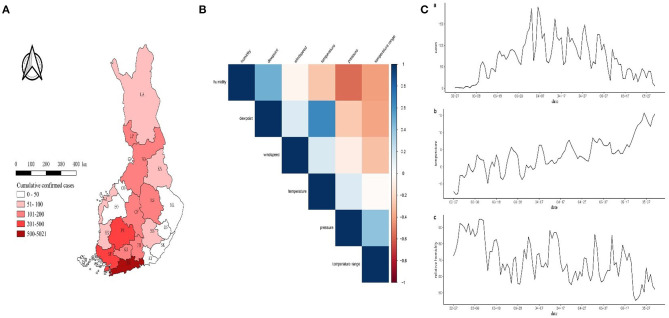
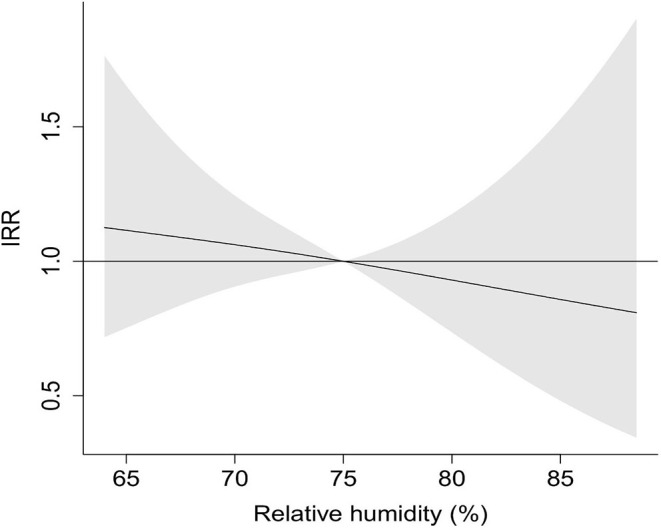
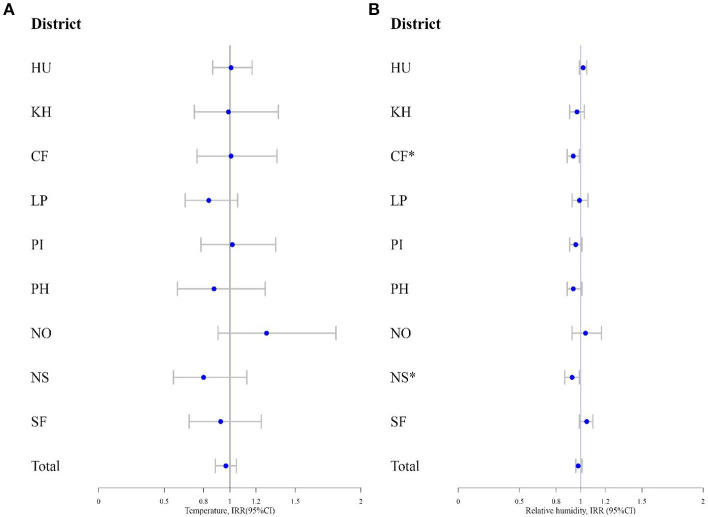
The current coronavirus disease 2019 (COVID-19) is spreading globally at an accelerated rate. There is some previous evidence that weather may influence the incidence of COVID-19 infection. We assessed the role of meteorological factors including temperature (T) and relative humidity (RH) considering the concentrations of two air pollutants, inhalable coarse particles (PM) and nitrogen dioxide (NO) in the incidence of COVID-19 infections in Finland, located in arctic-subarctic climatic zone. We retrieved daily counts of COVID-19 in Finland from Jan 1 to May 31, 2020, nationwide and separately for all 21 hospital districts across the country. The meteorological and air quality data were from the monitoring stations nearest to the central district hospital. A quasi-Poisson generalized additional model (GAM) was fitted to estimate the associations between district-specific meteorological factors and the daily counts of COVID-19 during the study period. Sensitivity analyses were conducted to test the robustness of the results. The incidence rate of COVID-19 gradually increased until a peak around April 6 and then decreased. There were no associations between daily temperature and incidence rate of COVID-19. Daily average RH was negatively associated with daily incidence rate of COVID-19 in two hospital districts located inland. No such association was found nationwide. Weather conditions, such as air temperature and relative humidity, were not related to the COVID-19 incidence during the first wave in the arctic and subarctic winter and spring. The inference is based on a relatively small number of cases and a restricted time period.
目前,2019 年冠状病毒病(COVID-19)正在全球加速传播。有一些先前的证据表明,天气可能会影响 COVID-19 感染的发病率。我们评估了气象因素的作用,包括温度(T)和相对湿度(RH),同时考虑了两种空气污染物,可吸入粗颗粒物(PM)和二氧化氮(NO)的浓度,这些因素在芬兰 COVID-19 感染的发病率中所起的作用。芬兰位于亚北极气候区。我们从 2020 年 1 月 1 日至 5 月 31 日,检索了芬兰全国和全国 21 个医院区的 COVID-19 每日病例数。气象和空气质量数据来自离地区中心医院最近的监测站。使用拟泊松广义附加模型(GAM)来估计研究期间地区特定气象因素与 COVID-19 每日病例数之间的关联。进行敏感性分析以检验结果的稳健性。COVID-19 的发病率逐渐增加,直到 4 月 6 日左右达到高峰,然后下降。每日平均 RH 与 COVID-19 的发病率之间没有关联。内陆两个医院区的每日平均 RH 与 COVID-19 的发病率呈负相关。全国范围内未发现这种关联。在亚北极冬季和春季的第一波疫情期间,天气条件(如气温和相对湿度)与 COVID-19 的发病率没有关系。该推断是基于相对较少的病例和有限的时间段。