Díaz Paula, Sandoval-Bórquez Alejandra, Bravo-Sagua Roberto, Quest Andrew F G, Lavandero Sergio
Advanced Center for Chronic Diseases (ACCDiS), Faculty of Chemical and Pharmaceutical Sciences and Faculty of Medicine, Universidad de Chile, Santiago, Chile.
Center for Studies on Exercise, Metabolism and Cancer (CEMC), Program of Cell and Molecular Biology, Faculty of Medicine, Institute of Biomedical Sciences (ICBM), Universidad de Chile, Santiago, Chile.
Front Cell Dev Biol. 2021 Feb 25;9:613336. doi: 10.3389/fcell.2021.613336. eCollection 2021.
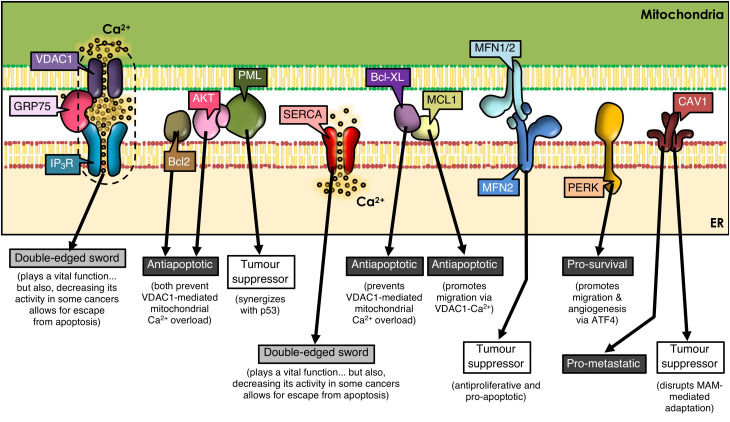
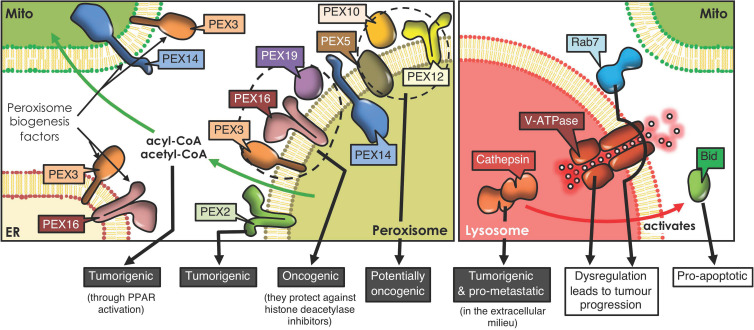
In recent decades, compelling evidence has emerged showing that organelles are not static structures but rather form a highly dynamic cellular network and exchange information through membrane contact sites. Although high-throughput techniques facilitate identification of novel contact sites (e.g., organelle-organelle and organelle-vesicle interactions), little is known about their impact on cellular physiology. Moreover, even less is known about how the dysregulation of these structures impacts on cellular function and therefore, disease. Particularly, cancer cells display altered signaling pathways involving several cell organelles; however, the relevance of interorganelle communication in oncogenesis and/or cancer progression remains largely unknown. This review will focus on organelle contacts relevant to cancer pathogenesis. We will highlight specific proteins and protein families residing in these organelle-interfaces that are known to be involved in cancer-related processes. First, we will review the relevance of endoplasmic reticulum (ER)-mitochondria interactions. This section will focus on mitochondria-associated membranes (MAMs) and particularly the tethering proteins at the ER-mitochondria interphase, as well as their role in cancer disease progression. Subsequently, the role of Ca at the ER-mitochondria interphase in cancer disease progression will be discussed. Members of the Bcl-2 protein family, key regulators of cell death, also modulate Ca transport pathways at the ER-mitochondria interphase. Furthermore, we will review the role of ER-mitochondria communication in the regulation of proteostasis, focusing on the ER stress sensor PERK (PRKR-like ER kinase), which exerts dual roles in cancer. Second, we will review the relevance of ER and mitochondria interactions with other organelles. This section will focus on peroxisome and lysosome organelle interactions and their impact on cancer disease progression. In this context, the peroxisome biogenesis factor (PEX) gene family has been linked to cancer. Moreover, the autophagy-lysosome system is emerging as a driving force in the progression of numerous human cancers. Thus, we will summarize our current understanding of the role of each of these organelles and their communication, highlighting how alterations in organelle interfaces participate in cancer development and progression. A better understanding of specific organelle communication sites and their relevant proteins may help to identify potential pharmacological targets for novel therapies in cancer control.
近几十年来,越来越多的确凿证据表明,细胞器并非静态结构,而是形成了一个高度动态的细胞网络,并通过膜接触位点交换信息。尽管高通量技术有助于识别新的接触位点(如细胞器-细胞器和细胞器-囊泡相互作用),但对于它们对细胞生理学的影响却知之甚少。此外,对于这些结构的失调如何影响细胞功能进而导致疾病,了解得更少。特别是,癌细胞表现出涉及多个细胞器的信号通路改变;然而,细胞器间通讯在肿瘤发生和/或癌症进展中的相关性仍 largely 未知。本综述将聚焦于与癌症发病机制相关的细胞器接触。我们将重点介绍存在于这些细胞器界面、已知参与癌症相关过程的特定蛋白质和蛋白质家族。首先,我们将回顾内质网(ER)-线粒体相互作用的相关性。本节将重点关注线粒体相关膜(MAMs),特别是内质网-线粒体界面处的拴系蛋白,以及它们在癌症疾病进展中的作用。随后,将讨论内质网-线粒体界面处的 Ca 在癌症疾病进展中的作用。Bcl-2 蛋白家族成员是细胞死亡的关键调节因子,也调节内质网-线粒体界面处的 Ca 转运途径。此外,我们将回顾内质网-线粒体通讯在蛋白质稳态调节中的作用,重点关注内质网应激传感器 PERK(PRKR 样内质网激酶),其在癌症中发挥双重作用。其次,我们将回顾内质网和线粒体与其他细胞器相互作用的相关性。本节将重点关注过氧化物酶体和溶酶体细胞器相互作用及其对癌症疾病进展的影响。在此背景下,过氧化物酶体生物发生因子(PEX)基因家族与癌症有关。此外,自噬-溶酶体系统正在成为众多人类癌症进展的驱动力。因此,我们将总结目前对这些细胞器各自作用及其通讯的理解,强调细胞器界面的改变如何参与癌症的发生和发展。更好地理解特定的细胞器通讯位点及其相关蛋白质可能有助于确定癌症控制新疗法的潜在药理学靶点。