Tang Philip Chiu-Tsun, Chan Alex Siu-Wing, Zhang Cai-Bin, García Córdoba Cristina Alexandra, Zhang Ying-Ying, To Ka-Fai, Leung Kam-Tong, Lan Hui-Yao, Tang Patrick Ming-Kuen
State Key Laboratory of Translational Oncology, Department of Anatomical and Cellular Pathology, The Chinese University of Hong Kong, Shatin, Hong Kong.
Department of Applied Social Sciences, The Hong Kong Polytechnic University, Hung Hom, Hong Kong.
Front Med (Lausanne). 2021 Feb 25;8:628519. doi: 10.3389/fmed.2021.628519. eCollection 2021.
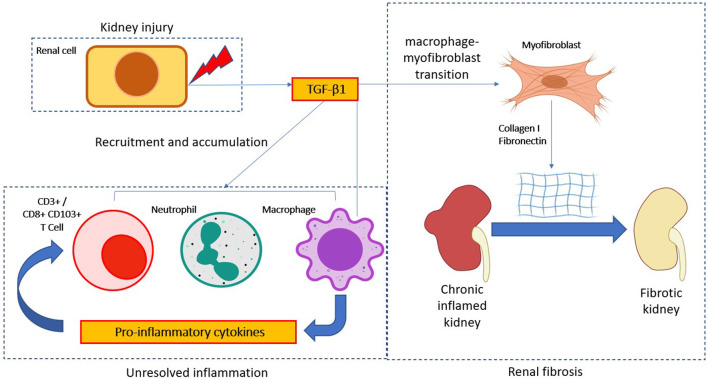
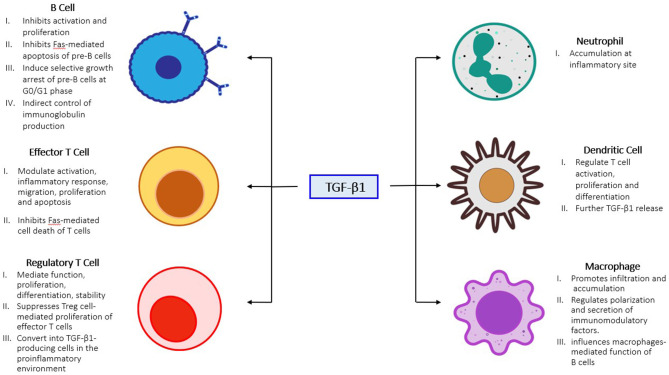
Chronic kidney disease (CKD) is a major cause of morbidity and mortality worldwide, imposing a great burden on the healthcare system. Regrettably, effective CKD therapeutic strategies are yet available due to their elusive pathogenic mechanisms. CKD is featured by progressive inflammation and fibrosis associated with immune cell dysfunction, leading to the formation of an inflammatory microenvironment, which ultimately exacerbating renal fibrosis. Transforming growth factor β1 (TGF-β1) is an indispensable immunoregulator promoting CKD progression by controlling the activation, proliferation, and apoptosis of immunocytes via both canonical and non-canonical pathways. More importantly, recent studies have uncovered a new mechanism of TGF-β1 for generation of myofibroblast via macrophage-myofibroblast transition (MMT). This review will update the versatile roles of TGF-β signaling in the dynamics of renal immunity, a better understanding may facilitate the discovery of novel therapeutic strategies against CKD.
慢性肾脏病(CKD)是全球发病和死亡的主要原因,给医疗系统带来了巨大负担。遗憾的是,由于其致病机制难以捉摸,目前尚无有效的CKD治疗策略。CKD的特征是与免疫细胞功能障碍相关的进行性炎症和纤维化,导致炎症微环境的形成,最终加剧肾纤维化。转化生长因子β1(TGF-β1)是一种不可或缺的免疫调节因子,通过经典和非经典途径控制免疫细胞的激活、增殖和凋亡,促进CKD进展。更重要的是,最近的研究发现了TGF-β1通过巨噬细胞-肌成纤维细胞转变(MMT)产生肌成纤维细胞的新机制。本综述将更新TGF-β信号在肾脏免疫动态中的多种作用,更好地理解可能有助于发现针对CKD的新型治疗策略。