Lebrasseur Audrey, Fortin-Bédard Noémie, Lettre Josiane, Raymond Emilie, Bussières Eve-Line, Lapierre Nolwenn, Faieta Julie, Vincent Claude, Duchesne Louise, Ouellet Marie-Christine, Gagnon Eric, Tourigny André, Lamontagne Marie-Ève, Routhier François
Centre for Interdisciplinary Research in Rehabilitation and Social Integration, Centre intégré universitaire de santé et de services sociaux de la Capitale-Nationale, Québec, QC, Canada.
Department of Rehabilitation, Université Laval, Québec, QC, Canada.
JMIR Aging. 2021 Apr 12;4(2):e26474. doi: 10.2196/26474.
The COVID-19 pandemic has drastically changed the lives of countless members of the general population. Older adults are known to experience loneliness, age discrimination, and excessive worry. It is therefore reasonable to anticipate that they would experience greater negative outcomes related to the COVID-19 pandemic given their increased isolation and risk for complications than younger adults.
This study aims to synthesize the existing research on the impact of the COVID-19 pandemic, and associated isolation and protective measures, on older adults. The secondary objective is to investigate the impact of the COVID-19 pandemic, and associated isolation and protective measures, on older adults with Alzheimer disease and related dementias.
A rapid review of the published literature was conducted on October 6, 2020, through a search of 6 online databases to synthesize results from published original studies regarding the impact of the COVID-19 pandemic on older adults. The Human Development Model conceptual framework-Disability Creation Process was used to describe and understand interactions between personal factors, environmental factors, and life habits. Methods and results are reported following the Preferred Reporting Items for Systematic Reviews and Meta-analyses Statement.
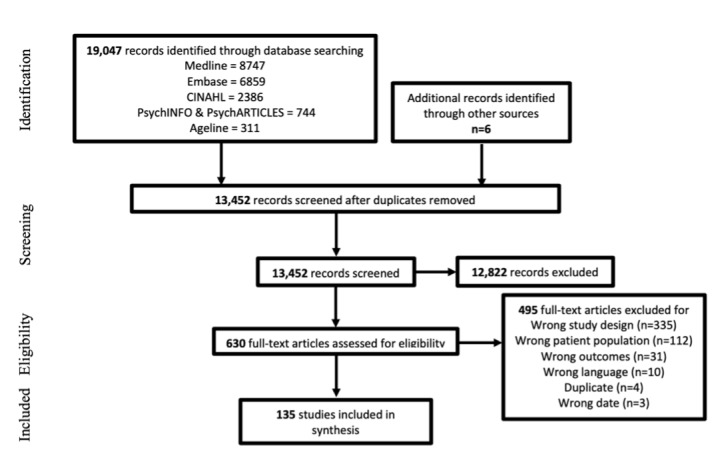
A total of 135 records were included from the initial search strategy of 13,452 individual studies. Of these, 113 (83.7%) studies were determined to be of level 4 according to the levels of evidence classification by the Centre for Evidence-Based Medicine. The presence of psychological symptoms, exacerbation of ageism, and physical deterioration of aged populations were reported in the included studies. Decreased social life and fewer in-person social interactions reported during the COVID-19 pandemic were occasionally associated with reduced quality of life and increased depression. Difficulties accessing services, sleep disturbances, and a reduction of physical activity were also noted.
Our results highlight the need for adequate isolation and protective measures. Older adults represent a heterogeneous group, which could explain the contradictory results found in the literature. Individual, organizational, and institutional strategies should be established to ensure that older adults are able to maintain social contacts, preserve family ties, and maintain the ability to give or receive help during the current pandemic. Future studies should focus on specific consequences and needs of more at-risk older adults to ensure their inclusion, both in public health recommendations and considerations made by policy makers.
新冠疫情极大地改变了无数普通民众的生活。众所周知,老年人会经历孤独、年龄歧视和过度担忧。因此,鉴于他们比年轻人面临更多的隔离以及更高的并发症风险,可以合理预期他们会在新冠疫情中经历更严重的负面后果。
本研究旨在综合现有的关于新冠疫情及其相关隔离和防护措施对老年人影响的研究。次要目的是调查新冠疫情及其相关隔离和防护措施对患有阿尔茨海默病及相关痴呆症的老年人的影响。
2020年10月6日,通过检索6个在线数据库对已发表文献进行了快速综述,以综合已发表的关于新冠疫情对老年人影响的原始研究结果。使用人类发展模型概念框架——残疾创造过程来描述和理解个人因素、环境因素和生活习惯之间的相互作用。按照系统评价和荟萃分析报告规范(PRISMA)报告方法和结果。
从对13452项个体研究的初步检索策略中总共纳入了135条记录。其中,根据循证医学中心的证据分类水平,113项(83.7%)研究被确定为4级。纳入研究报告了心理症状的出现、年龄歧视的加剧以及老年人群体身体状况的恶化。新冠疫情期间社交生活减少和面对面社交互动减少,偶尔与生活质量下降和抑郁增加有关。还注意到获得服务困难、睡眠障碍和身体活动减少。
我们的结果强调了采取适当隔离和防护措施的必要性。老年人是一个异质性群体,这可能解释了文献中发现的相互矛盾的结果。应制定个人、组织和机构层面的策略,以确保老年人在当前疫情期间能够保持社交联系、维系家庭关系并保持给予或接受帮助的能力。未来的研究应关注更多高危老年人的具体后果和需求,以确保他们能被纳入公共卫生建议以及政策制定者的考量之中。