Eli Lilly and Company, Indianapolis, IN, USA.
Humana Healthcare Research, Inc., Louisville, KY, USA.
J Parkinsons Dis. 2021;11(3):1381-1392. doi: 10.3233/JPD-202190.
Characterizing patients with Parkinson's disease (PD) and cognitive impairment is important toward understanding their natural history.
Understand clinical, treatment, and cost characteristics of patients with PD pre- and post-cognitive impairment (memory loss/mild cognitive impairment/dementia or dementia treatment) recognition.
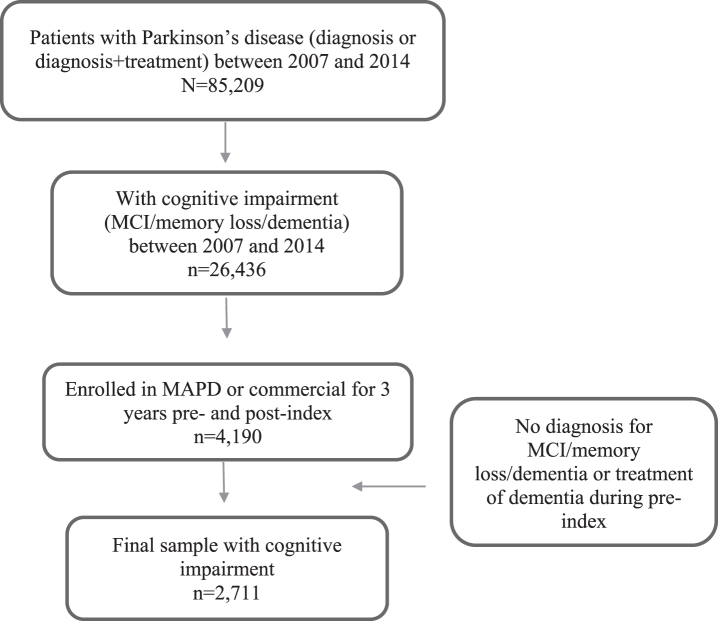
2,711 patients with PD newly diagnosed with cognitive impairment (index) were identified using administrative claims data. They were matched (1:1) on age and gender to patients with PD and no cognitive impairment (controls). These two cohorts were compared on patient characteristics, healthcare resource utilization, and total median costs for 3 years pre- and post-index using Chi-square tests, t-tests, and Wilcoxon rank-sum tests. Logistic regression was used to identify factors predicting cognitive impairment.
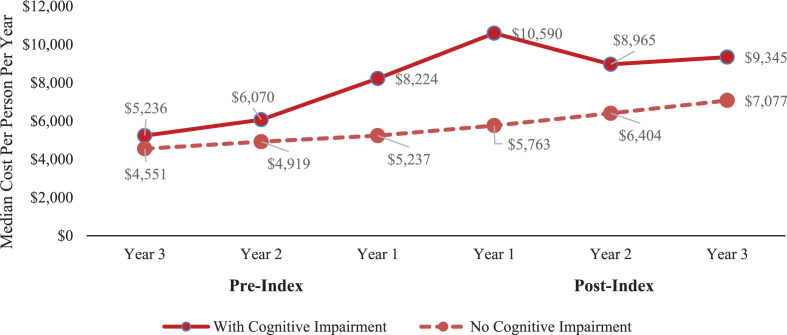
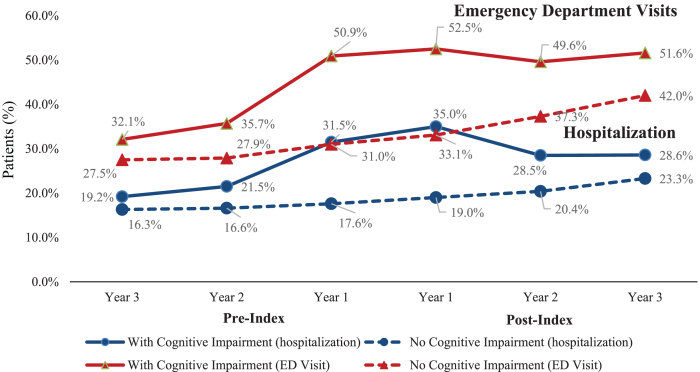
Comorbidity indices for patients with cognitive impairment increased during the 6-year study period, especially after the index. Enrollment in Medicare Advantage Prescription Drug plans vs. commercial (OR = 1.60), dual Medicare/Medicaid eligibility (OR = 1.36), cerebrovascular disease (OR = 1.24), and PD medication use (OR = 1.46) were associated with a new cognitive impairment diagnosis (all p < 0.05). A greater proportion of patients with cognitive impairment had hospitalizations and emergency department visits and higher median total healthcare costs than controls for each year pre- and post-index.
In patients with PD newly diagnosed with cognitive impairment, comorbidity burden, hospitalizations, emergency department visits, and total costs peaked 1-year pre- and post-identification. These data coupled with recommendations for annual screening for cognitive impairment in PD support the early diagnosis and management of cognitive impairment in order to optimize care for patients and their caregivers.
对帕金森病(PD)患者认知障碍的特征进行描述,对于了解其自然病程很重要。
了解 PD 患者认知障碍(记忆丧失/轻度认知障碍/痴呆或痴呆治疗)识别前后的临床、治疗和成本特征。
使用行政索赔数据确定了 2711 名新诊断为认知障碍(索引)的 PD 患者。根据年龄和性别与 PD 且无认知障碍(对照)的患者进行 1:1 匹配。使用卡方检验、t 检验和 Wilcoxon 秩和检验比较两组患者特征、医疗资源利用情况和索引前 3 年的总中位费用。使用逻辑回归来识别预测认知障碍的因素。
在 6 年的研究期间,认知障碍患者的合并症指数增加,尤其是在索引后。与商业保险(OR=1.60)相比,医疗保险优势处方药计划(OR=1.60)、双重医疗保险/医疗补助资格(OR=1.36)、脑血管疾病(OR=1.24)和 PD 药物使用(OR=1.46)与新的认知障碍诊断相关(均 p<0.05)。与对照组相比,认知障碍患者索引前和索引后每年的住院和急诊就诊次数以及中位总医疗费用均较高。
在新诊断为认知障碍的 PD 患者中,合并症负担、住院、急诊就诊和总费用在识别前 1 年和识别后 1 年达到峰值。这些数据加上 PD 患者认知障碍的年度筛查建议,支持认知障碍的早期诊断和管理,以优化患者及其护理人员的护理。