Department of Anesthesiology, The Third Affiliated Hospital of Zhengzhou University, Zhengzhou, Henan, China (mainland).
Med Sci Monit. 2021 Mar 15;27:e929283. doi: 10.12659/MSM.929283.
BACKGROUND We aimed to explore the factors leading to epidural-related maternal fever and the influence of intrapartum fever on neonates. MATERIAL AND METHODS A retrospective analysis was performed on data from pregnant women who received epidural analgesia during labor. The primary aim was to determine the influence of epidural labor analgesia on the incidence of intrapartum fever in pregnant women. The secondary aim was to determine the influence of intrapartum fever on neonates. RESULTS Logistic regression analysis showed that premature rupture of membranes (OR=2.008, 95% CI: 1.551-2.600), vaginal examination performed more than 6 times (OR=1.681, 95% CI: 1.286-2.197), long duration of labor (OR=1.090, 95% CI: 1.063-1.118), and long time from rupture of membranes to delivery (OR=1.048, 95% CI: 1.010-1.087) were all risk factors for intrapartum fever in pregnant women with epidural labor analgesia. Regarding the secondary research outcome, the incidence of intrapartum fever was significantly associated with the number of neonates with Apgar score of 10 delivered from pregnant women with epidural labor analgesia (P<0.05). There was no statistically significant difference in the transfer rate of newborns to the Neonatal Intensive Care Unit (NICU) (P>0.05). CONCLUSIONS Premature rupture of membranes, vaginal examination performed more than 6 times, long duration of labor, and long time from rupture of membranes to delivery are all factors raising the risk of fever during epidural labor analgesia. Although intrapartum fever in the mothers had a significant influence on the number of neonates with Apgar score of 10, it did not affect the outcome of neonates in terms of NICU transfer rate.
本研究旨在探讨导致硬膜外相关产妇发热的因素,以及产时发热对新生儿的影响。
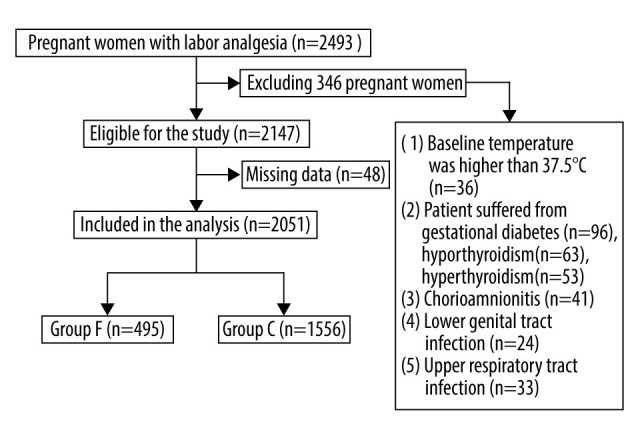
对接受硬膜外分娩镇痛的孕妇进行回顾性分析。主要目的是确定硬膜外分娩镇痛对孕妇产时发热发生率的影响,次要目的是确定产时发热对新生儿的影响。
Logistic 回归分析显示,胎膜早破(OR=2.008,95%CI:1.551-2.600)、阴道检查次数超过 6 次(OR=1.681,95%CI:1.286-2.197)、产程延长(OR=1.090,95%CI:1.063-1.118)、破膜至分娩时间延长(OR=1.048,95%CI:1.010-1.087)均是硬膜外分娩镇痛孕妇产时发热的危险因素。关于次要研究结果,硬膜外分娩镇痛孕妇产时发热与 Apgar 评分 10 分新生儿的分娩数量显著相关(P<0.05)。但两组新生儿转入新生儿重症监护病房(NICU)的比例无统计学差异(P>0.05)。
胎膜早破、阴道检查次数超过 6 次、产程延长、破膜至分娩时间延长均是增加硬膜外分娩镇痛产妇发热风险的因素。虽然产妇产时发热对 Apgar 评分 10 分新生儿数量有显著影响,但对新生儿转入 NICU 的比例无影响。