Turner Institute for Brain and Mental Health, Monash University, Melbourne, VIC, 3800, Australia.
Institute for Breathing and Sleep, Austin Health, Melbourne, VIC, 3084, Australia.
BMC Public Health. 2021 Mar 15;21(1):503. doi: 10.1186/s12889-021-10410-x.
Governments worldwide recommended unprecedented measures to contain the coronavirus disease 2019 (COVID-19) pandemic, caused by severe acute respiratory syndrome coronavirus 2 (SARS-CoV-2). As pressure mounted to scale back measures, understanding public priorities was critical. We assessed initial public adherence with and support for stay-at-home orders in nations and cities with different SARS-CoV-2 infection and COVID-19 death rates.
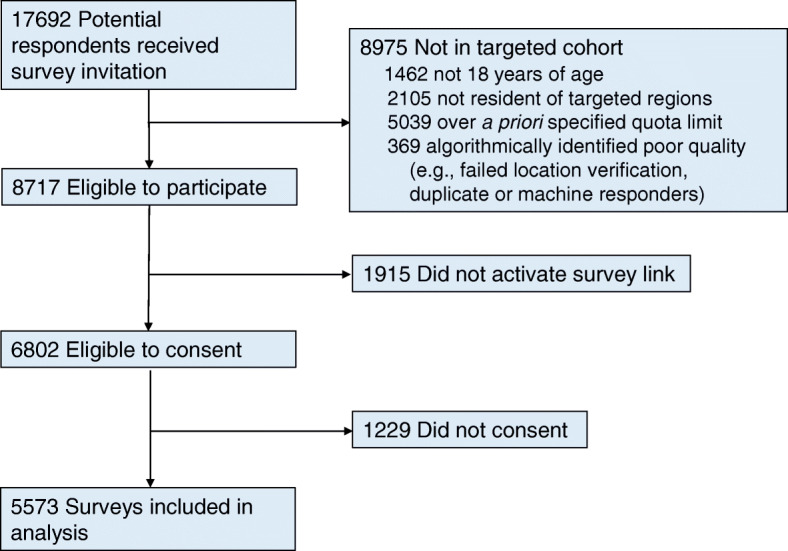
Cross-sectional surveys were administered to representative samples of adults aged ≥18 years from regions with different SARS-CoV-2 prevalences from April 2-8, 2020. Regions included two nations [the United States (US-high prevalence) and Australia (AU-low prevalence)] and two US cities [New York City (NY-high prevalence) and Los Angeles (LA-low prevalence)]. Regional SARS-CoV-2 and COVID-19 prevalence (cumulative SARS-CoV-2 infections, COVID-19 deaths) as of April 8, 2020: US (363,321, 10,845), AU (5956, 45), NY (81,803, 4571), LA (7530, 198). Of 8718 eligible potential respondents, 5573 (response rate, 63.9%) completed surveys. Median age was 47 years (range, 18-89); 3039 (54.5%) were female.
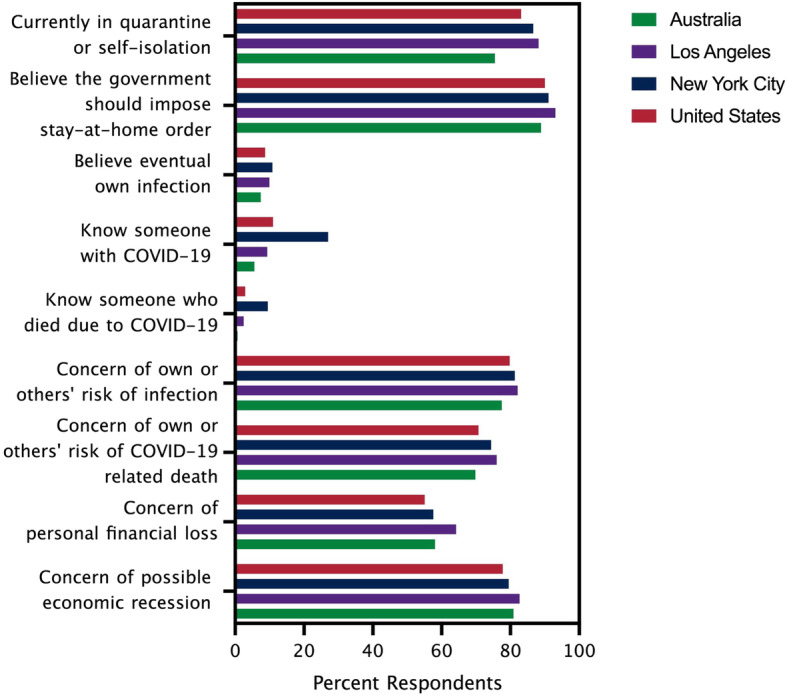
Of 5573 total respondents, 4560 (81.8%) reported adherence with recommended quarantine or stay-at-home policies (range of samples, 75.5-88.2%). Additionally, 29.1% of respondents screened positive for anxiety or depression symptoms (range of samples, 28.6-32.0%), with higher prevalences among those of younger age, female gender, and those in quarantine or staying at home most of the time versus those who did not report these behaviours. Despite elevated prevalences of adverse mental health symptoms and significant life disruptions, 5022 respondents (90.1%) supported government-imposed stay-at-home orders (range of samples, 88.9-93.1%). Of these, 90.8% believed orders should last at least three more weeks or until public health or government officials recommended, with support spanning the political spectrum.
Public adherence with COVID-19 mitigation policies was highly prevalent, in both highly-affected (US, NY) and minimally-affected regions (AU, LA). Despite disruption of respondents' lives, the vast majority supported continuation of extended stay-at-home orders. Despite common support, these two countries diverged in stringent mitigation implementation, which may have contributed to subsequent outcomes. These results reveal the importance of surveillance of public support for and adherence with such policies during the COVID-19 pandemic and for future infectious disease outbreaks.
由严重急性呼吸综合征冠状病毒 2(SARS-CoV-2)引起的 2019 年冠状病毒病(COVID-19)大流行,全球各国政府都建议采取前所未有的措施加以控制。随着减少措施的压力越来越大,了解公众的优先事项至关重要。我们评估了不同 SARS-CoV-2 感染率和 COVID-19 死亡率国家和城市中公众对居家令的最初遵守和支持情况。
2020 年 4 月 2 日至 8 日,对来自 SARS-CoV-2 不同流行地区的 18 岁及以上成年人的代表性样本进行了横断面调查。调查地区包括两个国家[美国(高流行率,US-高)和澳大利亚(低流行率,AU-低)]和两个美国城市[纽约市(高流行率,NY-高)和洛杉矶(低流行率,LA-低)]。截至 2020 年 4 月 8 日,各地区 SARS-CoV-2 和 COVID-19 的流行率(累计 SARS-CoV-2 感染,COVID-19 死亡):美国(363,321,10,845),澳大利亚(5956,45),纽约(81,803,4571),洛杉矶(7530,198)。在 8718 名符合条件的潜在受访者中,有 5573 名(应答率,63.9%)完成了调查。中位年龄为 47 岁(范围,18-89);3039 名(54.5%)为女性。
在 5573 名总受访者中,4560 名(81.8%)报告遵守了推荐的检疫或居家隔离政策(样本范围为 75.5-88.2%)。此外,29.1%的受访者筛查出焦虑或抑郁症状(样本范围为 28.6-32.0%),年龄较小、女性、大部分时间处于隔离或居家状态的受访者比例高于未报告这些行为的受访者。尽管心理健康不良症状和生活严重中断的发生率较高,但 5022 名受访者(90.1%)支持政府实施的居家令(样本范围为 88.9-93.1%)。其中,90.8%的人认为这些命令至少应再持续三周或直到公共卫生或政府官员建议,支持范围跨越政治谱系。
在受影响严重的地区(美国,纽约)和受影响最小的地区(澳大利亚,洛杉矶),公众对 COVID-19 缓解政策的遵守程度都很高。尽管受访者的生活受到干扰,但绝大多数人支持继续延长居家令。尽管普遍支持,但这两个国家在严格执行缓解措施方面存在分歧,这可能导致了随后的结果。这些结果揭示了在 COVID-19 大流行期间以及未来传染病爆发时监测公众对这些政策的支持和遵守情况的重要性。