Department of Spine Surgery, Second Affiliated Hospital, Zhejiang University School of Medicine, Hangzhou, 310009, People's Republic of China.
Department of Spine Surgery, Ningbo No.6 Hospital, Ningbo, 315040, People's Republic of China.
BMC Musculoskelet Disord. 2021 Mar 15;22(1):280. doi: 10.1186/s12891-021-04151-6.
This study was to evaluate and compare the biomechanical features of multilevel lateral lumbar interbody fusion (LLIF) with or without supplemental instrumentations.
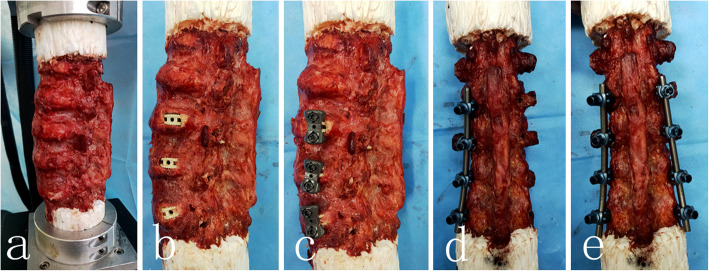
Six human lumbar specimens were tested under multidirectional nondestructive moments (7.5 N·m), with a 6 degree-of-freedom spine simulator. The overall and intervertebral range of motion (ROM) were measured optoelectronically. Each specimen was tested under the following conditions at L2-5 levels: intact; stand-alone; cage supplemented with lateral plate (LP); cage supplemented with unilateral or bilateral pedicle screw/rod (UPS or BPS).
Compared with intact condition, the overall and intersegmental ROM were significantly reduced after multilevel stand-alone LLIF. The ROM was further reduced after using LP instrumentation. In flexion-extension (FE) and axial rotation (AR), pedicle screw/rod demonstrated greater overall ROM reduction compared to LP (P < 0.01), and bilateral greater than unilateral (P < 0.01). In lateral bending (LB), BPS demonstrated greater overall ROM reduction compared to UPS and LP (P < 0.01), however, UPS and LP showed similar reduction (P = 0.245). Intervertebral ROM reductions showed similar trend as the overall ones after using different types of instrumentation. However, at L2/3 (P = 0.57) and L3/4 (P = 0.097) levels, the intervertebral ROM reductions in AR were similar between UPS and LP.
The overall and intervertebral stability increased significantly after multilevel LLIF with or without supplemental instrumentation. BPS provided the greatest stability, followed by UPS and LP. However, in clinical practice, less invasive adjunctive fixation methods including UPS and LP may provide sufficient biomechanical stability for multilevel LLIF.
本研究旨在评估和比较多节段侧方腰椎椎间融合术(LLIF)联合或不联合辅助内固定的生物力学特征。
6 个人体腰椎标本在 6 自由度脊柱模拟器下进行多向非破坏性力矩(7.5N·m)测试。采用光电方法测量整体和椎间活动度(ROM)。在 L2-5 水平,每个标本分别在以下条件下进行测试:完整;单纯; cage 联合侧方板(LP); cage 联合单侧或双侧椎弓根螺钉/棒(UPS 或 BPS)。
与完整状态相比,多节段单纯 LLIF 后整体和节段间 ROM 明显减小。使用 LP 器械后,ROM 进一步减小。在屈伸(FE)和轴向旋转(AR)方向,椎弓根螺钉/棒与 LP 相比,整体 ROM 减小更为显著(P<0.01),双侧比单侧更显著(P<0.01)。在侧屈(LB)方向,BPS 与 UPS 和 LP 相比,整体 ROM 减小更为显著(P<0.01),但 UPS 和 LP 减小程度相似(P=0.245)。使用不同类型器械后,椎间 ROM 减小趋势与整体 ROM 相似。然而,在 L2/3(P=0.57)和 L3/4(P=0.097)水平,AR 方向 UPS 和 LP 之间的椎间 ROM 减小相似。
多节段 LLIF 联合或不联合辅助内固定后,整体和椎间稳定性显著增加。BPS 提供最大的稳定性,其次是 UPS 和 LP。然而,在临床实践中,包括 UPS 和 LP 在内的微创辅助固定方法可能为多节段 LLIF 提供足够的生物力学稳定性。