Oh Sun-Young, Kang Jin-Ju, Kim Sohui, Lee Jong-Min, Kim Ji-Soo, Dieterich Marianne
Department of Neurology, Jeonbuk National University Hospital and School of Medicine, Jeonju-si, South Korea.
Research Institute of Clinical Medicine of Jeonbuk National University-Biomedical Research Institute of Jeonbuk National University Hospital, Jeonju-si, South Korea.
Front Neurol. 2022 Jul 25;13:955158. doi: 10.3389/fneur.2022.955158. eCollection 2022.
This study aims to investigate the efficacy of botulinum toxin type A (BTX-A) in the prophylactic management of vestibular migraine (VM) and to determine whether this treatment modulates intrinsic functional brain network.
Vestibular migraine patients ( = 20, mean age 45.4 years) who were resistant to conventional prophylactic therapies had BTX-A injection and rs-fMRI before and 2 months after the injection. We also measured the changes in the frequency of vertigo and migraine attacks, symptomatic functional disability scores, and neuropsychiatric inventories.
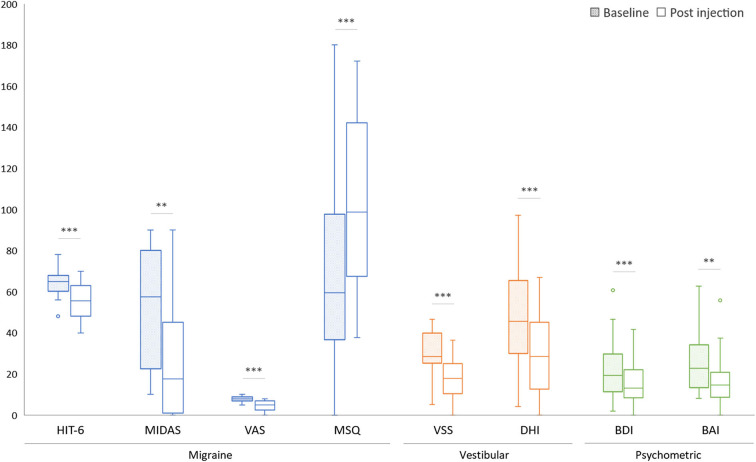
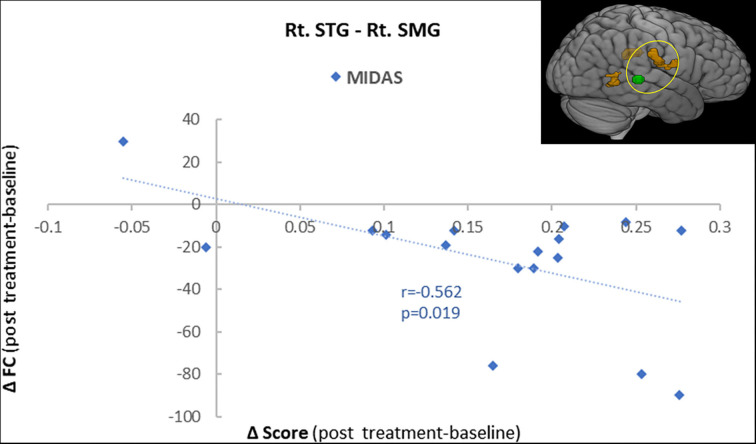
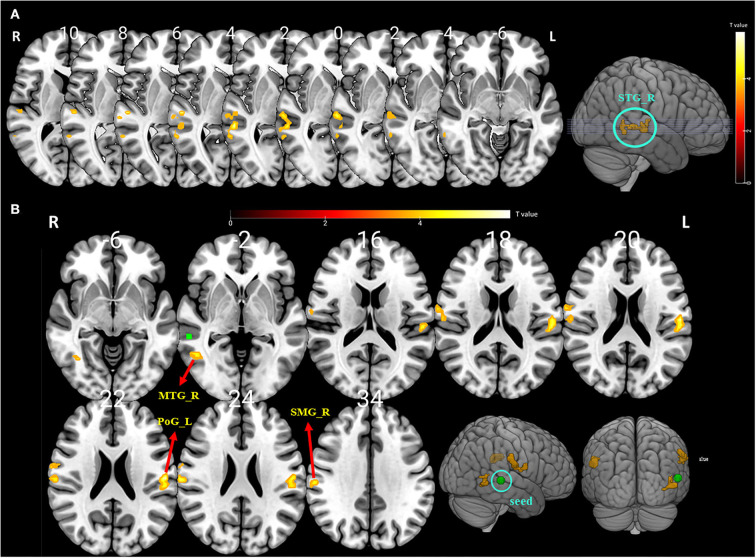
After BTX-A injection, the mean monthly frequencies of migraine and vertigo episodes decreased significantly compared with the baseline ( < 0.01, paired -test). The Headache Impact Test-6 score and the Migraine Disability Assessment, and the vertigo parameters, measured by the Dizziness Handicap Inventory and the Vertigo Symptom Scale, showed an improvement, as did the anxiety and depression scores 2 months after BTX-A treatment. The low-frequency fluctuation analysis of the rs-fMRI data found significant changes in the functional connectivity of the right superior temporal gyrus. Adoption of this cluster as the seed region increased the functional connectivity with the left post-central gyrus, right supramarginal gyrus, and right middle temporal gyrus after BTX-A treatment.
This prospective study suggests that BTX-A treatment is effective at ameliorating migraine and vertigo symptoms in VM patients who were resistant to conventional therapies. Along with symptomatic improvements, changes in the functional connectivity within the multisensory vestibular and pain networks suggest a dysmodulation of multimodal sensory integration and abnormal cortical processing of the vestibular and pain signals in VM patients.
本研究旨在探讨A型肉毒杆菌毒素(BTX-A)在前庭性偏头痛(VM)预防性治疗中的疗效,并确定该治疗是否能调节大脑内在功能网络。
对20例(平均年龄45.4岁)对传统预防性治疗耐药的前庭性偏头痛患者进行BTX-A注射,并在注射前和注射后2个月进行静息态功能磁共振成像(rs-fMRI)。我们还测量了眩晕和偏头痛发作频率、症状性功能残疾评分以及神经精神量表的变化。
BTX-A注射后,偏头痛和眩晕发作的平均每月频率与基线相比显著降低(P<0.01,配对t检验)。头痛影响测试-6评分、偏头痛残疾评估以及由头晕残障量表和眩晕症状量表测量的眩晕参数均有改善,BTX-A治疗2个月后的焦虑和抑郁评分也有所改善。rs-fMRI数据的低频波动分析发现右侧颞上回的功能连接有显著变化。以该簇为种子区域,BTX-A治疗后与左侧中央后回、右侧缘上回和右侧颞中回的功能连接增加。
这项前瞻性研究表明,BTX-A治疗对改善对传统疗法耐药的VM患者的偏头痛和眩晕症状有效。除了症状改善外,多感觉前庭和疼痛网络内功能连接的变化表明VM患者多模态感觉整合失调以及前庭和疼痛信号的皮层处理异常。