Catalytic Carbon Transformation Center, National Renewable Energy Laboratory, Golden, CO 80401.
Mechanical and Aerospace Engineering, University of Dayton, Dayton, OH 45469.
Proc Natl Acad Sci U S A. 2021 Mar 30;118(13). doi: 10.1073/pnas.2023008118.
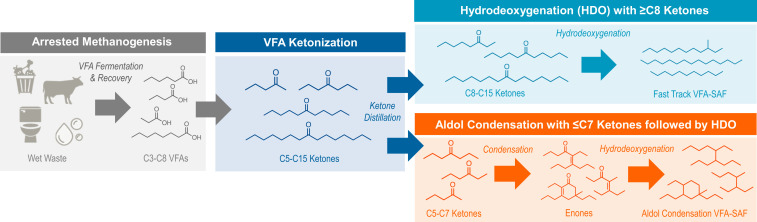
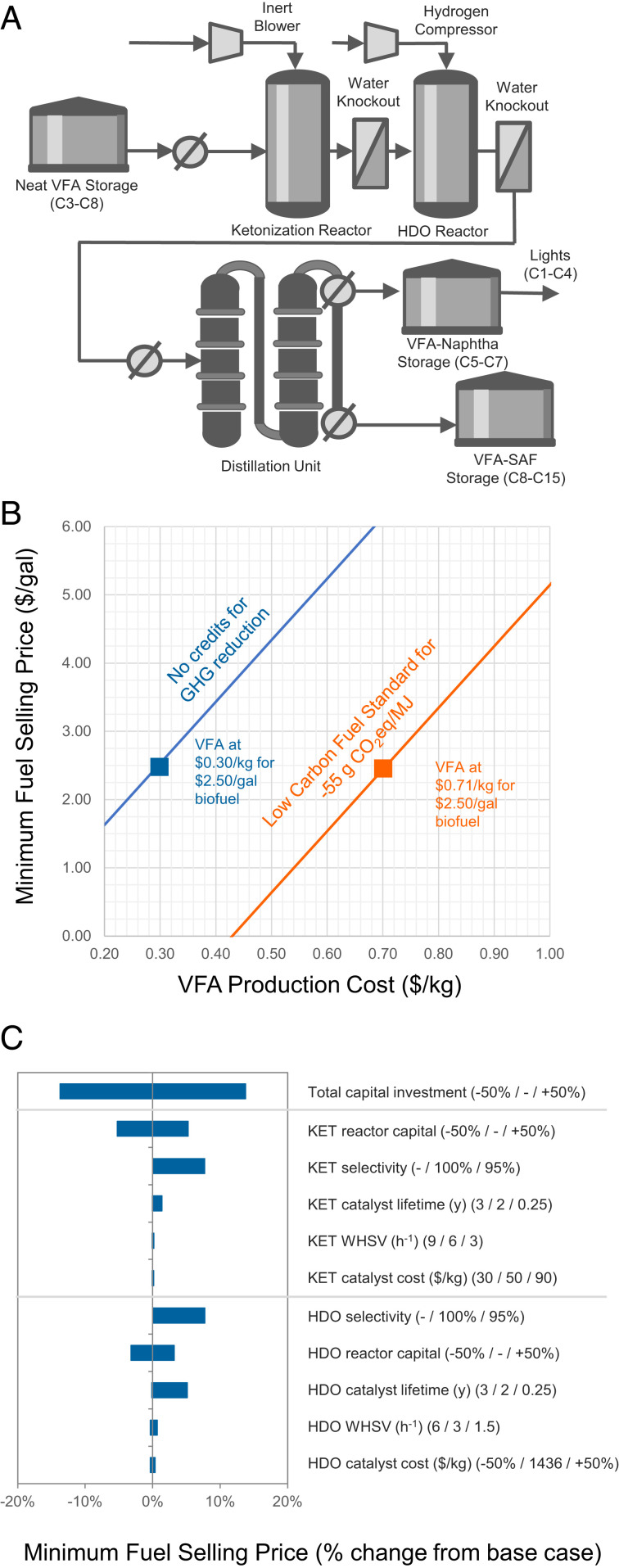
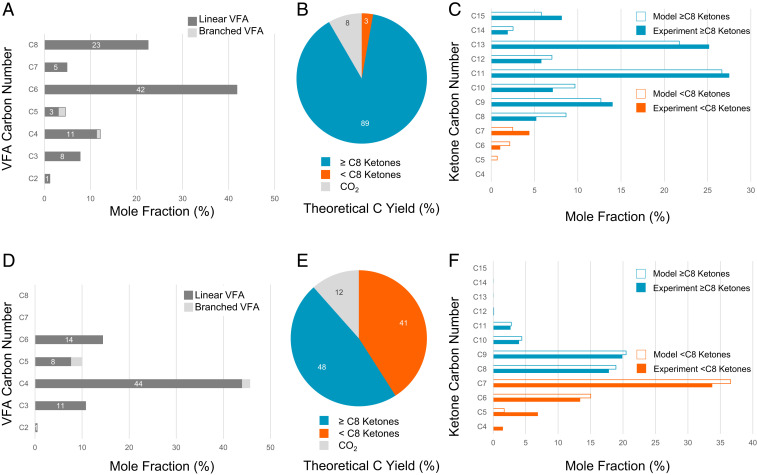
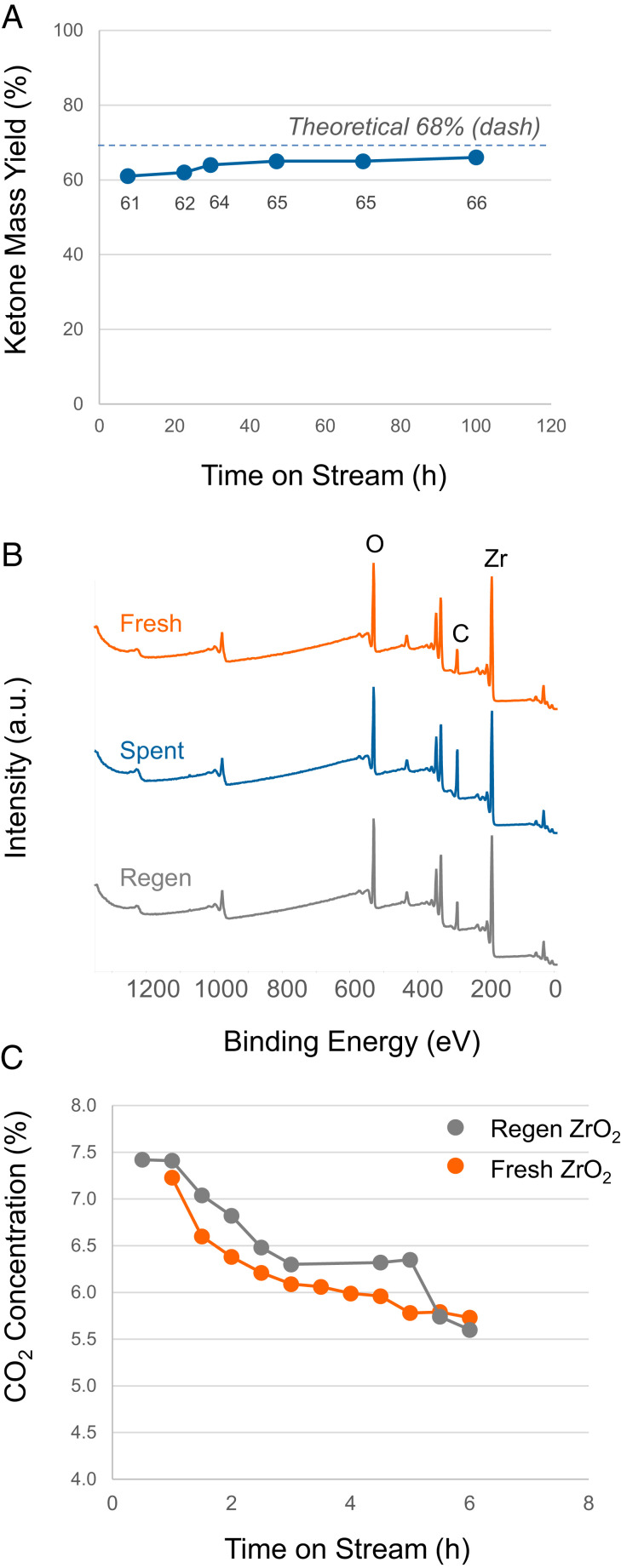
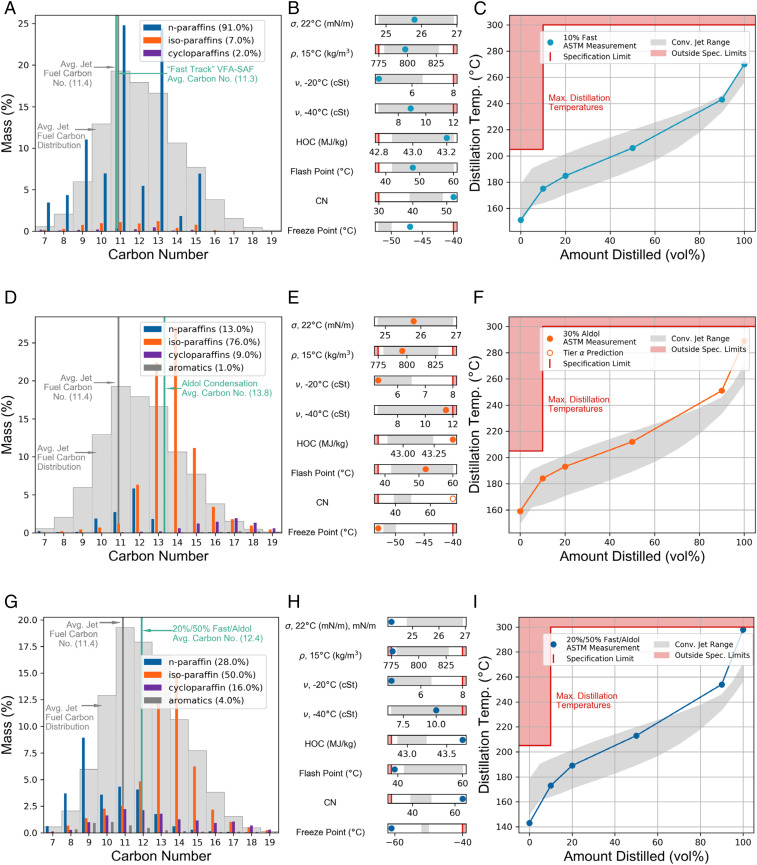
With the increasing demand for net-zero sustainable aviation fuels (SAF), new conversion technologies are needed to process waste feedstocks and meet carbon reduction and cost targets. Wet waste is a low-cost, prevalent feedstock with the energy potential to displace over 20% of US jet fuel consumption; however, its complexity and high moisture typically relegates its use to methane production from anaerobic digestion. To overcome this, methanogenesis can be arrested during fermentation to instead produce C to C volatile fatty acids (VFA) for catalytic upgrading to SAF. Here, we evaluate the catalytic conversion of food waste-derived VFAs to produce n-paraffin SAF for near-term use as a 10 vol% blend for ASTM "Fast Track" qualification and produce a highly branched, isoparaffin VFA-SAF to increase the renewable blend limit. VFA ketonization models assessed the carbon chain length distributions suitable for each VFA-SAF conversion pathway, and food waste-derived VFA ketonization was demonstrated for >100 h of time on stream at approximately theoretical yield. Fuel property blending models and experimental testing determined normal paraffin VFA-SAF meets 10 vol% fuel specifications for "Fast Track." Synergistic blending with isoparaffin VFA-SAF increased the blend limit to 70 vol% by addressing flashpoint and viscosity constraints, with sooting 34% lower than fossil jet. Techno-economic analysis evaluated the major catalytic process cost-drivers, determining the minimum fuel selling price as a function of VFA production costs. Life cycle analysis determined that if food waste is diverted from landfills to avoid methane emissions, VFA-SAF could enable up to 165% reduction in greenhouse gas emissions relative to fossil jet.
随着对净零可持续航空燃料 (SAF) 的需求不断增加,需要新的转化技术来处理废物原料,并达到碳减排和成本目标。湿废物是一种低成本、普遍存在的原料,具有替代超过 20%的美国喷气燃料消耗的能源潜力;然而,其复杂性和高水分通常使其只能用于厌氧消化产生甲烷。为了克服这一问题,可以在发酵过程中阻止产甲烷作用,从而产生 C 至 C 挥发性脂肪酸 (VFA),用于催化升级为 SAF。在这里,我们评估了从食物废物衍生的 VFA 转化为生产正构烷烃 SAF 的催化转化,以在近期用作 ASTM“快速通道”资格认证的 10 体积%混合物,并生产高支化、异链烷烃 VFA-SAF,以提高可再生混合物的限制。VFA 酮化模型评估了适合每种 VFA-SAF 转化途径的碳链长度分布,并且在大约理论产率下,对食物废物衍生的 VFA 酮化进行了 >100 小时的时间测试。燃料性质混合模型和实验测试确定了正构烷烃 VFA-SAF 符合“快速通道”的 10 体积%燃料规格。与异链烷烃 VFA-SAF 的协同混合通过解决闪点和粘度限制将混合限制提高到 70 体积%,烟尘比化石喷气燃料低 34%。技术经济分析评估了主要催化工艺成本驱动因素,确定了燃料销售价格的最低值作为 VFA 生产成本的函数。生命周期分析确定,如果将食物废物从垃圾填埋场转移以避免甲烷排放,VFA-SAF 可以使温室气体排放量相对于化石喷气燃料减少高达 165%。