Department of Prevention and Health Care, Shantou Central Hospital/Affiliated Shantou Hospital of Sun Yat-sen University, Shantou, China.
Department of Health Management, School of Health Services Management, Southern Medical University, Guangzhou, China.
Cancer Med. 2021 Apr;10(8):2904-2913. doi: 10.1002/cam4.3843. Epub 2021 Mar 16.
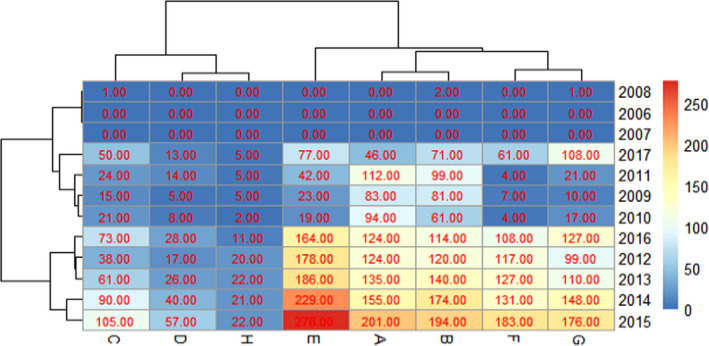
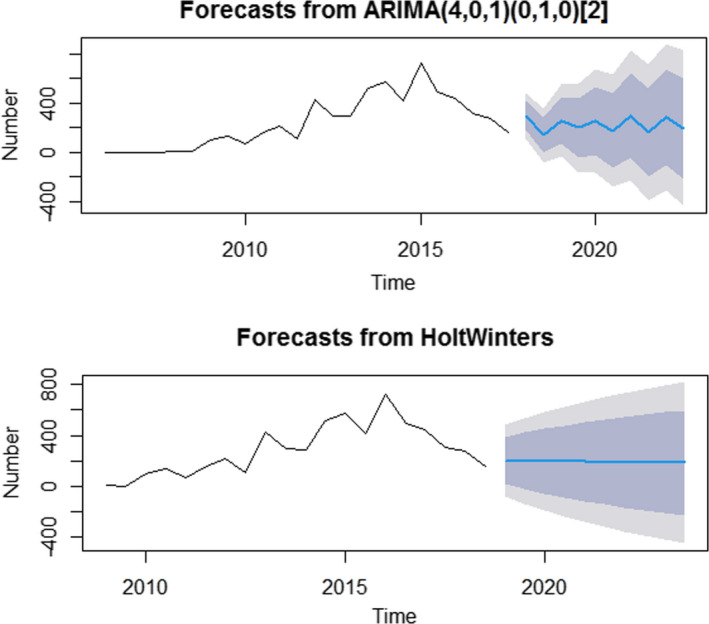
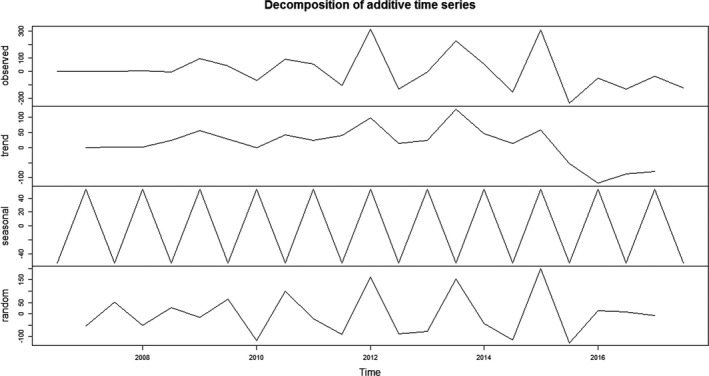
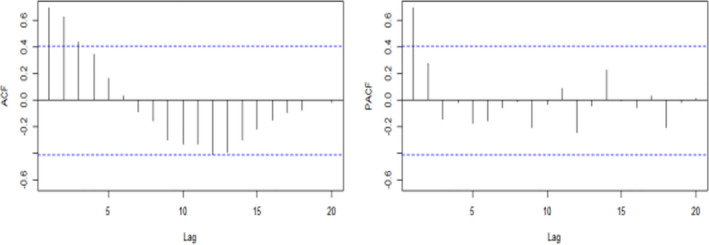
This study aimed to explore the epidemiological characteristics of breast cancer and establish an Exponential Smoothing (ETS) and Autoregressive Integrated Moving Average (ARIMA) models to predict the development of incidence in Shantou. This study has a large sample size, strong representativeness, and wide-ranging and comprehensive medical insurance information, which can fill the gaps in basic epidemiological research on breast cancer in Shantou. Successful completion of this study is a helpful tool to understand the epidemiology of Guangdong Province and Southern China. This study also provides data and scientific references for the government and future research on breast cancer prevention and control. This retrospective study was conducted to describe the epidemic intensity, epidemic distribution, and epidemic trend of breast cancer in Shantou, Guangdong Province, from 2006 to 2017, gathered from the Shantou's Medical Security Bureau covers the whole districts of Shantou. ETS and ARIMA models were used to describe the regional distribution, time distribution, and population distribution of breast cancer in Shantou. Moreover, based on the ARIMA model and ETS model, the incidence trend of breast cancer was predicted during 2018-2022. This study included 5,681 breast cancer patients, majority of whom were aged 50-59 years. The male-to-female ratio of the breast cancer patients was about 1:107 (the same ratio of the insured population was 1:1). Female patients accounted for 98.61% of the total insured population. The incidence and mortality rates of female breast cancer were 16.42/100,000 and 0.66/100,000, respectively. Based on the ARIMA model or ARIMA and ETS model, a gradually decreasing trend in the incidence of breast cancer is expected in the future. Comparing the performances of the ARIMA model and ETS model, ARIMA (4, 0, 1) (0, 1, 0) model had a lower the root mean squared error and the mean absolute percentage error than ETS (M, N) model. This population-based retrospective study showed that the high-risk age for the age-specific incidence of female breast cancer was 50-55 years. It is recommended that healthcare administration should strengthen program awareness and education regarding breast cancer prevention and control. It is also possible that feasibility of extrapolating the current methodology to other future studies or broader populations in which the cancer registry data are not available.
本研究旨在探讨乳腺癌的流行病学特征,并建立指数平滑(ETS)和自回归综合移动平均(ARIMA)模型,以预测汕头地区发病情况的发展。本研究样本量大,代表性强,医疗保险信息广泛全面,能填补汕头地区乳腺癌基础流行病学研究的空白。成功完成本研究有助于了解广东省和华南地区的乳腺癌流行病学。本研究还为政府和未来的乳腺癌防治研究提供了数据和科学参考。本回顾性研究旨在描述 2006 年至 2017 年广东省汕头市乳腺癌的流行强度、分布和趋势,数据来自汕头市医疗保障局,涵盖汕头市所有区。使用 ETS 和 ARIMA 模型描述了汕头市乳腺癌的区域分布、时间分布和人群分布。此外,基于 ARIMA 模型和 ETS 模型,预测了 2018-2022 年乳腺癌的发病趋势。本研究纳入了 5681 例乳腺癌患者,多数患者年龄为 50-59 岁。乳腺癌患者的男女比例约为 1:107(参保人群的相同比例为 1:1)。女性患者占总参保人群的 98.61%。女性乳腺癌的发病率和死亡率分别为 16.42/10 万和 0.66/10 万。基于 ARIMA 模型或 ARIMA 和 ETS 模型,预计未来乳腺癌的发病率将呈逐渐下降趋势。比较 ARIMA 模型和 ETS 模型的性能,ARIMA(4,0,1)(0,1,0)模型的均方根误差和平均绝对百分比误差均低于 ETS(M,N)模型。这项基于人群的回顾性研究表明,女性乳腺癌年龄别发病率的高危年龄为 50-55 岁。建议卫生行政部门加强对乳腺癌防治的项目意识和教育。此外,本研究的方法也有可能推广应用于其他未来的研究或更广泛的癌症登记数据不可用的人群。