School of Sport Science, Shanghai University of Sport, Shanghai.
Beijing Dance Academy.
Medicine (Baltimore). 2021 Mar 12;100(10):e25020. doi: 10.1097/MD.0000000000025020.
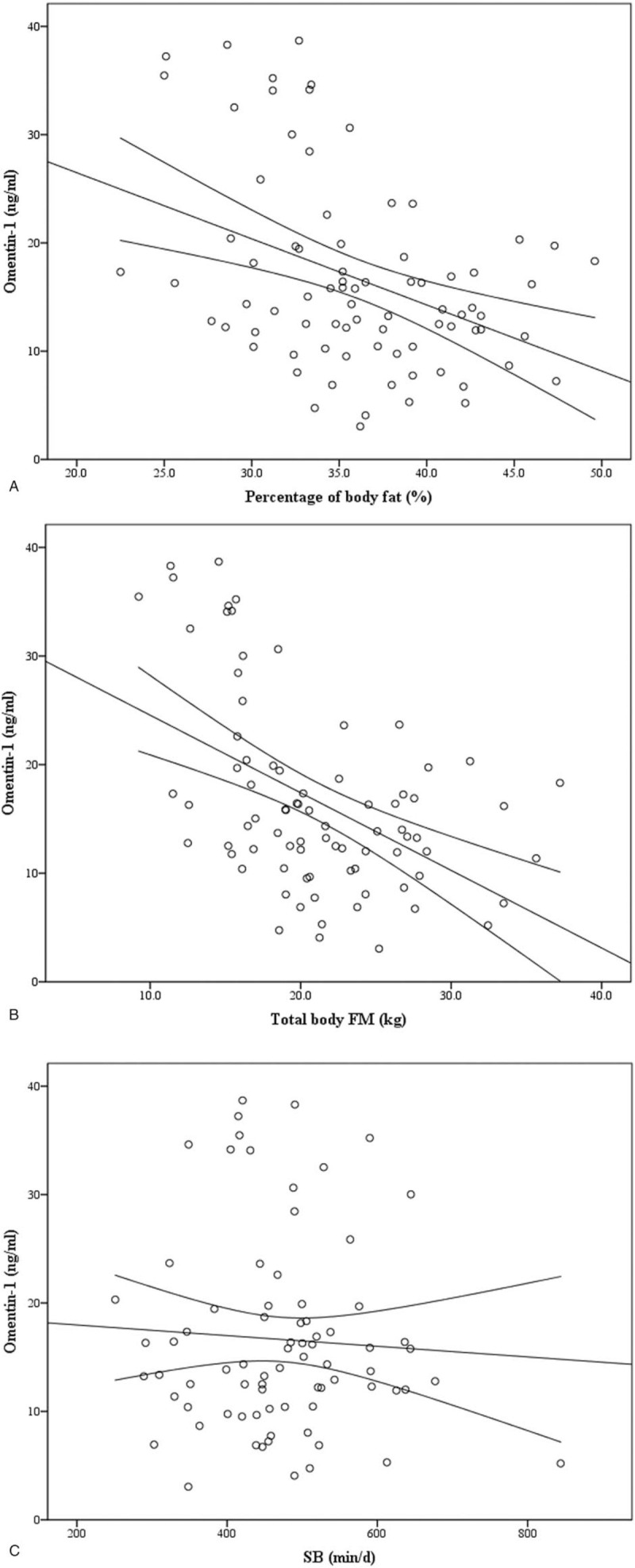
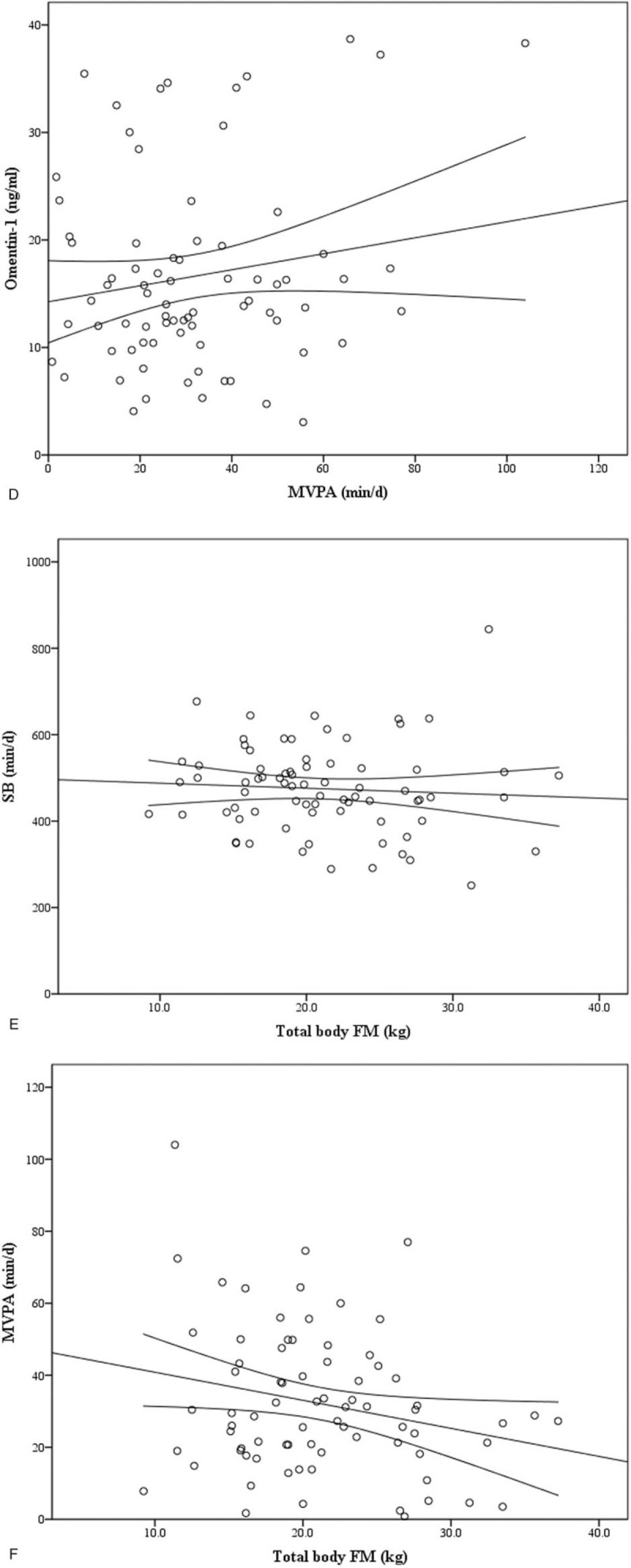
This study aimed to investigate the relationships between omentin-1, body composition and physical activity (PA) levels in older women.Eighty-one older women (age = 64 ± 6years; body mass index = 24.2 ± 3.2 kg/m2; body fat percentage = 36.1 ± 5.7%) participated in this study. We divided the subjects into overweight/obesity and normal weight group. Body composition was measured by dual energy X-ray absorptiometry. Serum omentin-1 concentration was measured using enzyme linked immunosorbent assay. PA levels were obtained by using accelerometers. In addition, anthropometric and insulin resistance values were determined.Omentin-1 level in overweight/obesity group was significantly lower than in the normal weight group (P < .01). Analysis of all subjects showed that serum omentin-1 was negatively correlated with body weight, BMI (body mass index), waist circumference (WC), WHR (waist-to-hip ratio), percentage of body fat, total body fat mass (FM), fat-free mass (FFM) (r = -.571, -0.569, -0.546, -0.382, -0.394, -0.484, -0.524, all P < .01), respectively. We also found a negative correlation between moderate-to-vigorous physical activity (MVPA) and total body FM (r = -.233, P < .05). However, no significant correlation was found between omentin-1 and sedentary behavior and MVPA (both P > .05). Moreover, the relationship between omentin-1, body composition and PA was analyzed by using multiple linear stepwise regressions. The results showed that serum omentin-1 concentration was inversely correlated with total body FM (β = -0.334, P = .004) in multiple linear stepwise regression analysis.We found that total body FM was inversely related to serum omentin-1 concentration and PA levels, but there was no correlation between omentin-1 and PA levels. These results showed that PA may participate in the regulation of body composition, which may be also affected by serum omentin-1. However, the mechanism by which PA affects body composition may not be through omentin-1 and was more likely through other metabolic pathways.
本研究旨在探讨网膜素-1 与老年人身体成分和身体活动(PA)水平之间的关系。81 名老年女性(年龄=64±6 岁;体重指数=24.2±3.2kg/m2;体脂百分比=36.1±5.7%)参与了本研究。我们将受试者分为超重/肥胖组和正常体重组。身体成分通过双能 X 射线吸收法测量。使用酶联免疫吸附试验测量血清网膜素-1 浓度。通过加速度计获得 PA 水平。此外,还测定了人体测量学和胰岛素抵抗值。超重/肥胖组的网膜素-1 水平明显低于正常体重组(P<0.01)。对所有受试者的分析表明,血清网膜素-1 与体重、BMI(体重指数)、腰围(WC)、腰臀比(WHR)、体脂百分比、全身脂肪量(FM)、去脂体重(FFM)呈负相关(r=-0.571、-0.569、-0.546、-0.382、-0.394、-0.484、-0.524,均 P<0.01)。我们还发现中等至剧烈体力活动(MVPA)与全身 FM 呈负相关(r=-0.233,P<0.05)。然而,网膜素-1 与久坐行为和 MVPA 之间没有显著相关性(均 P>0.05)。此外,我们还通过多元线性逐步回归分析了网膜素-1、身体成分和 PA 之间的关系。结果表明,在多元线性逐步回归分析中,血清网膜素-1 浓度与全身 FM 呈负相关(β=-0.334,P=0.004)。我们发现,全身 FM 与血清网膜素-1 浓度和 PA 水平呈负相关,但网膜素-1 与 PA 水平之间无相关性。这些结果表明,PA 可能参与了身体成分的调节,这可能也受到血清网膜素-1 的影响。然而,PA 影响身体成分的机制可能不是通过网膜素-1,而是通过其他代谢途径。