• 文献检索
  • 文档翻译
  • 深度研究
  • 学术资讯
  • Suppr Zotero 插件Zotero 插件
  • 邀请有礼
  • 套餐&价格
  • 历史记录
应用&插件
Suppr Zotero 插件Zotero 插件浏览器插件Mac 客户端Windows 客户端微信小程序
定价
高级版会员购买积分包购买API积分包
服务
文献检索文档翻译深度研究API 文档MCP 服务
关于我们
关于 Suppr公司介绍联系我们用户协议隐私条款
关注我们

Suppr 超能文献

核心技术专利:CN118964589B侵权必究
粤ICP备2023148730 号-1Suppr @ 2026

文献检索

告别复杂PubMed语法,用中文像聊天一样搜索,搜遍4000万医学文献。AI智能推荐,让科研检索更轻松。

立即免费搜索

文件翻译

保留排版,准确专业,支持PDF/Word/PPT等文件格式,支持 12+语言互译。

免费翻译文档

深度研究

AI帮你快速写综述,25分钟生成高质量综述,智能提取关键信息,辅助科研写作。

立即免费体验

家庭护理手臂康复(MERLIN):基于严肃游戏的无源设备远程康复可改善慢性脑卒中患者的上肢功能。

HoMEcare aRm rehabiLItatioN (MERLIN): telerehabilitation using an unactuated device based on serious games improves the upper limb function in chronic stroke.

机构信息

Department of Rehabilitation Medicine, University of Groningen, University Medical Center Groningen, Groningen, The Netherlands.

Neurorehabilitation Area, Health Division of TECNALIA, Basque Research and Technology Alliance (BRTA), San Sebastian, Spain.

出版信息

J Neuroeng Rehabil. 2021 Mar 16;18(1):48. doi: 10.1186/s12984-021-00841-3.

DOI:10.1186/s12984-021-00841-3
PMID:33726801
原文链接:https://pmc.ncbi.nlm.nih.gov/articles/PMC7961165/
Abstract

BACKGROUND

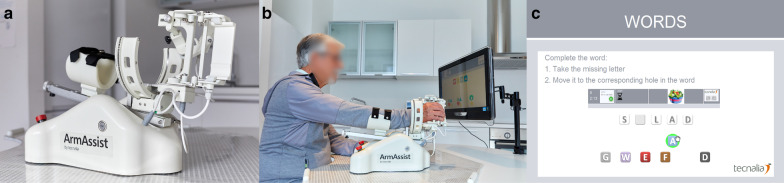
HoMEcare aRm rehabiLItatioN (MERLIN) is an unactuated version of the robotic device ArmAssist combined with a telecare platform. Stroke patients are able to train the upper limb function using serious games at home. The aim of this study is to investigate the effect of MERLIN training on the upper limb function of patients with unilateral upper limb paresis in the chronic phase of stroke (> 6 months post stroke).

METHODS

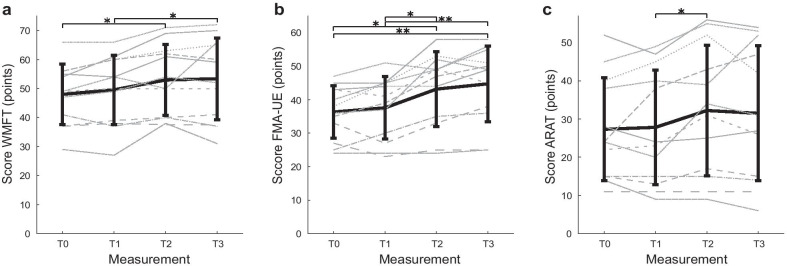
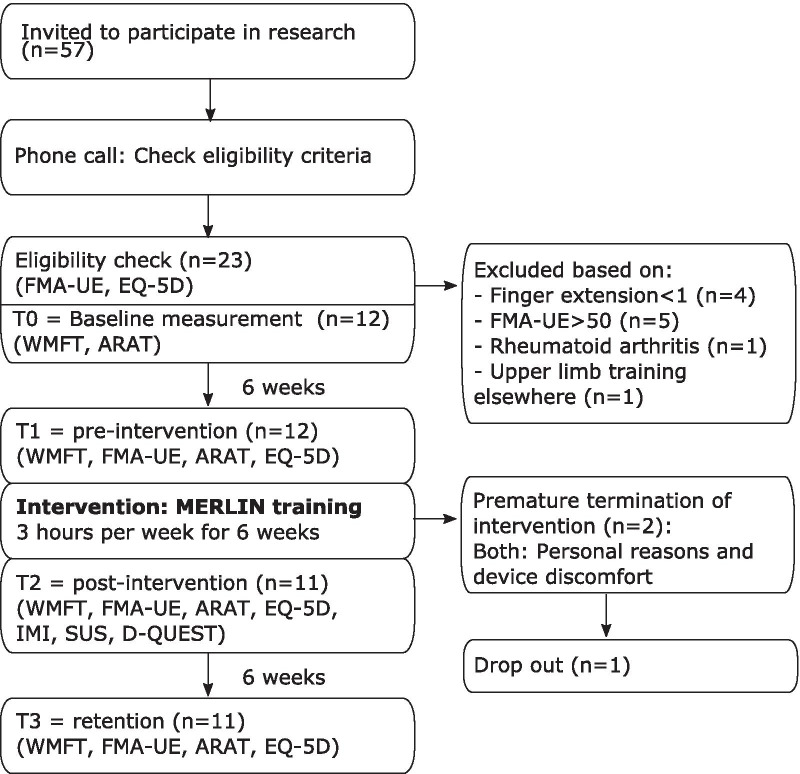
Patients trained task specific serious games for three hours per week during six weeks using an unactuated version of a robotic device. Progress was monitored and game settings were tailored through telerehabilitation. Measurements were performed six weeks pre-intervention (T0), at the start (T1), end (T2) and six weeks post-intervention (T3). Primary outcome was the Wolf Motor Function Test (WMFT). Secondary outcomes were other arm function tests, quality of life, user satisfaction and motivation.

RESULTS

Twelve patients were included, ten completed the training. From start of the intervention to six weeks follow up, WMFT improved significantly with 3.8 points (p = .006), which is also clinically relevant. No significant changes in quality of life were observed. Patients were overall satisfied with the usability of the device. Comfort and the robustness of the system need further improvements.

CONCLUSION

Patients in the chronic phase of stroke significantly improved their upper limb function with the MERLIN training at home. Trial registration This study is registered at the Netherlands Trial Register (NL7535). Registered 18-02-2019, https://www.trialregister.nl/trial/7535 .

摘要

背景

HoMEcare aRm rehabiLItatioN(MERLIN)是一种与远程医疗平台相结合的无动力机器人设备 ArmAssist 的版本。中风患者可以在家中使用严肃游戏来训练上肢功能。本研究旨在探讨 MERLIN 训练对中风后慢性期(>6 个月)单侧上肢瘫痪患者上肢功能的影响。

方法

患者使用无动力机器人设备进行每周 3 小时、为期 6 周的专项严肃游戏训练。通过远程康复来监测进展并调整游戏设置。在干预前 6 周(T0)、开始时(T1)、结束时(T2)和干预后 6 周(T3)进行测量。主要结果是 Wolf 运动功能测试(WMFT)。次要结果包括其他上肢功能测试、生活质量、用户满意度和动机。

结果

共纳入 12 例患者,其中 10 例完成了训练。从干预开始到 6 周随访,WMFT 显著提高了 3.8 分(p=0.006),这也是具有临床意义的。生活质量没有显著变化。患者对设备的可用性总体满意。舒适性和系统的稳健性需要进一步改进。

结论

中风慢性期患者在家中使用 MERLIN 训练显著提高了上肢功能。

试验注册

本研究在荷兰试验注册中心(NL7535)注册。注册日期为 2019 年 2 月 18 日,https://www.trialregister.nl/trial/7535。
https://cdn.ncbi.nlm.nih.gov/pmc/blobs/bd75/7962368/efa373cbd98e/12984_2021_841_Fig3_HTML.jpg
https://cdn.ncbi.nlm.nih.gov/pmc/blobs/bd75/7962368/431021de41a4/12984_2021_841_Fig1_HTML.jpg
https://cdn.ncbi.nlm.nih.gov/pmc/blobs/bd75/7962368/9612b21305c7/12984_2021_841_Fig2_HTML.jpg
https://cdn.ncbi.nlm.nih.gov/pmc/blobs/bd75/7962368/efa373cbd98e/12984_2021_841_Fig3_HTML.jpg
https://cdn.ncbi.nlm.nih.gov/pmc/blobs/bd75/7962368/431021de41a4/12984_2021_841_Fig1_HTML.jpg
https://cdn.ncbi.nlm.nih.gov/pmc/blobs/bd75/7962368/9612b21305c7/12984_2021_841_Fig2_HTML.jpg
https://cdn.ncbi.nlm.nih.gov/pmc/blobs/bd75/7962368/efa373cbd98e/12984_2021_841_Fig3_HTML.jpg

相似文献

1
HoMEcare aRm rehabiLItatioN (MERLIN): telerehabilitation using an unactuated device based on serious games improves the upper limb function in chronic stroke.家庭护理手臂康复(MERLIN):基于严肃游戏的无源设备远程康复可改善慢性脑卒中患者的上肢功能。
J Neuroeng Rehabil. 2021 Mar 16;18(1):48. doi: 10.1186/s12984-021-00841-3.
2
A usability study in patients with stroke using MERLIN, a robotic system based on serious games for upper limb rehabilitation in the home setting.一项针对 stroke 患者的可用性研究,使用 MERLIN,这是一种基于严肃游戏的机器人系统,用于家庭环境中的上肢康复。
J Neuroeng Rehabil. 2021 Feb 23;18(1):41. doi: 10.1186/s12984-021-00837-z.
3
HoMEcare aRm rehabiLItatioN (MERLIN): preliminary evidence of long term effects of telerehabilitation using an unactuated training device on upper limb function after stroke.远程康复训练对脑卒中后上肢功能的长期影响:使用无源训练装置的远程康复的初步证据
J Neuroeng Rehabil. 2021 Sep 19;18(1):141. doi: 10.1186/s12984-021-00934-z.
4
Video Game Rehabilitation for Outpatient Stroke (VIGoROUS): protocol for a multi-center comparative effectiveness trial of in-home gamified constraint-induced movement therapy for rehabilitation of chronic upper extremity hemiparesis.门诊卒中的电子游戏康复治疗(VIGoROUS):一项针对慢性上肢偏瘫康复的家庭式游戏化强制性运动疗法的多中心比较疗效试验方案
BMC Neurol. 2017 Jun 8;17(1):109. doi: 10.1186/s12883-017-0888-0.
5
Stroke survivors' experiences with home-based telerehabilitation using an assistive device to improve upper limb function: a qualitative study.脑卒中幸存者使用辅助设备进行居家远程康复以改善上肢功能的体验:一项定性研究。
Disabil Rehabil Assist Technol. 2024 Apr;19(3):730-738. doi: 10.1080/17483107.2022.2120641. Epub 2022 Sep 22.
6
Feasibility study into self-administered training at home using an arm and hand device with motivational gaming environment in chronic stroke.关于使用带有激励性游戏环境的手臂和手部设备在家中进行自我管理训练对慢性中风患者可行性的研究。
J Neuroeng Rehabil. 2015 Oct 9;12:89. doi: 10.1186/s12984-015-0080-y.
7
ArmAssist Robotic System versus Matched Conventional Therapy for Poststroke Upper Limb Rehabilitation: A Randomized Clinical Trial.用于中风后上肢康复的手臂辅助机器人系统与匹配的传统疗法:一项随机临床试验
Biomed Res Int. 2017;2017:7659893. doi: 10.1155/2017/7659893. Epub 2017 Jan 31.
8
Effects of a remote-handling-concept-based task-oriented arm training (ReHab-TOAT) on arm-hand skill performance in chronic stroke: a study protocol for a two-armed randomized controlled trial.基于远程操作概念的任务导向手臂训练(ReHab-TOAT)对慢性脑卒中患者上肢手功能的影响:一项双臂随机对照试验的研究方案。
Trials. 2023 Mar 14;24(1):189. doi: 10.1186/s13063-023-07139-w.
9
Commercial head-mounted display virtual reality for upper extremity rehabilitation in chronic stroke: a single-case design study.商业头戴式显示虚拟现实用于慢性脑卒中上肢康复:单病例设计研究。
J Neuroeng Rehabil. 2020 Nov 23;17(1):154. doi: 10.1186/s12984-020-00788-x.
10
A comparison of the effects and usability of two exoskeletal robots with and without robotic actuation for upper extremity rehabilitation among patients with stroke: a single-blinded randomised controlled pilot study.两种带和不带机器人驱动的外骨骼机器人在上肢康复中对脑卒中患者的效果和可用性的比较:一项单盲随机对照初步研究。
J Neuroeng Rehabil. 2020 Oct 19;17(1):137. doi: 10.1186/s12984-020-00763-6.

引用本文的文献

1
Effects of game design characteristics of a virtual reality serious game for upper-limb prosthesis control training on motor learning.一款用于上肢假肢控制训练的虚拟现实严肃游戏的设计特征对运动学习的影响。
Front Rehabil Sci. 2025 Jun 17;6:1520184. doi: 10.3389/fresc.2025.1520184. eCollection 2025.
2
Novel Robotic Balloon-Based Device for Wrist-Extension Therapy of Hemiparesis Stroke Patients.用于偏瘫中风患者手腕伸展治疗的新型基于机器人球囊的装置。
Sensors (Basel). 2025 Feb 23;25(5):1360. doi: 10.3390/s25051360.
3
Poststroke eHealth Technologies-Based Rehabilitation for Upper Limb Recovery: Systematic Review.

本文引用的文献

1
The REDCap consortium: Building an international community of software platform partners.REDCap 联盟:构建软件平台合作伙伴的国际社区。
J Biomed Inform. 2019 Jul;95:103208. doi: 10.1016/j.jbi.2019.103208. Epub 2019 May 9.
2
Home-based technologies for stroke rehabilitation: A systematic review.基于家庭的脑卒中康复技术:系统评价。
Int J Med Inform. 2019 Mar;123:11-22. doi: 10.1016/j.ijmedinf.2018.12.001. Epub 2018 Dec 11.
3
Effects of robot-assisted upper limb rehabilitation in stroke patients: a systematic review with meta-analysis.
基于电子健康技术的中风后上肢康复:系统评价
J Med Internet Res. 2025 Mar 4;27:e57957. doi: 10.2196/57957.
4
Unlocking the potential of serious games for rehabilitation in low and middle-income countries: addressing potential and current limitations.挖掘低收入和中等收入国家严肃游戏用于康复的潜力:应对潜在及当前的限制因素。
Front Digit Health. 2025 Jan 31;7:1505717. doi: 10.3389/fdgth.2025.1505717. eCollection 2025.
5
Exploring New Tools in Upper Limb Rehabilitation After Stroke Using an Exoskeletal Aid: A Pilot Randomized Control Study.使用外骨骼辅助设备探索中风后上肢康复的新工具:一项试点随机对照研究。
Healthcare (Basel). 2025 Jan 6;13(1):91. doi: 10.3390/healthcare13010091.
6
Unsupervised robot-assisted rehabilitation after stroke: feasibility, effect on therapy dose, and user experience.卒中后无监督机器人辅助康复:可行性、对治疗剂量的影响和用户体验。
J Neuroeng Rehabil. 2024 Apr 9;21(1):52. doi: 10.1186/s12984-024-01347-4.
7
Outcome Measures Utilized to Assess the Efficacy of Telerehabilitation for Post-Stroke Rehabilitation: A Scoping Review.用于评估远程康复对中风后康复疗效的结局指标:一项范围综述
Brain Sci. 2023 Dec 17;13(12):1725. doi: 10.3390/brainsci13121725.
8
ICTs and interventions in telerehabilitation and their effects on stroke recovery.信息通信技术与远程康复干预及其对中风恢复的影响。
Front Neurol. 2023 Aug 14;14:1234003. doi: 10.3389/fneur.2023.1234003. eCollection 2023.
9
Home-Based Rehabilitation of the Shoulder Using Auxiliary Systems and Artificial Intelligence: An Overview.基于辅助系统和人工智能的居家肩部康复:综述。
Sensors (Basel). 2023 Aug 11;23(16):7100. doi: 10.3390/s23167100.
10
The use of home-based digital technology to support post-stroke upper limb rehabilitation: A scoping review.利用基于家庭的数字技术支持脑卒中后上肢康复:范围综述。
Clin Rehabil. 2024 Jan;38(1):60-71. doi: 10.1177/02692155231189257. Epub 2023 Jul 19.
机器人辅助上肢康复治疗脑卒中患者的效果:系统评价与荟萃分析。
Neurol Sci. 2017 Sep;38(9):1561-1569. doi: 10.1007/s10072-017-2995-5. Epub 2017 May 24.
4
ArmAssist Robotic System versus Matched Conventional Therapy for Poststroke Upper Limb Rehabilitation: A Randomized Clinical Trial.用于中风后上肢康复的手臂辅助机器人系统与匹配的传统疗法:一项随机临床试验
Biomed Res Int. 2017;2017:7659893. doi: 10.1155/2017/7659893. Epub 2017 Jan 31.
5
Validity, responsiveness, and minimal clinically important difference of EQ-5D-5L in stroke patients undergoing rehabilitation.EQ-5D-5L在接受康复治疗的中风患者中的效度、反应度及最小临床重要差异
Qual Life Res. 2016 Jun;25(6):1585-96. doi: 10.1007/s11136-015-1196-z. Epub 2015 Nov 30.
6
Feasibility study into self-administered training at home using an arm and hand device with motivational gaming environment in chronic stroke.关于使用带有激励性游戏环境的手臂和手部设备在家中进行自我管理训练对慢性中风患者可行性的研究。
J Neuroeng Rehabil. 2015 Oct 9;12:89. doi: 10.1186/s12984-015-0080-y.
7
Self-Administered, Home-Based SMART (Sensorimotor Active Rehabilitation Training) Arm Training: A Single-Case Report.自我管理的居家智能(感觉运动主动康复训练)手臂训练:单病例报告
Am J Occup Ther. 2015 Jul-Aug;69(4):6904210020p1-8. doi: 10.5014/ajot.2015.016055.
8
Can The EQ-5D Detect Meaningful Change? A Systematic Review.EQ-5D能否检测出有意义的变化?一项系统评价。
Pharmacoeconomics. 2015 Nov;33(11):1137-54. doi: 10.1007/s40273-015-0295-6.
9
The HAAPI (Home Arm Assistance Progression Initiative) Trial: A Novel Robotics Delivery Approach in Stroke Rehabilitation.HAAPI(家庭手臂辅助进展计划)试验:中风康复中的一种新型机器人辅助方法。
Neurorehabil Neural Repair. 2015 Nov-Dec;29(10):958-68. doi: 10.1177/1545968315575612. Epub 2015 Mar 17.
10
Home-based Computer Assisted Arm Rehabilitation (hCAAR) robotic device for upper limb exercise after stroke: results of a feasibility study in home setting.用于中风后上肢锻炼的居家计算机辅助手臂康复(hCAAR)机器人设备:居家环境下可行性研究的结果
J Neuroeng Rehabil. 2014 Dec 12;11:163. doi: 10.1186/1743-0003-11-163.