School of Chemistry and Physics, Queensland University of Technology (QUT), Brisbane, QLD, Australia.
Centre for Materials Science, Queensland University of Technology (QUT), Brisbane, QLD, Australia.
Nat Commun. 2021 Mar 16;12(1):1691. doi: 10.1038/s41467-021-21797-x.
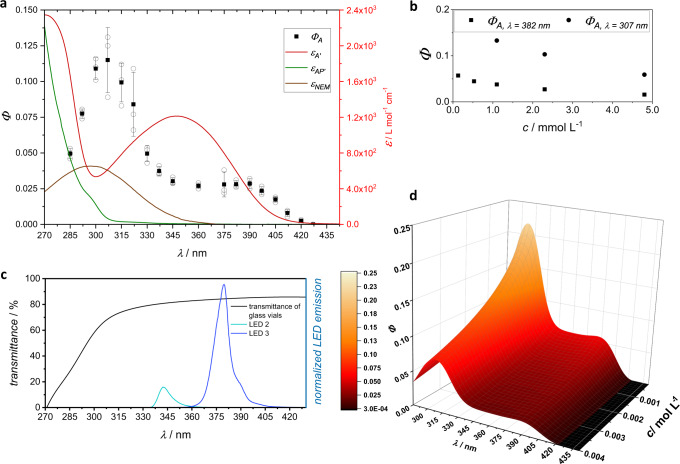
Predicting the conversion and selectivity of a photochemical experiment is a conceptually different challenge compared to thermally induced reactivity. Photochemical transformations do not currently have the same level of generalized analytical treatment due to the nature of light interaction with a photoreactive substrate. Herein, we bridge this critical gap by introducing a framework for the quantitative prediction of the time-dependent progress of photoreactions via common LEDs. A wavelength and concentration dependent reaction quantum yield map of a model photoligation, i.e., the reaction of thioether o-methylbenzaldehydes via o-quinodimethanes with N-ethylmaleimide, is initially determined with a tunable laser system. Combined with experimental parameters, the data are employed to predict LED-light induced conversion through a wavelength-resolved numerical simulation. The model is validated with experiments at varied wavelengths. Importantly, a second algorithm allows the assessment of competing photoreactions and enables the facile design of λ-orthogonal ligation systems based on substituted o-methylbenzaldehydes.
预测光化学反应的转化和选择性与热诱导反应在概念上是不同的挑战。由于光与光反应底物相互作用的性质,光化学转化目前没有相同水平的广义分析处理。在此,我们通过引入一个通过普通 LED 定量预测光反应时变进程的框架来弥补这一关键差距。通过可调谐激光系统,最初确定了模型光连接的波长和浓度依赖性反应量子产率图,即硫醚邻甲基苯甲醛通过邻醌二甲基与 N-乙基马来酰亚胺的反应。结合实验参数,数据可用于通过波长分辨数值模拟预测 LED 光诱导的转化。该模型通过在不同波长下的实验进行了验证。重要的是,第二个算法允许评估竞争光反应,并能够基于取代的邻甲基苯甲醛轻松设计 λ-正交连接系统。