Ryu Gwanghui, Shin Hyun-Woo
Department of Otorhinolaryngology-Head and Neck Surgery, Soonchunhyang University College of Medicine, Cheonan 31151, Korea.
Obstructive Upper airway Research (OUaR) Laboratory, Department of Pharmacology, Seoul National University College of Medicine, Seoul 03080, Korea.
Immune Netw. 2021 Mar 2;21(1):e3. doi: 10.4110/in.2021.21.e3. eCollection 2021 Feb.
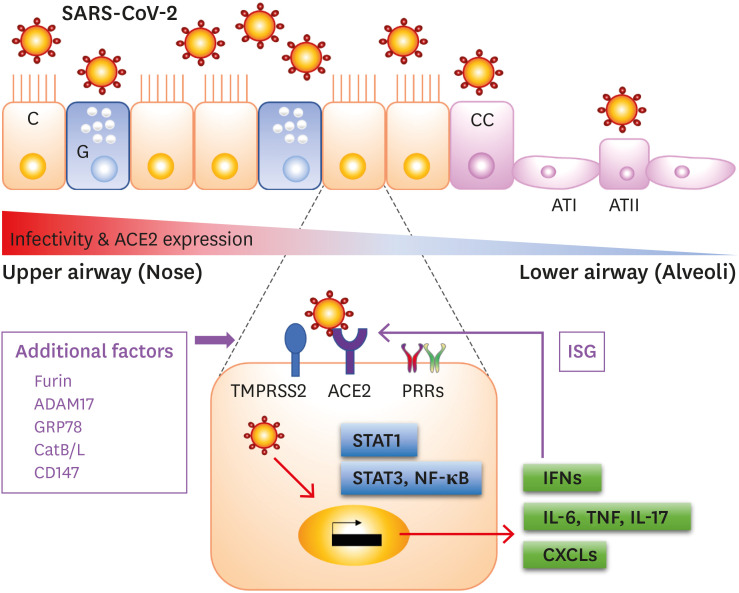
Coronavirus disease 2019 caused by severe acute respiratory syndrome coronavirus 2 (SARS-CoV-2) has been spreading worldwide since its outbreak in December 2019, and World Health Organization declared it as a pandemic on March 11, 2020. SARS-CoV-2 is highly contagious and is transmitted through airway epithelial cells as the first gateway. SARS-CoV-2 is detected by nasopharyngeal or oropharyngeal swab samples, and the viral load is significantly high in the upper respiratory tract. The host cellular receptors in airway epithelial cells, including angiotensin-converting enzyme 2 and transmembrane serine protease 2, have been identified by single-cell RNA sequencing or immunostaining. The expression levels of these molecules vary by type, function, and location of airway epithelial cells, such as ciliated cells, secretory cells, olfactory epithelial cells, and alveolar epithelial cells, as well as differ from host to host depending on age, sex, or comorbid diseases. Infected airway epithelial cells by SARS-CoV-2 in experiments produce chemokines and cytokines to recruit inflammatory cells to target organs. Same as other viral infections, IFN signaling is a critical pathway for host defense. Various studies are underway to confirm the pathophysiological mechanisms of SARS-CoV-2 infection. Herein, we review cellular entry, host-viral interactions, immune responses to SARS-CoV-2 in airway epithelial cells. We also discuss therapeutic options related to epithelial immune reactions to SARS-CoV-2.
由严重急性呼吸综合征冠状病毒2(SARS-CoV-2)引起的2019冠状病毒病自2019年12月爆发以来一直在全球范围内传播,世界卫生组织于2020年3月11日宣布其为大流行病。SARS-CoV-2具有高度传染性,通过气道上皮细胞作为首要门户进行传播。通过鼻咽或口咽拭子样本检测SARS-CoV-2,且其上呼吸道中的病毒载量显著较高。通过单细胞RNA测序或免疫染色已确定气道上皮细胞中的宿主细胞受体,包括血管紧张素转换酶2和跨膜丝氨酸蛋白酶2。这些分子的表达水平因气道上皮细胞的类型、功能和位置(如纤毛细胞、分泌细胞、嗅觉上皮细胞和肺泡上皮细胞)而异,并且因宿主的年龄、性别或合并症不同而有所差异。在实验中,被SARS-CoV-2感染的气道上皮细胞会产生趋化因子和细胞因子,以将炎症细胞募集到靶器官。与其他病毒感染一样,IFN信号传导是宿主防御的关键途径。目前正在进行各种研究以确认SARS-CoV-2感染的病理生理机制。在此,我们综述了气道上皮细胞中SARS-CoV-2的细胞进入、宿主-病毒相互作用、免疫反应。我们还讨论了与上皮细胞对SARS-CoV-2免疫反应相关的治疗选择。