Institute of Hematology, Union Hospital, Tongji Medical College, Huazhong University of Science and Technology, Wuhan, 430022 Hubei, China.
Hubei Clinical Medical Center of Cell Therapy for Neoplastic Disease, Wuhan, 430022 Hubei, China.
Biomed Res Int. 2021 Feb 25;2021:6616391. doi: 10.1155/2021/6616391. eCollection 2021.
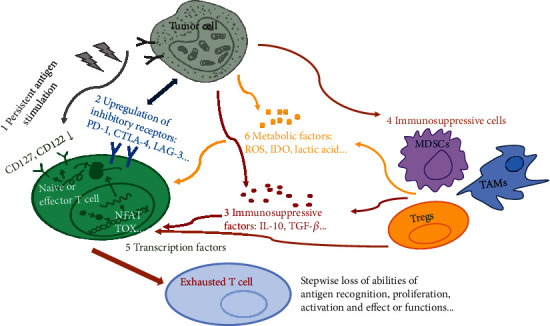
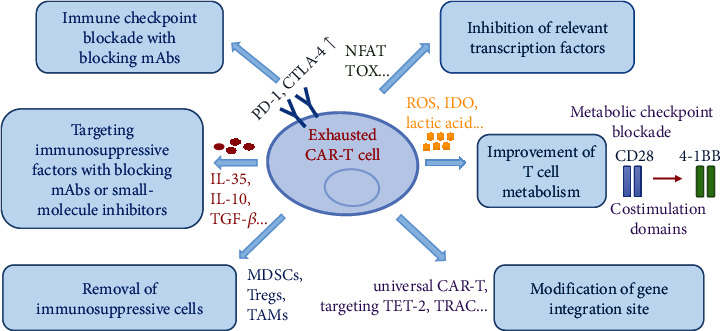
T cell exhaustion has been recognized to play an immunosuppressive role in malignant diseases. Persistent tumor antigen stimulation, the presence of inhibitory immune cells and cytokines in tumor microenvironment (TME), upregulated expression of inhibitory receptors, changes in T cell-related transcription factors, and metabolic factors can all result in T cell exhaustion. Strategies dedicated to preventing or reversing T cell exhaustion are required to reduce the morbidity from cancer and enhance the effectiveness of adoptive cellular immunotherapy. Here, we summarize the current findings of T cell exhaustion in hematological malignancies and chimeric antigen receptor T (CAR-T) immunotherapy, as well as the value of novel technologies, to inverse such dysfunction. Our emerging understanding of T cell exhaustion may be utilized to develop personalized strategies to restore antitumor immunity.
T 细胞耗竭已被认为在恶性疾病中发挥免疫抑制作用。持续的肿瘤抗原刺激、肿瘤微环境(TME)中抑制性免疫细胞和细胞因子的存在、抑制性受体的上调表达、T 细胞相关转录因子的变化以及代谢因素都可能导致 T 细胞耗竭。需要专门的策略来预防或逆转 T 细胞耗竭,以降低癌症的发病率并提高过继细胞免疫疗法的效果。在这里,我们总结了 T 细胞耗竭在血液恶性肿瘤和嵌合抗原受体 T(CAR-T)免疫疗法中的最新发现,以及逆转这种功能障碍的新技术的价值。我们对 T 细胞耗竭的认识的不断提高,可能被用于制定个性化策略,以恢复抗肿瘤免疫。