Department of Medical Epidemiology and Biostatistics, Karolinska Institutet, Stockholm, Sweden.
Department of Child and Adolescent Psychiatry and Psychology, Clínic Institute of Neurosciences, Hospital Clínic de Barcelona, Barcelona, Spain.
PLoS One. 2021 Mar 17;16(3):e0247724. doi: 10.1371/journal.pone.0247724. eCollection 2021.
Individuals with ADHD are at increased risk for poor occupational outcomes. Educational attainment and psychiatric comorbidity may be important contributing factors for these outcomes, but the role of these factors is not well characterized. This study aimed to investigate the associations between ADHD and occupational outcomes, and to examine the influence of educational attainment, comorbid developmental disorders and intellectual disability on these associations.
We linked the Swedish population graduating from compulsory school 1998-2008 (N = 1.2 millions) to population-wide register-based data on clinical psychiatric diagnoses and medications, objective annual measures of educational, and occupational outcomes. Individuals were followed for between 6 to 16 years after graduation.
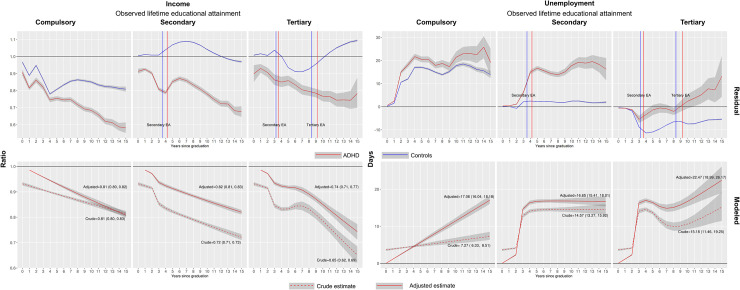
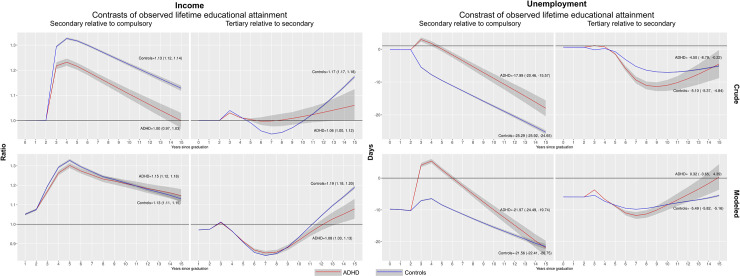
Individuals with ADHD had annually on average 17 percent lower income, ratio = 0.83 (95% CI 0.83-0.84), 12.19 (11.89-12.49) more days of unemployment, and a higher likelihood of receiving disability pension, odds-ratio = 19.0 (18.4-19.6), compared to controls. Comorbid diagnoses of intellectual disability and developmental disorder explained most of the association between ADHD and disability pension, while lifetime educational attainment partially explained associations between ADHD and all occupational outcomes. Analyses of occupational trajectories found that income was lower and unemployment elevated relative to controls with the same educational attainment. Higher educational attainment correlated with higher income similarly among individuals with ADHD and controls after accounting for individual background factors.
The occupational burden associated with ADHD is substantial. Comorbid developmental disorders, intellectual disability and educational difficulties (e.g., failing grades) from childhood to adulthood are important factors to consider when designing interventions to improve occupational outcomes in individuals with ADHD.
患有注意力缺陷多动障碍(ADHD)的个体发生职业不良结局的风险增加。受教育程度和共患精神障碍可能是导致这些结局的重要因素,但这些因素的作用尚未得到充分描述。本研究旨在探讨 ADHD 与职业结局之间的关联,并研究受教育程度、共患发育障碍和智力残疾对这些关联的影响。
我们将 1998-2008 年从义务教育毕业的瑞典人群(N=120 万)与基于人群的临床精神科诊断和药物使用、客观的年度教育和职业结局记录进行了链接。个体在毕业后被随访了 6-16 年。
与对照组相比,ADHD 个体的年收入平均低 17%,比率为 0.83(95%CI 0.83-0.84),失业天数多 12.19 天(11.89-12.49),且更有可能领取残疾抚恤金,比值比=19.0(18.4-19.6)。智力残疾和发育障碍的共患诊断解释了 ADHD 与残疾抚恤金之间的大部分关联,而终身受教育程度部分解释了 ADHD 与所有职业结局之间的关联。职业轨迹分析发现,与具有相同受教育程度的对照组相比,ADHD 个体的收入较低,失业较高。考虑到个体背景因素后,较高的受教育程度与 ADHD 个体和对照组的收入增加呈正相关。
与 ADHD 相关的职业负担相当大。共患发育障碍、智力残疾和儿童期至成年期的教育困难(例如成绩不佳)是设计干预措施以改善 ADHD 个体职业结局时需要考虑的重要因素。