Institute of Health and Wellbeing, University of Glasgow, Glasgow, United Kingdom.
Information Services Division, Edinburgh, United Kingdom.
PLoS Med. 2020 Oct 13;17(10):e1003290. doi: 10.1371/journal.pmed.1003290. eCollection 2020 Oct.
Neurodevelopmental conditions commonly coexist in children, but compared to adults, childhood multimorbidity attracts less attention in research and clinical practice. We previously reported that children treated for attention deficit hyperactivity disorder (ADHD) and depression have more school absences and exclusions, additional support needs, poorer attainment, and increased unemployment. They are also more likely to have coexisting conditions, including autism and intellectual disability. We investigated prevalence of neurodevelopmental multimorbidity (≥2 conditions) among Scottish schoolchildren and their educational outcomes compared to peers.
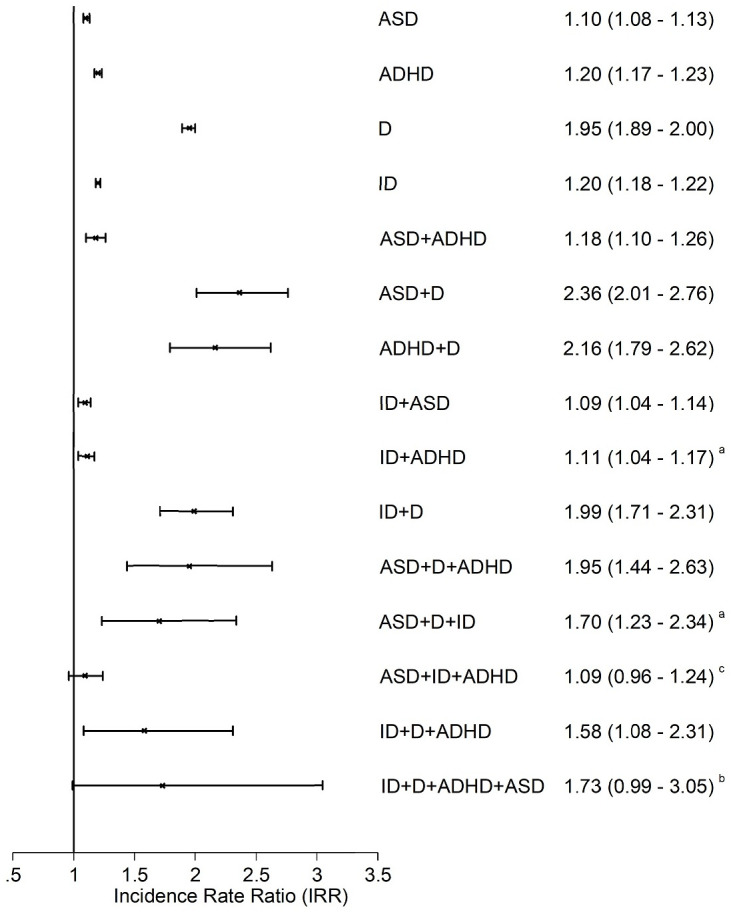
We retrospectively linked 6 Scotland-wide databases to analyse 766,244 children (390,290 [50.9%] boys; 375,954 [49.1%] girls) aged 4 to 19 years (mean = 10.9) attending Scottish schools between 2009 and 2013. Children were distributed across all deprivation quintiles (most to least deprived: 22.7%, 20.1%, 19.3%, 19.5%, 18.4%). The majority (96.2%) were white ethnicity. We ascertained autism spectrum disorder (ASD) and intellectual disabilities from records of additional support needs and ADHD and depression through relevant encashed prescriptions. We identified neurodevelopmental multimorbidity (≥2 of these conditions) in 4,789 (0.6%) children, with ASD and intellectual disability the most common combination. On adjusting for sociodemographic (sex, age, ethnicity, deprivation) and maternity (maternal age, maternal smoking, sex-gestation-specific birth weight centile, gestational age, 5-minute Apgar score, mode of delivery, parity) factors, multimorbidity was associated with increased school absenteeism and exclusion, unemployment, and poorer exam attainment. Significant dose relationships were evident between number of conditions (0, 1, ≥2) and the last 3 outcomes. Compared to children with no conditions, children with 1 condition, and children with 2 or more conditions, had more absenteeism (1 condition adjusted incidence rate ratio [IRR] 1.28, 95% CI 1.27-1.30, p < 0.001 and 2 or more conditions adjusted IRR 1.23, 95% CI 1.20-1.28, p < 0.001), greater exclusion (adjusted IRR 2.37, 95% CI 2.25-2.48, p < 0.001 and adjusted IRR 3.04, 95% CI 2.74-3.38, p < 0.001), poorer attainment (adjusted odds ratio [OR] 3.92, 95% CI 3.63-4.23, p < 0.001 and adjusted OR 12.07, 95% CI 9.15-15.94, p < 0.001), and increased unemployment (adjusted OR 1.57, 95% CI 1.49-1.66, p < 0.001 and adjusted OR 2.11, 95% CI 1.83-2.45, p < 0.001). Associations remained after further adjustment for comorbid physical conditions and additional support needs. Coexisting depression was the strongest driver of absenteeism and coexisting ADHD the strongest driver of exclusion. Absence of formal primary care diagnoses was a limitation since ascertaining depression and ADHD from prescriptions omitted affected children receiving alternative or no treatment and some antidepressants can be prescribed for other indications.
Structuring clinical practice and training around single conditions may disadvantage children with neurodevelopmental multimorbidity, who we observed had significantly poorer educational outcomes compared to children with 1 condition and no conditions.
神经发育障碍在儿童中通常同时存在,但与成人相比,儿童多病共存在研究和临床实践中受到的关注较少。我们之前报告称,接受注意力缺陷多动障碍 (ADHD) 和抑郁症治疗的儿童的缺课和退学率更高,需要更多的支持,学业成绩更差,失业的可能性更大。他们也更有可能同时患有其他疾病,包括自闭症和智力障碍。我们调查了苏格兰学龄儿童神经发育性多病共存(≥2 种疾病)的患病率,并与同龄人进行了比较。
我们回顾性地链接了 6 个苏格兰全数据库,以分析 766244 名 4 至 19 岁(平均年龄 10.9 岁)的苏格兰在校儿童的数据(390290 [50.9%] 男孩;375954 [49.1%] 女孩)。儿童分布在所有贫困五分位数(最贫困到最不贫困:22.7%、20.1%、19.3%、19.5%、18.4%)。大多数(96.2%)为白种人。我们从额外支持需求的记录中确定了自闭症谱系障碍 (ASD) 和智力残疾,从相关的已兑现处方中确定了 ADHD 和抑郁症。我们发现 4789 名(0.6%)儿童有多发性神经发育障碍(≥2 种疾病),ASD 和智力障碍是最常见的组合。在校正了社会人口学(性别、年龄、种族、贫困)和产科(母亲年龄、母亲吸烟、性别特异性出生体重百分位数、胎龄、5 分钟 Apgar 评分、分娩方式、产次)因素后,多疾病与增加的缺课和退学、失业和较差的考试成绩有关。在数量(0、1、≥2)和最后 3 个结果之间存在显著的剂量关系。与没有疾病的儿童相比,有 1 种疾病的儿童和有 2 种或更多疾病的儿童的缺课率更高(1 种疾病的调整发病率比 [IRR] 为 1.28,95%CI 为 1.27-1.30,p < 0.001,2 种或更多疾病的调整 IRR 为 1.23,95%CI 为 1.20-1.28,p < 0.001),被开除的可能性更大(调整后的 IRR 为 2.37,95%CI 为 2.25-2.48,p < 0.001 和调整后的 IRR 为 3.04,95%CI 为 2.74-3.38,p < 0.001),学业成绩更差(调整后的比值比 [OR] 为 3.92,95%CI 为 3.63-4.23,p < 0.001 和调整后的 OR 为 12.07,95%CI 为 9.15-15.94,p < 0.001),失业的可能性更高(调整后的 OR 为 1.57,95%CI 为 1.49-1.66,p < 0.001 和调整后的 OR 为 2.11,95%CI 为 1.83-2.45,p < 0.001)。在进一步调整了合并的身体疾病和额外支持需求后,这些关联仍然存在。并存的抑郁症是缺勤的最强驱动因素,并存的 ADHD 是退学的最强驱动因素。缺乏正式的初级保健诊断是一个限制因素,因为从处方中确定抑郁症和 ADHD 会遗漏接受替代或无治疗的受影响儿童,并且一些抗抑郁药可能会用于其他适应症。
围绕单一疾病进行临床实践和培训可能会使患有神经发育性多病共存的儿童处于不利地位,我们观察到这些儿童的教育结果明显比患有 1 种疾病和没有疾病的儿童差。