College of Education, Psychology, and Social Work, Flinders University, GPO Box 2100, Adelaide, South Australia, 5001, Australia.
J Autism Dev Disord. 2022 Feb;52(2):490-507. doi: 10.1007/s10803-021-04963-4. Epub 2021 Mar 17.
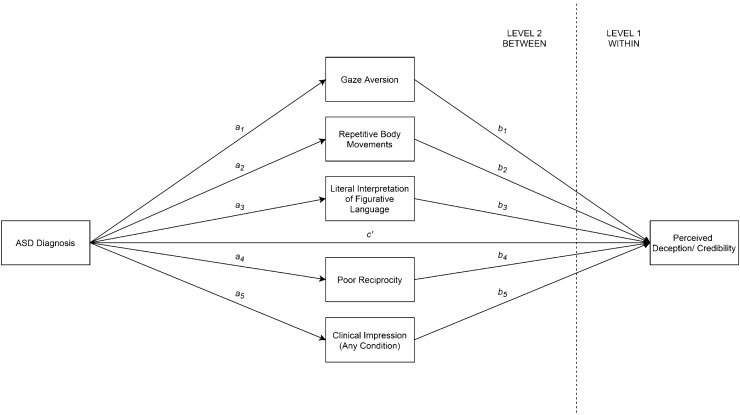
We hypothesized that autistic adults may be erroneously judged as deceptive or lacking credibility due to demonstrating unexpected and atypical behaviors. Thirty autistic and 29 neurotypical individuals participated in video-recorded interviews, and we measured their demonstration of gaze aversion, repetitive body movements, literal interpretation of figurative language, poor reciprocity, and flat affect. Participants (N = 1410) viewed one of these videos and rated their perception of the individual's truthfulness or credibility. The hypothesis was partially supported, with autistic individuals perceived as more deceptive and less credible than neurotypical individuals when telling the truth. However, this relationship was not influenced by the presence of any of the target behaviors, but instead, by the individual's overall presentation.
我们假设,由于表现出意外的、非典型的行为,自闭症成年人可能会被错误地判断为欺骗或缺乏可信度。30 名自闭症患者和 29 名神经典型个体参与了视频记录访谈,我们测量了他们的回避目光、重复身体动作、对比喻语言的字面解释、互动不良和情感平淡的表现。参与者(N=1410)观看了其中一段视频,并对他们对个体真实性或可信度的感知进行了评价。该假设得到了部分支持,与神经典型个体相比,自闭症个体在说实话时被认为更具欺骗性和可信度更低。然而,这种关系不受任何目标行为的影响,而是受个体的整体表现影响。