Division of Health, Department of Psychology, College of Arts and Sciences, University of Miami, USA.
Division of Health, Department of Psychology, College of Arts and Sciences, University of Miami, USA.
J Psychosom Res. 2021 May;144:110403. doi: 10.1016/j.jpsychores.2021.110403. Epub 2021 Feb 22.
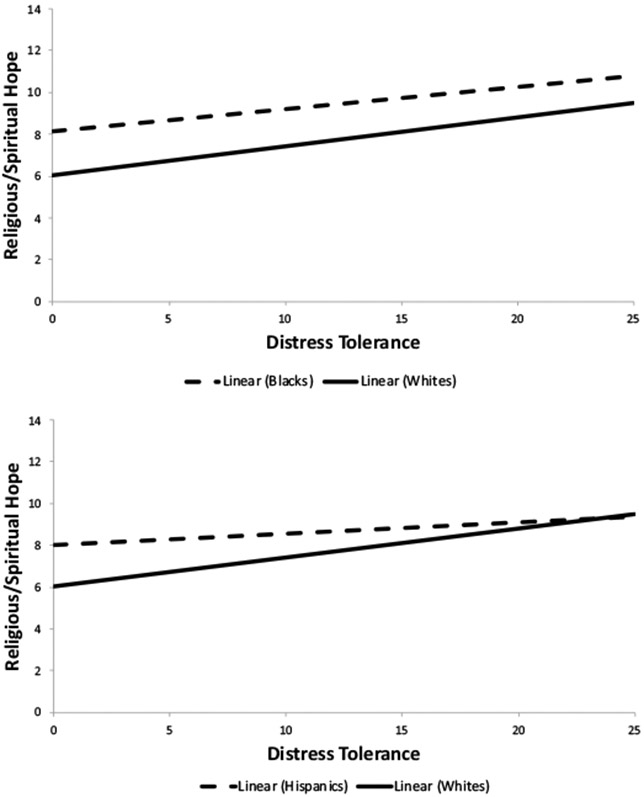
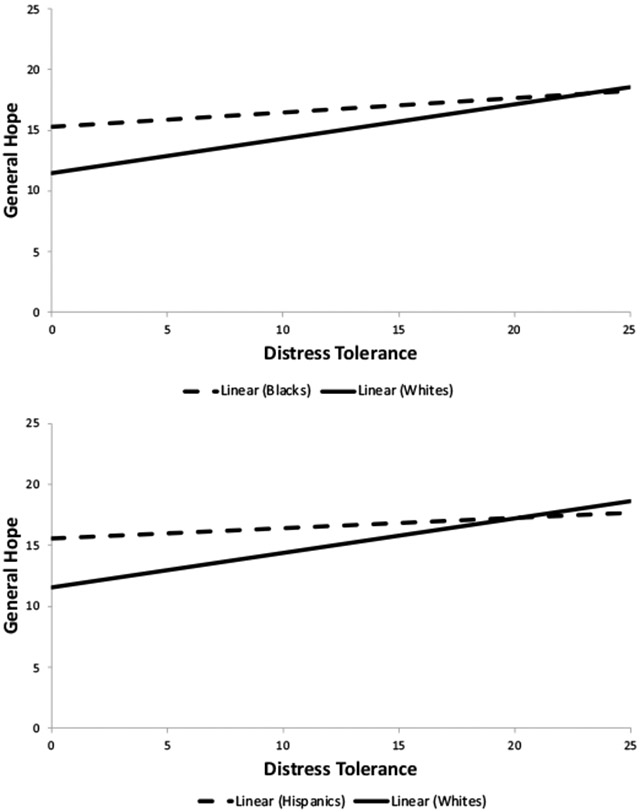
Racial and ethnic minorities, including Blacks/African-Americans and Hispanics/Latinos,indicate lower tolerance to psychological distress (DT) and secular hope yet endorse more religious and spiritual hope than their non-Hispanic White (NHW) counterparts. Whether racial-ethnic minorities derive greater benefit from non-secular hope on the tolerance of psychological distress remains unclear. Self-reported endorsement of religious/spiritual (R/S) hope, secular hope, DT, and a number of other psychosocial, R/S and sociodemographic variables were analyzed from a nationwide survey of persons aged over 18 years (N = 2875) identifying as Black (14.2%), Hispanic (15.4%), or NHW (67.3%) using multiple regression. Overall, higher levels of both R/S and secular hope predicted greater DT. In turn, greater DT was associated with lower psychosomatic distress. Compared to NHW, the ethnic-minority groups reported lower overall levels of DT. An interaction for race-ethnicity further revealed that compared to distress intolerant NHW, Blacks/African-Americans at lower levels of DT report higher R/S and secular hope. Hispanics/Latinos were also higher on R/S and secular hope, but endorsed lower hope at higher levels of DT than the reference group. Although hope is considered a more passive form of coping, it is more frequently endorsed in marginalized ethnic-minority groups. However, compared to NHW, differences do exist in the extent to which R/S hope mitigates DT in Blacks/African-Americans compared to Hispanics/Latinos.
包括黑人和西班牙裔在内的少数族裔对心理困扰(DT)的耐受性较低,世俗希望也较低,但他们比非西班牙裔白人(NHW)更支持宗教和精神希望。少数族裔是否从非世俗希望中获得更多对心理困扰的耐受性益处尚不清楚。从一项对 18 岁以上人群(N=2875)的全国性调查中分析了宗教/精神(R/S)希望、世俗希望、DT 以及其他一些心理社会、R/S 和社会人口学变量,这些人自我报告支持宗教/精神(R/S)希望、世俗希望、DT 以及许多其他心理社会、R/S 和社会人口学变量。总体而言,R/S 和世俗希望水平越高,DT 水平越高。反过来,更高的 DT 与更低的身心困扰有关。与 NHW 相比,少数民族群体报告的 DT 总体水平较低。种族-族裔的相互作用进一步表明,与无法忍受痛苦的 NHW 相比,DT 水平较低的黑人和西班牙裔报告说 R/S 和世俗希望更高。西班牙裔/拉丁裔在 R/S 和世俗希望方面也较高,但在 DT 水平较高时,他们的希望水平低于参考组。虽然希望被认为是一种更被动的应对方式,但它在边缘化的少数族裔群体中更频繁地被认可。然而,与 NHW 相比,R/S 希望在多大程度上减轻黑人和西班牙裔的 DT 与西班牙裔之间存在差异。