Department of Social Medicine of School of Public Health, Zhejiang University School of Medicine, 866 Yuhangtang Road, Hangzhou, 310058, Zhejiang, People's Republic of China.
Department of Pharmacy of the First Affiliated Hospital, Zhejiang University School of Medicine, 79 Qingchun Road, Hangzhou, 310003, Zhejiang, People's Republic of China.
Health Qual Life Outcomes. 2021 Mar 17;19(1):88. doi: 10.1186/s12955-021-01732-w.
Outcomes derived from longitudinal self-reported health-related quality of life measures can be confounded by response shift. This study was aimed to detect response shift among patients with hypertension attending a community-based disease management program.
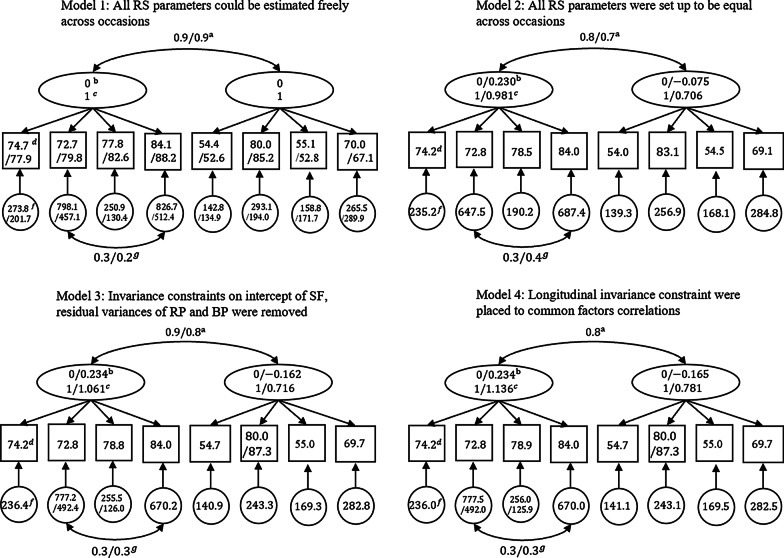
240 consecutive consulting or follow-up patients with diagnosed hypertension were recruited. The Short Form 36-item Health Survey was self-administered at 12 community health service stations at baseline and four weeks after attending the program. The 4-step structural equation modeling approach assessed response shift.
Data from 203 (84.6%) patients were eligible for analyses (mean age 65.9 ± 10.8 years, 46.3% female). The results showed uniform recalibration of social functioning (Formula: see text = 22.98, P < 0.001), and non-uniform recalibration of role limitations due to physical problems (Formula: see text = 8.84, P = 0.003), and bodily pain (Formula: see text = 17.41, P < 0.001). The effects of response shift on social functioning were calculated as "small" (effect-size = 0.35), but changed the observed changes from improvement (effect-size = 0.25) to slight deterioration (effect-size = -0.10). After accounting for the response shift effect, the general physical health of participants was improved (effect-size = 0.37), while deterioration (effect-size = -0.21) in the general mental health was also found.
Recalibration existed among patients with hypertension attending the disease management program. The interventions in the program might act as a catalyst that induced the response shift. We conclude that response shift should be considered in hypertension research with longitudinal health-related quality of life data.
源于纵向自我报告的健康相关生活质量指标的结果可能会受到反应转移的影响。本研究旨在检测参加社区疾病管理计划的高血压患者是否存在反应转移。
招募了 240 名连续就诊或随访的高血压患者。在基线和参加该计划四周后,在 12 个社区卫生服务站进行了简短的 36 项健康调查。采用 4 步结构方程建模方法评估反应转移。
共有 203 名(84.6%)患者的数据符合分析要求(平均年龄 65.9±10.8 岁,46.3%为女性)。结果显示,社会功能的统一再校准(Formula: see text=22.98,P<0.001),身体问题导致的角色限制的非统一再校准(Formula: see text=8.84,P=0.003)和身体疼痛(Formula: see text=17.41,P<0.001)。反应转移对社会功能的影响被计算为“小”(效应大小=0.35),但将观察到的变化从改善(效应大小=0.25)转变为轻微恶化(效应大小=-0.10)。考虑到反应转移的影响后,参与者的一般身体健康状况得到改善(效应大小=0.37),同时也发现一般心理健康状况恶化(效应大小=-0.21)。
参加疾病管理计划的高血压患者存在再校准现象。该计划中的干预措施可能是引起反应转移的催化剂。我们得出结论,在使用纵向健康相关生活质量数据进行高血压研究时,应考虑反应转移。