Sebri Valeria, Durosini Ilaria, Triberti Stefano, Pravettoni Gabriella
Department of Oncology and Hemato-Oncology, University of Milan, Milan, Italy.
Applied Research Division for Cognitive and Psychological Science, IEO, European Institute of Oncology IRCCS, Milan, Italy.
Front Psychol. 2021 Mar 1;12:611954. doi: 10.3389/fpsyg.2021.611954. eCollection 2021.
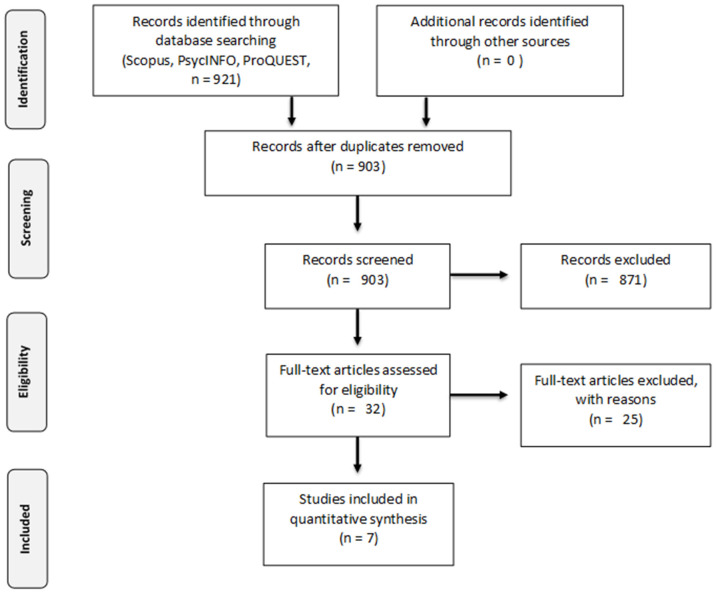
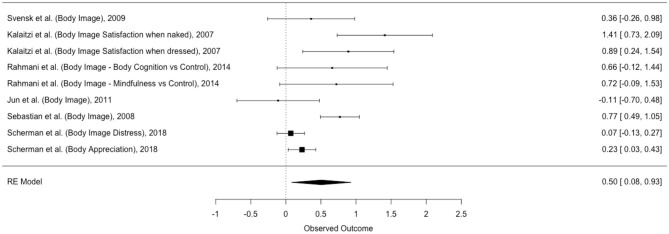
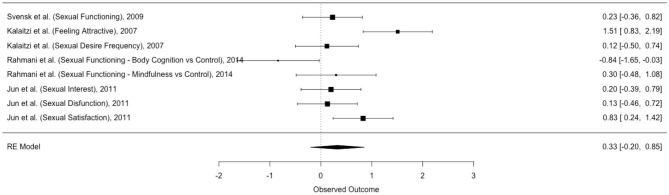
The experience of breast cancer and related treatments has notable effects on women's mental health. Among them, the subjective perception of the body or body image (BI) is altered. Such alterations deserve to be properly treated because they augment the risk for depression and mood disorders, and impair intimate relationships. A number of studies revealed that focused psychological interventions are effective in reducing BI issues related to breast cancer. However, findings are inconsistent regarding the dimension of such effects. This meta-analysis synthesizes and quantifies the efficacy of psychological interventions for BI in breast cancer patients and survivors. Additionally, since sexual functioning emerged as a relevant aspect in the BI distortions, we explored the efficacy of psychological interventions on sexual functioning related to BI in breast cancer patients and survivors. The literature search for relevant contributions was carried out in March 2020 through the following electronic databases: Scopus, PsycINFO, and ProQUEST. Only articles available in English and that featured psychological interventions for body image in breast cancer patients or survivors with controls were included. Seven articles with 17 dependent effect sizes were selected for this meta-analysis. Variables were grouped into: (six studies, nine dependent effect sizes) and in breast cancer patients and survivors (four studies, eight dependent effect sizes). The three-level meta-analysis showed a statistically significant effect for [ = 0.50; 95% CI (0.08; 0.93); < 0.05] but no significant results for [ = 0.33; 95% CI (-0.20; 0.85); = 0.19]. These results suggest that psychological interventions are effective in reducing body image issues but not in reducing sexual functioning issues related to body image in breast cancer patients and survivors. Future review efforts may include gray literature and qualitative studies to better understand body image and sexual functioning issues in breast cancer patients. Also, high-quality studies are needed to inform future meta-analyses.
乳腺癌经历及相关治疗对女性心理健康有显著影响。其中,身体的主观感受或身体意象(BI)会发生改变。这种改变值得妥善处理,因为它们会增加抑郁和情绪障碍的风险,并损害亲密关系。多项研究表明,有针对性的心理干预在减少与乳腺癌相关的身体意象问题方面是有效的。然而,关于此类效果的维度,研究结果并不一致。这项荟萃分析综合并量化了心理干预对乳腺癌患者及幸存者身体意象的疗效。此外,由于性功能是身体意象扭曲中的一个相关方面,我们探讨了心理干预对乳腺癌患者及幸存者与身体意象相关的性功能的疗效。2020年3月通过以下电子数据库进行了相关文献检索:Scopus、PsycINFO和ProQUEST。仅纳入了英文且以乳腺癌患者或幸存者的身体意象心理干预为特色并设有对照的文章。本荟萃分析选取了7篇文章,共17个效应量。变量分为:(6项研究,9个效应量)以及乳腺癌患者及幸存者中的(4项研究,8个效应量)。三级荟萃分析显示,对于[效应量 = 0.50;95%置信区间(0.08;0.93);P < 0.05]有统计学显著效应,但对于[效应量 = 0.33;95%置信区间(-0.20;0.85);P = 0.19]无显著结果。这些结果表明,心理干预在减少身体意象问题方面是有效的,但在减少乳腺癌患者及幸存者与身体意象相关的性功能问题方面无效。未来的综述工作可能包括灰色文献和定性研究,以更好地理解乳腺癌患者的身体意象和性功能问题。此外,需要高质量的研究为未来的荟萃分析提供信息。