School of Public Health and Community Medicine, Institute of Medicine, Sahlgrenska Academy, University of Gothenburg, Gothenburg, Sweden.
Department of Health Sciences, University West, Trollhättan, Sweden.
Front Public Health. 2021 Feb 25;9:599921. doi: 10.3389/fpubh.2021.599921. eCollection 2021.
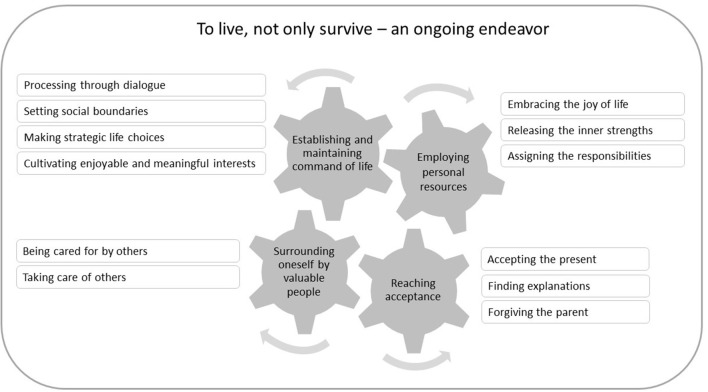
A significant proportion of individuals exposed to maltreatment in childhood adapt positively in adulthood despite the adversities, i.e., show resilience. Little is known about resources and processes related to adulthood that promote resilience. Since women are overrepresented as victims of intrafamilial violence, understanding resilience among adult women is important. To explore experiences of resilience among adult women who perceive well-being and well-functioning although being exposed to maltreatment during childhood. This study included 22 women with experiences of childhood maltreatment, mean age of 48 years, living in Sweden. Individual interviews were conducted and analyzed according to constructivist grounded theory. The process of resilience was experienced as an ongoing endeavor to live, not only survive, an internal process that interacted with external processes involving social relations and conditions. This endeavor was built on four interrelated resources: establishing and maintaining command of life; employing personal resources; surrounding oneself with valuable people; and reaching acceptance. These worked together, not in a linear or chronological order, but in up and down ways, turns and straight lines (now and then), through the process from maltreatment to well-being. Resilience was found to rest on intrapersonal and interpersonal resources. Individual's inherent capabilities can be, depending on life circumstances and available resources, realized in a way that promote well-being and well-functioning despite severe adversities. Therefore, public health initiatives, social services, and policies should provide conditions that help women maltreated in childhood to live fully rather than merely to survive.
尽管童年时期遭受虐待,相当一部分人在成年后仍能积极适应逆境,即表现出韧性。然而,人们对与成年期相关的促进韧性的资源和过程知之甚少。由于女性在家庭内暴力中受害的比例过高,因此了解成年女性的韧性非常重要。本研究旨在探讨尽管童年时期遭受虐待,但仍能感知到幸福和良好功能的成年女性的韧性体验。
本研究纳入了 22 名经历过童年期虐待的成年女性,平均年龄为 48 岁,居住在瑞典。采用建构主义扎根理论对个体访谈进行分析。韧性的过程被体验为一种持续的努力,不仅是为了生存,而是为了生活,这是一个内部过程,与涉及社会关系和条件的外部过程相互作用。这种努力基于四个相互关联的资源:掌握生活并维持生活;运用个人资源;与有价值的人交往;并接受现实。这些资源共同作用,不是以线性或时间顺序,而是以起伏、曲折和直线(有时)的方式,贯穿从虐待到幸福的整个过程。
韧性建立在个人和人际关系资源之上。个人的内在能力可以根据生活环境和可用资源,以促进幸福和良好功能的方式实现,尽管面临严重的逆境。因此,公共卫生倡议、社会服务和政策应该提供条件,帮助那些在童年时期遭受虐待的女性充分生活,而不仅仅是生存。