Department of Psychology,University of Pennsylvania,Philadelphia,USA.
Department of Clinical Psychology,Graduate School of Education,The University of Tokyo,Tokyo 113-0033,Japan.
Psychol Med. 2017 Nov;47(15):2628-2639. doi: 10.1017/S0033291717001027. Epub 2017 Aug 14.
Adults who were victims of childhood maltreatment tend to have poorer health compared with adults who did not experience abuse. However, many are in good health. We tested whether safe, supportive, and nurturing relationships buffer women with a history of childhood maltreatment from poor health outcomes in later life.
Participants included women from the Environmental Risk (E-Risk) Longitudinal Twin Study who were involved in an intimate relationship at some point by the time their twin children were 10 years old. Women were initially interviewed in 1999-2000 (mean age = 33 years) and 2, 5, and 7 years later. They reported on their physical and mental health, and their health-risk behaviours.
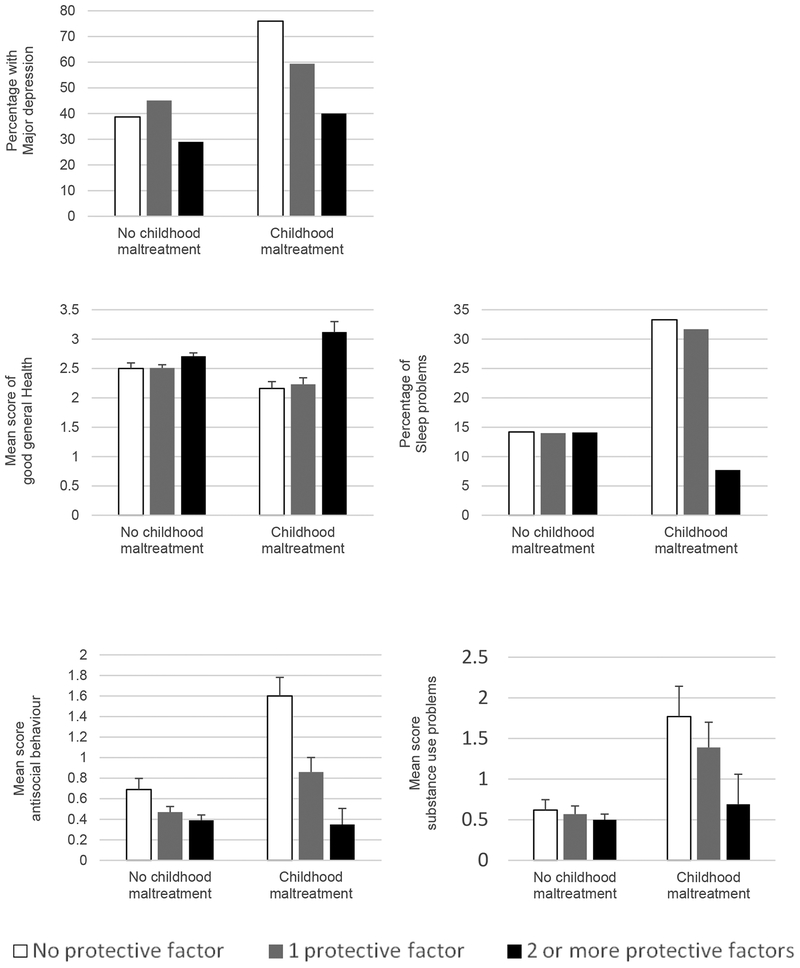
Compared with women who did not experience abuse in childhood, women with histories of maltreatment were at elevated risk for mental, physical, and health-risk behaviours, including major depressive disorder, sleep, and substance use problems. Cumulatively, safe, supportive, and nurturing relationships characterized by a lack of violence, emotional intimacy, and social support buffered women with a history of maltreatment from poor health outcomes.
Our findings emphasize that negative social determinants of health - such as a childhood history of maltreatment - confer risk for psychopathology and other physical health problems. If, however, a woman's current social circumstances are sufficiently positive, they can promote good health, particularly in the face of past adversity.
相较于未曾遭受虐待的成年人,童年时期遭受虐待的成年人往往健康状况较差。然而,许多人仍保持着良好的健康状态。本研究旨在测试安全、支持和关爱的人际关系是否可以缓冲有童年虐待史的女性在晚年健康状况较差的问题。
研究对象为环境风险(E-Risk)纵向双胞胎研究中的女性,在双胞胎孩子 10 岁时,这些女性中至少有一人与伴侣建立了亲密关系。女性最初于 1999-2000 年(平均年龄 33 岁)、2 年后、5 年后和 7 年后接受访谈。她们报告了自己的身心健康状况和健康风险行为。
与未遭受童年虐待的女性相比,有虐待史的女性更有可能出现心理健康、身体健康和健康风险行为问题,包括重度抑郁障碍、睡眠和物质使用问题。总体而言,缺乏暴力、情感亲密和社会支持的安全、支持和关爱的关系缓冲了有虐待史的女性的不良健康结果。
本研究结果强调了社会健康决定因素(如童年虐待史)会增加患精神病理学和其他身体健康问题的风险。然而,如果女性目前的社会环境足够积极,那么她们可以促进良好的健康,尤其是在面对过去的逆境时。