School of Fisheries, Aquaculture and Aquatic Sciences, Auburn University, Auburn, Alabama, United States of America.
Auburn University Shellfish Lab, Dauphin Island, Alabama, United States of America.
PLoS One. 2021 Mar 18;16(3):e0243569. doi: 10.1371/journal.pone.0243569. eCollection 2021.
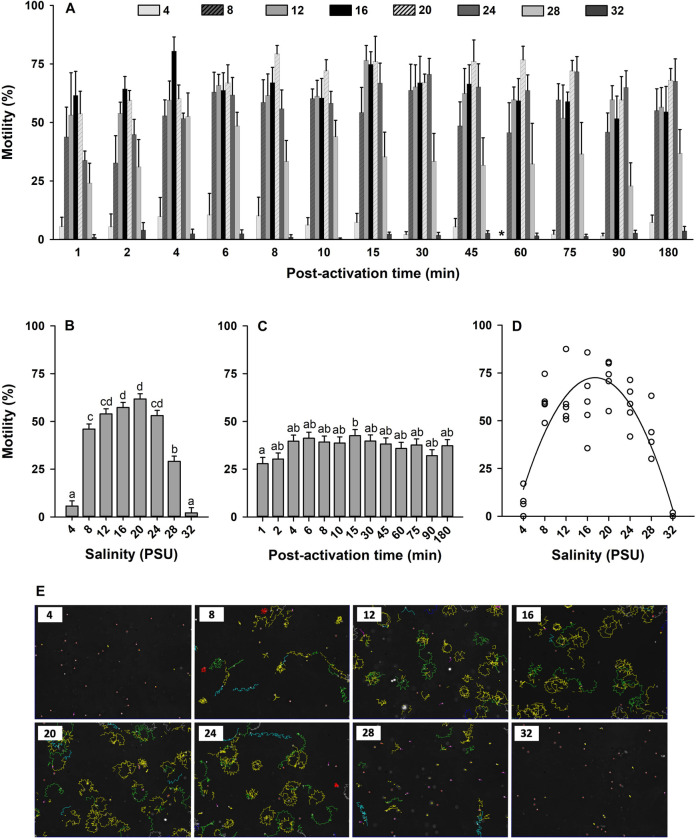
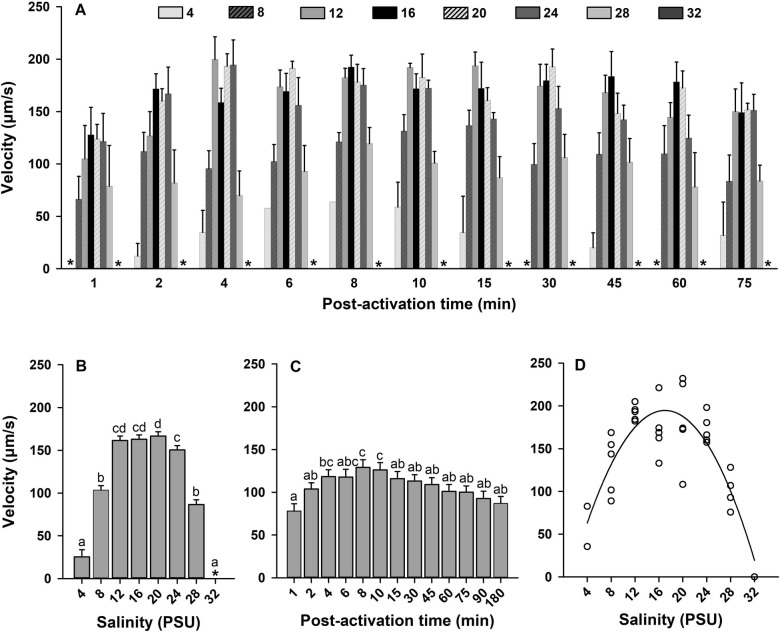
Oyster aquaculture is expanding worldwide, where many farms rely on seed produced by artificial spawning. As sperm motility and velocity are key determinants for fertilization success, understanding the regulation of sperm motility and identifying optimal environmental conditions can increase fertility and seed production. In the present study, we investigated the physiological mechanisms regulating sperm motility in Eastern oyster, Crassostrea virginica. Sperm motility was activated in ambient seawater with salinity 4-32 PSU with highest motility and velocity observed at 12-24 PSU. In artificial seawater (ASW) with salinity of 20 PSU, sperm motility was activated at pH 6.5-10.5 with the highest motility and velocity recorded at pH 7.5-10.0. Sperm motility was inhibited or totally suppressed in Na+, K+, Ca2+, and Mg2+-free ASW at 20 PSU. Applications of K+ (500 μM glybenclamide and 10-50 mM 4-aminopyridine), Ca2+ (1-50 μM mibefradil and 10-200 μM verapamil), or Na+ (0.2-2.0 mM amiloride) channel blockers into ASW at 20 PSU inhibited or suppressed sperm motility and velocity. Chelating extracellular Ca2+ ions by 3.0 and 3.5 mM EGTA resulted in a significant reduction and full suppression of sperm motility by 4 to 6 min post-activation. These results suggest that extracellular K+, Ca2+, and Na+ ions are involved in regulation of ionic-dependent sperm motility in Eastern oyster. A comparison with other bivalve species typically spawning at higher salinities or in full-strength seawater shows that ionic regulation of sperm motility is physiologically conserved in bivalves. Elucidating sperm regulation in C. virginica has implications to develop artificial reproduction, sperm short-term storage, or cryopreservation protocols, and to better predict how changes in the ocean will impact oyster spawning dynamics.
牡蛎养殖在全球范围内不断扩大,许多养殖场依赖人工授精生产的苗种。由于精子活力和速度是受精成功的关键决定因素,因此了解精子活力的调节机制并确定最佳环境条件可以提高受精率和苗种产量。在本研究中,我们研究了调控美洲牡蛎(Crassostrea virginica)精子活力的生理机制。在盐度为 4-32 PSU 的环境海水中,精子活力被激活,在 12-24 PSU 时观察到最高的活力和速度。在盐度为 20 PSU 的人工海水中(ASW),在 pH 6.5-10.5 时精子活力被激活,在 pH 7.5-10.0 时记录到最高的活力和速度。在 20 PSU 的无 Na+、K+、Ca2+和 Mg2+的 ASW 中,精子活力受到抑制或完全抑制。在 20 PSU 的 ASW 中应用 K+(500 μM 格列本脲和 10-50 mM 4-氨基吡啶)、Ca2+(1-50 μM 米贝拉地尔和 10-200 μM 维拉帕米)或 Na+(0.2-2.0 mM 氨氯吡咪)通道阻断剂会抑制或抑制精子活力和速度。螯合细胞外 Ca2+离子(3.0 和 3.5 mM EGTA)会导致激活后 4-6 分钟精子活力显著降低和完全抑制。这些结果表明,细胞外 K+、Ca2+和 Na+离子参与调控美洲牡蛎的离子依赖性精子活力。与通常在更高盐度或全强度海水中产卵的其他双壳类物种进行比较表明,双壳类动物的精子活力的离子调节在生理上是保守的。阐明 C. virginica 精子的调节机制对于开发人工繁殖、精子短期储存或冷冻保存方案,以及更好地预测海洋变化将如何影响牡蛎产卵动态具有重要意义。