State Key Laboratory for Infectious Disease Prevention and Control, National Institute for Communicable Disease Control and Prevention, Chinese Center for Disease Control and Prevention, Beijing, China.
People's Hospital of Sanya, Hainan province, China.
PLoS Negl Trop Dis. 2021 Mar 18;15(3):e0009158. doi: 10.1371/journal.pntd.0009158. eCollection 2021 Mar.
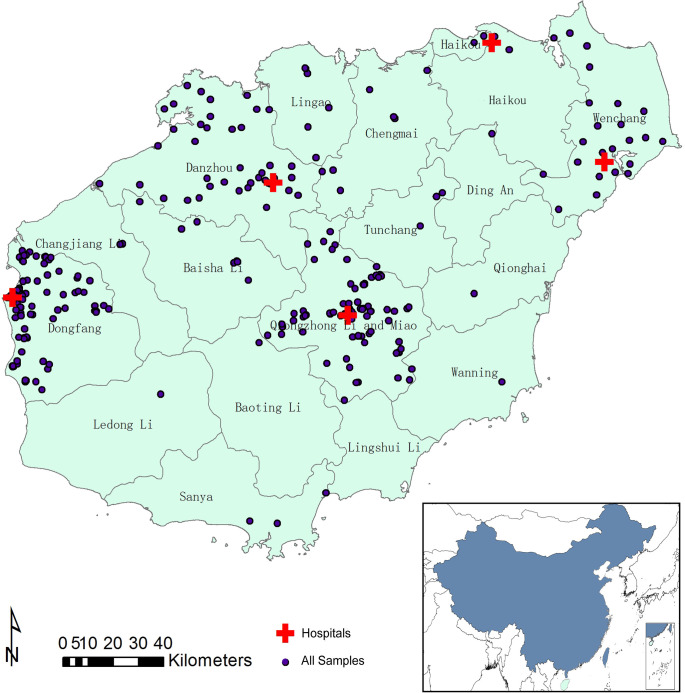
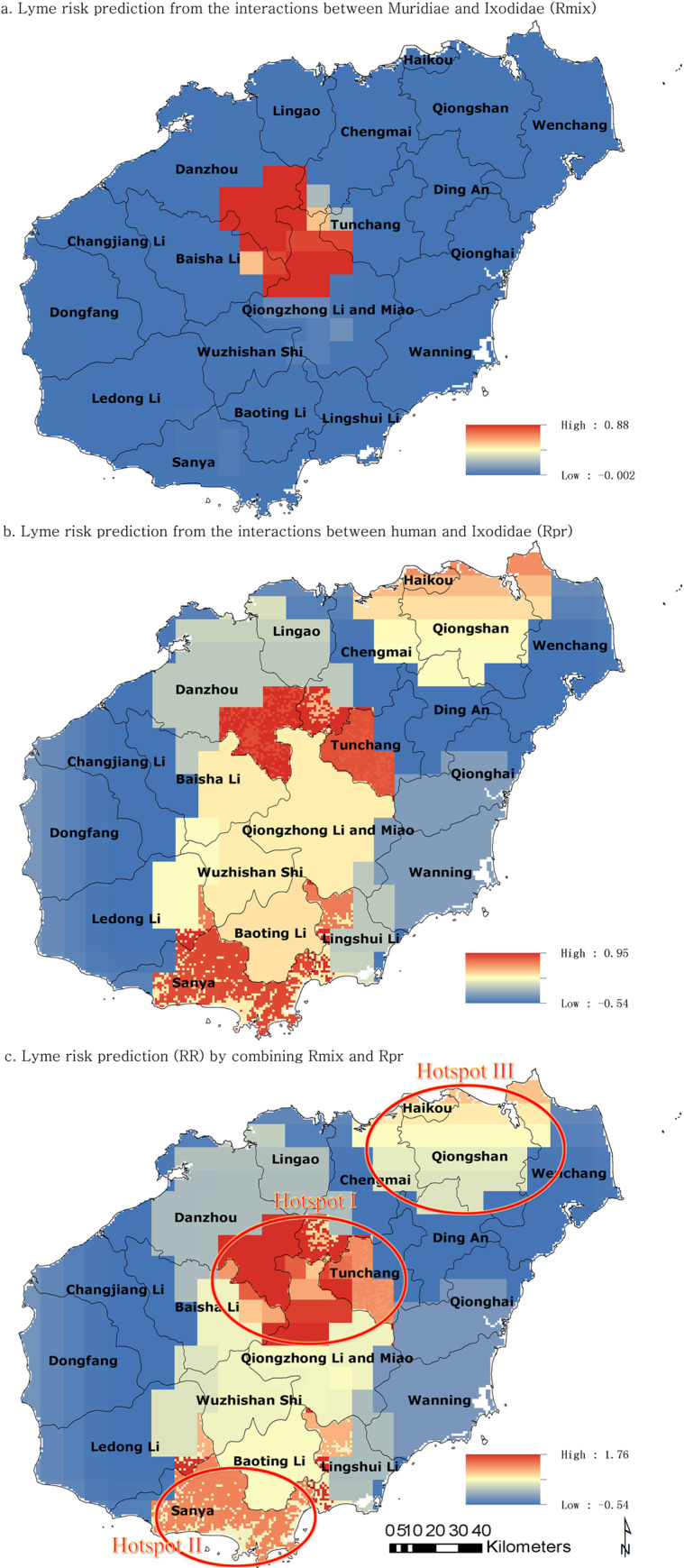
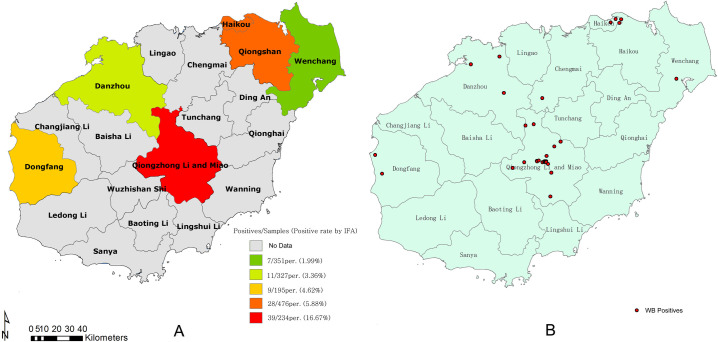
Lyme disease (LD) is one of the most important vector-borne diseases worldwide. However, there is limited information on the prevalence and risk analysis using correlated factors in the tropical areas. A total of 1583 serum samples, collected from five hospitals of Hainan Province, were tested by immunofluorescence assay (IFA) and western blot (WB) analyses using anti-Borrelia burgdorferi antibodies. Then, we mapped the distribution of positive rate (by IFA) and the spread of confirmed Lyme patients (by WB). Using ArcGIS, we compiled host-vector-human interactions and correlated data as risk factor layers to predict LD risk in Hainan Province. There are three LD hotspots, designated hotspot I, which is located in central Hainan, hotspot II, which contains Sanya district, and hotspot III, which lies in the Haikou-Qiongshan area. The positive rate (16.67% by IFA) of LD in Qiongzhong, located in hotspot I, was higher than that in four other areas. Of confirmed cases of LD, 80.77% of patients (42/52) whose results had been confirmed by WB were in hotspots I and III. Hotspot II, with unknowed prevalence of LD, need to be paid more attention considering human-vector interaction. Wuzhi and Limu mountains might be the most important areas for the prevalence of LD, as the severe host-vector and human-vector interactions lead to a potential origin site for LD. Qiongzhong is the riskiest area and is located to the east of Wuzhi Mountain. In the Sanya and Haikou-Qiongshan area, intervening in the human-vector interaction would help control the prevalence of LD.
莱姆病(LD)是全球最重要的虫媒传染病之一。然而,关于热带地区的流行率和相关因素的风险分析的信息有限。从海南省五家医院采集了 1583 份血清样本,通过免疫荧光分析(IFA)和使用抗伯氏疏螺旋体抗体的 Western blot(WB)分析进行检测。然后,我们绘制了阳性率(IFA)的分布和确诊莱姆病患者(WB)的传播情况。使用 ArcGIS,我们编译了宿主-媒介-人类相互作用和相关数据作为风险因素层,以预测海南省的 LD 风险。有三个 LD 热点,热点 I 位于海南中部,热点 II 包含三亚地区,热点 III 位于海口-琼山地区。位于热点 I 的琼中县 LD 的阳性率(IFA 为 16.67%)高于其他四个地区。在通过 WB 确认的 52 例 LD 确诊病例中,80.77%(42/52)的病例位于热点 I 和 III。热点 II 区 LD 的流行率未知,需要更多关注人类-媒介相互作用。五指山和黎母山可能是 LD 流行的最重要地区,因为严重的宿主-媒介和人类-媒介相互作用导致 LD 的潜在起源地。琼中是最危险的地区,位于五指山东部。在三亚和海口-琼山地区,干预人类-媒介相互作用将有助于控制 LD 的流行。