Department of Respiratory Intensive Care Unit, The First Affiliated Hospital of Zhengzhou University, Zhengzhou, Henan Province, China.
PLoS One. 2021 Mar 18;16(3):e0248675. doi: 10.1371/journal.pone.0248675. eCollection 2021.
In December 2019, a new disease named coronavirus disease 2019 (COVID-19) was occurred. Patients who are critically ill with COVID-19 are more likely to die, especially elderly patients. We aimed to describe the effect of age on the clinical and immune characteristics of critically ill patients with COVID-19.
We retrospectively included 32 patients with COVID-19 who were confirmed to have COVID-19 by the local health authority and who were admitted to the first affiliated hospital of Zhengzhou University in Zhengzhou, China between January 3 and March 20, 2020. Clinical information and experimental test data were retrospectively collected for the patients. The 32 patients in this study were all in a critical condition and were classified as severe, according to the guidelines of 2019-nCoV infection from the National Health Commission of the People's Republic of China. Data were compared between those <60 years old and ≥60 years old.
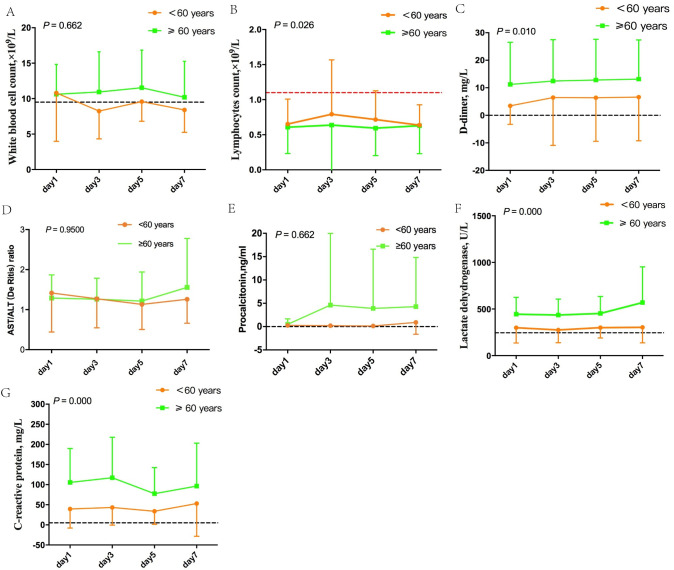
Of 32 patients, 13 were under 60 years old, and 19 patients were ≥60 years old. The most common symptom among all patients upon admission was fever (93.8%, 30/32). Compared to younger patients, older patients exhibited increased comorbidities. Among patients who were 60 years and older, platelet count, direct bilirubin (DBIL), indirect bilirubin(IBIL), lactate dehydrogenase (LDH), B-type natriuretic peptide (BNP), C-reactive protein (CRP), procalcitonin (PCT), and interleukin-10 (IL-10) were significantly higher than in younger patients who were less than 60 years old. CD4+ T lymphocytes, CD8+ T lymphocytes, and NKT lymphocytes were decreased, CD4+/CD8+ T lymphocytes were significantly increased in all 32 patients, while there were no evident differences between younger and older patients. The CURB-65 (confusion, urea, respiratory, rate, blood pressure plus age ≥65 years), Acute Physiology and Chronic Health Evaluation (APACHE) II and pH value were significantly higher in older patients than in patients who were under 60 years old. However, the PaO2 and PaO2:FiO2 were lower in older patients than the younger. Compared to patients under 60 years old, patients who were 60 years and older tended to develop ARDS (15 [78.9%] vs 5 [38.5%]), septic shock (7 [36.8%] vs 0 [0.0%]) and were more likely to receive mechanical ventilation (13 [68.4%] vs 3[23.1%]). Dynamic trajectories of seven laboratory parameters were tracked on days 1, 3, 5 and 7, and significant differences in lymphocyte count (P = 0.026), D-dimer (P = 0.010), lactate dehydrogenase (P = 0.000) and C-reactive protein (P = 0.000) were observed between the two age groups.
A high proportion of critically ill patients were 60 or older. Furthermore, rapid disease progression was noted in elderly patients. Therefore, close monitoring and timely treatment should be performed in elderly COVID-19 patients.
2019 年 12 月,一种名为 2019 年冠状病毒病(COVID-19)的新疾病爆发。患有 COVID-19 的重症患者更有可能死亡,尤其是老年患者。我们旨在描述年龄对 COVID-19 重症患者临床和免疫特征的影响。
我们回顾性纳入了 2020 年 1 月 3 日至 3 月 20 日期间在中国郑州大学第一附属医院确诊为 COVID-19 并入院的 32 例 COVID-19 患者。回顾性收集患者的临床信息和实验检测数据。本研究中的 32 例患者均处于危急状态,根据《中国国家卫生健康委员会 2019 年新型冠状病毒感染指南》,均被归类为重症。比较了年龄<60 岁和≥60 岁的患者。
32 例患者中,年龄<60 岁者 13 例,年龄≥60 岁者 19 例。所有患者入院时最常见的症状是发热(93.8%,30/32)。与年轻患者相比,老年患者合并症更多。年龄≥60 岁的患者中血小板计数、直接胆红素(DBIL)、间接胆红素(IBIL)、乳酸脱氢酶(LDH)、B 型利钠肽(BNP)、C 反应蛋白(CRP)、降钙素原(PCT)和白细胞介素-10(IL-10)显著高于年龄<60 岁的患者。CD4+T 淋巴细胞、CD8+T 淋巴细胞和 NKT 淋巴细胞减少,所有 32 例患者 CD4+/CD8+T 淋巴细胞均显著升高,但年轻患者与老年患者之间无明显差异。年龄≥60 岁的患者 CURB-65(意识障碍、尿素氮、呼吸频率、血压和年龄≥65 岁)、急性生理学和慢性健康评估(APACHE)Ⅱ评分和 pH 值明显高于年龄<60 岁的患者。但老年患者的 PaO2 和 PaO2:FiO2 低于年轻患者。与年龄<60 岁的患者相比,年龄≥60 岁的患者更易发生急性呼吸窘迫综合征(15[78.9%] vs 5[38.5%])、感染性休克(7[36.8%] vs 0[0.0%])和更有可能接受机械通气(13[68.4%] vs 3[23.1%])。在第 1、3、5 和 7 天追踪了 7 项实验室参数的动态轨迹,两组患者的淋巴细胞计数(P=0.026)、D-二聚体(P=0.010)、乳酸脱氢酶(P=0.000)和 C 反应蛋白(P=0.000)均有显著差异。
高龄患者中重症患者比例较高。此外,老年患者的病情进展迅速。因此,应密切监测和及时治疗老年 COVID-19 患者。
