U.S. Environmental Protection Agency, Public Health and Integrated Toxicology Division, 109 TW Alexander Dr., Research Triangle Park, NC 27511, United States of America.
U.S. Environmental Protection Agency, Public Health and Integrated Toxicology Division, 109 TW Alexander Dr., Research Triangle Park, NC 27511, United States of America.
Sci Total Environ. 2021 May 10;768:144750. doi: 10.1016/j.scitotenv.2020.144750. Epub 2021 Jan 23.
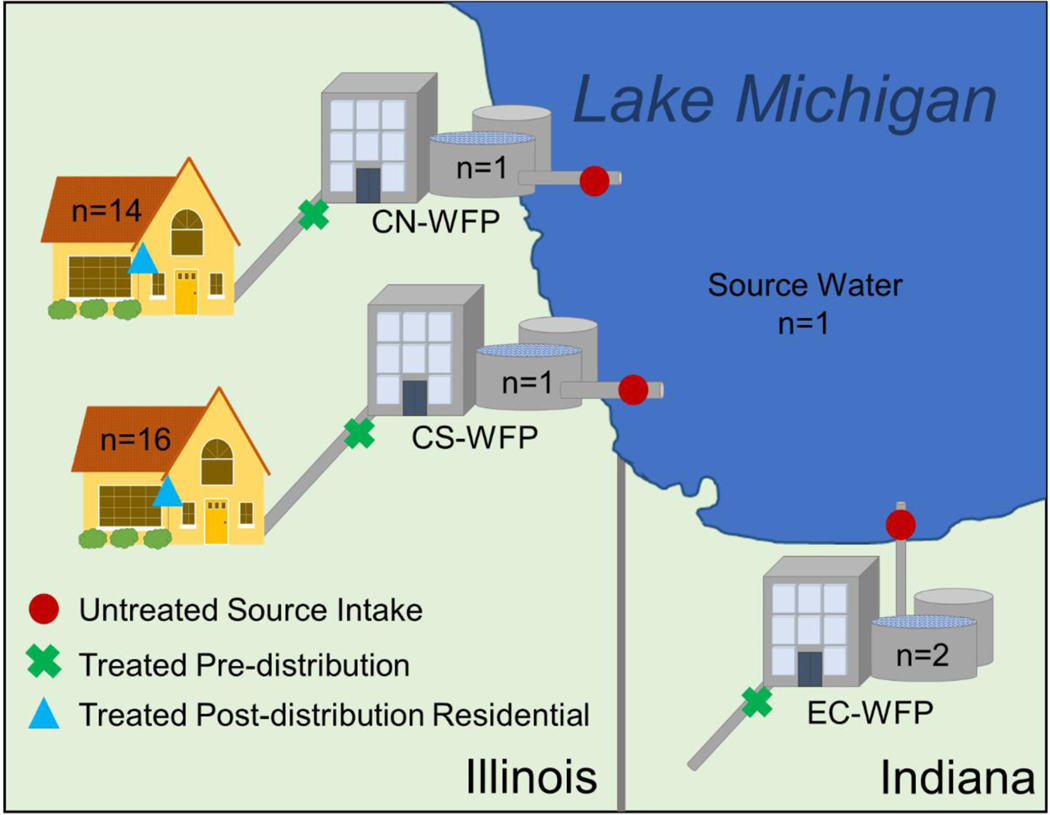
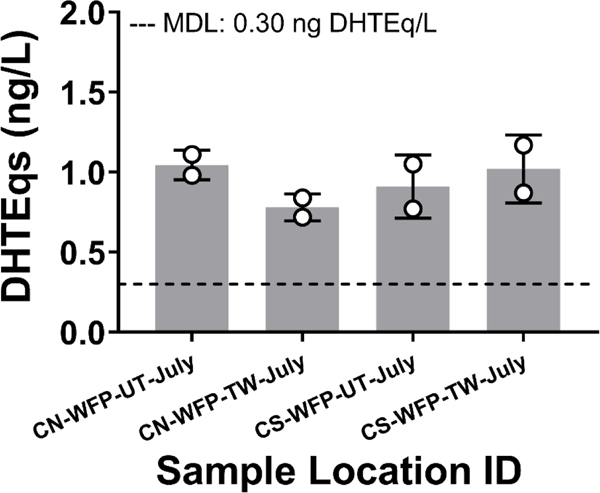
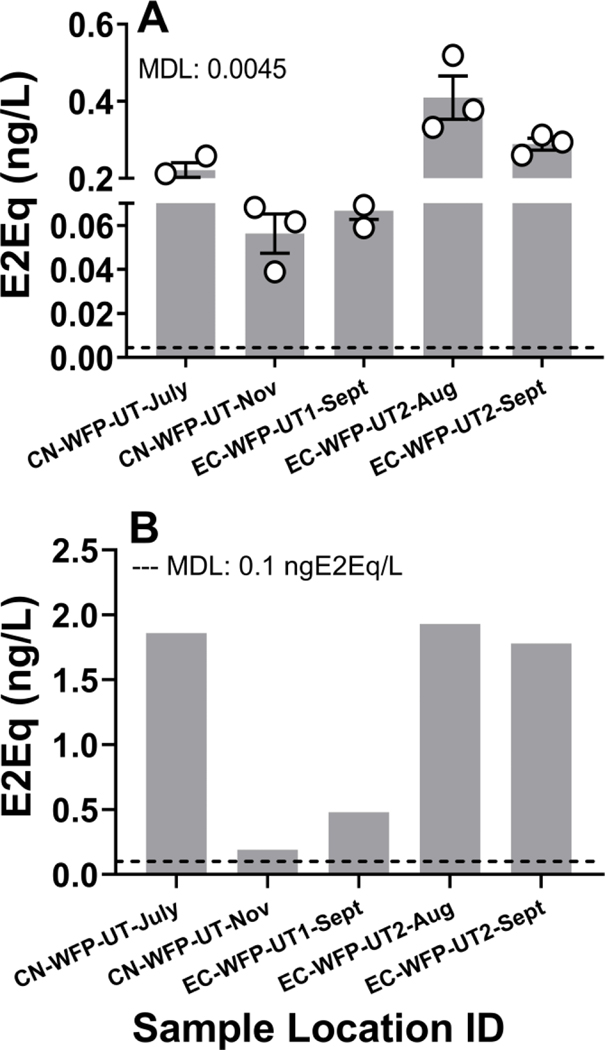
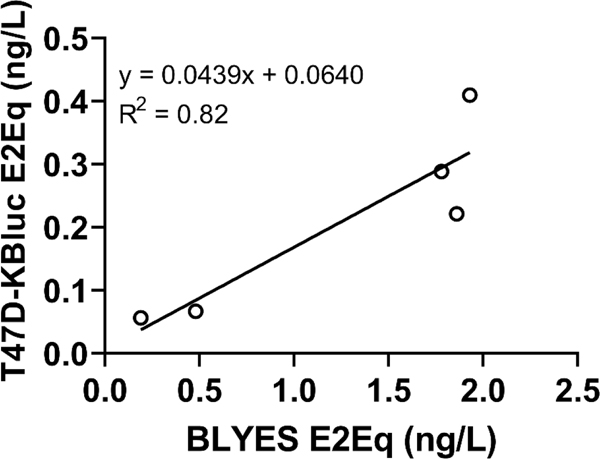
Recent urban public water supply contamination events emphasize the importance of screening treated drinking water quality after distribution. In vitro bioassays, when run concurrently with analytical chemistry methods, are effective tools to evaluating the efficacy of water treatment processes and water quality. We tested 49 water samples representing the Chicago Department of Water Management service areas for estrogen, (anti)androgen, glucocorticoid receptor-activating contaminants and cytotoxicity. We present a tiered screening approach suitable to samples with anticipated low-level activity and initially tested all extracts for statistically identifiable endocrine activity; performing a secondary dilution-response analysis to determine sample EC and biological equivalency values (BioEq). Estrogenic activity was detected in untreated Lake Michigan intake water samples using mammalian (5/49; median: 0.21 ng E2Eq/L) and yeast cell (5/49; 1.78 ng E2Eq/L) bioassays. A highly sensitive (anti)androgenic activity bioassay was applied for the first time to water quality screening and androgenic activity was detected in untreated intake and treated pre-distribution samples (4/49; 0.93 ng DHTEq/L). No activity was identified above method detection limits in the yeast androgenic, mammalian anti-androgenic, and both glucocorticoid bioassays. Known estrogen receptor agonists were detected using HPLC/MS-MS (estrone: 0.72-1.4 ng/L; 17α-estradiol: 1.3-1.5 ng/L; 17β-estradiol: 1.4 ng/L; equol: 8.8 ng/L), however occurrence did not correlate with estrogenic bioassay results. Many studies have applied bioassays to water quality monitoring using only relatively small samples sets often collected from surface and/or wastewater effluent. However, to realistically adapt these tools to treated water quality monitoring, water quality managers must have the capacity to screen potentially hundreds of samples in short timeframes. Therefore, we provided a tiered screening model that increased sample screening speed, without sacrificing statistical stringency, and detected estrogenic and androgenic activity only in pre-distribution Chicago area samples.
最近的城市公共供水污染事件强调了在分配后筛选处理饮用水水质的重要性。体外生物测定法与分析化学方法同时使用时,是评估水处理工艺和水质效果的有效工具。我们测试了代表芝加哥水务局服务区域的 49 个水样,以检测雌激素、(抗)雄激素、糖皮质激素受体激活污染物和细胞毒性。我们提出了一种分层筛选方法,适用于预计活性较低的样品,并最初测试了所有提取物中是否存在可识别的内分泌活性;进行二次稀释-反应分析,以确定样品的 EC 和生物等效值(BioEq)。使用哺乳动物(5/49;中位数:0.21ng E2Eq/L)和酵母细胞(5/49;1.78ng E2Eq/L)生物测定法在未经处理的密西根湖进水水样中检测到雌激素活性。首次将高度敏感的(抗)雄激素活性生物测定法应用于水质筛选,并在未经处理的进水和处理前分配样品中检测到雄激素活性(4/49;0.93ng DHTEq/L)。在酵母雄激素、哺乳动物抗雄激素和糖皮质激素生物测定法中,均未在方法检测限以上检测到活性。使用 HPLC/MS-MS 检测到已知的雌激素受体激动剂(雌酮:0.72-1.4ng/L;17α-雌二醇:1.3-1.5ng/L;17β-雌二醇:1.4ng/L;雌马酚:8.8ng/L),但发生情况与雌激素生物测定结果无关。许多研究已经应用生物测定法对水质监测进行了研究,仅使用相对较小的样本集,这些样本通常来自地表水和/或废水排放。然而,为了将这些工具实际应用于处理后水质监测,水质管理人员必须有能力在短时间内筛选潜在的数百个样本。因此,我们提供了一种分层筛选模型,在不牺牲统计严格性的情况下提高了样本筛选速度,并且仅在芝加哥地区的预分配样本中检测到雌激素和雄激素活性。