John Ann, Marchant Amanda, Demmler Joanne, Tan Jacinta, DelPozo-Banos Marcos
FFPH, Swansea University Medical School, Data Science Building, Swansea University, UK.
Swansea University Medical School, Data Science Building, Swansea University, UK.
BJPsych Open. 2021 Mar 19;7(2):e67. doi: 10.1192/bjo.2021.23.
Individuals with eating disorders who self-harm are a vulnerable group characterised by greater pathology and poorer outcomes.
To explore healthcare utilisation and mortality in those with a record of: self-harm only; eating disorders only; and both co-occurring.
We conducted a retrospective whole population e-cohort study of individuals aged 10-64 years from 2003 to 2016. Individuals were divided into: record of self-harm only; eating disorders only; both self-harm and eating disorders; and no record of self-harm or eating disorders. We used linked routinely collected healthcare data across primary care, emergency departments, hospital admissions and out-patient appointments to examine healthcare contacts and mortality.
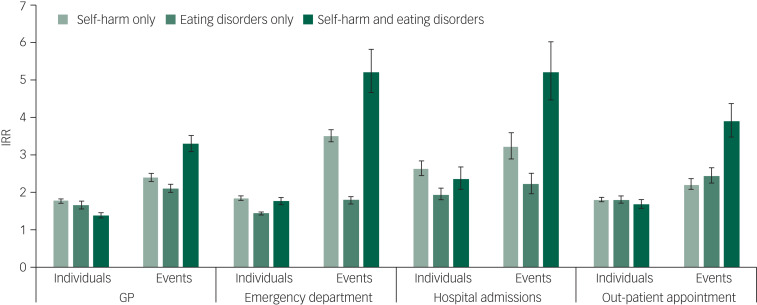
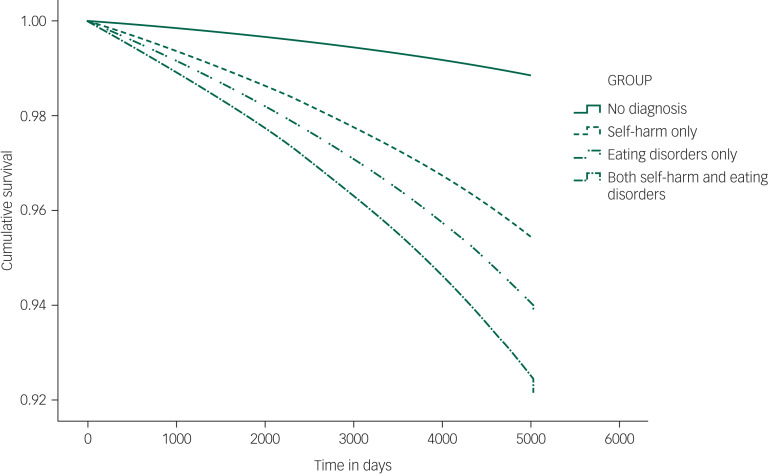
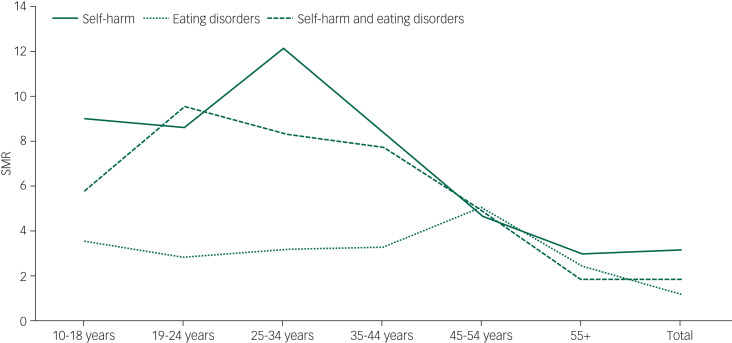
We identified 82 627 individuals: n = 75 165 with self-harm only; n = 5786 with eating disorders only; n = 1676 with both combined. Across all groups and settings significantly more individuals attended with significantly more contacts than the rest of the population. The combined group had the highest number of contacts per person (general practitioner, incident rate ratio IRR = 3.3, 95% CI 3.1-3.5; emergency department, IRR = 5.2, 95% CI 4.7-5.8; hospital admission, IRR = 5.2, 95% CI 4.5-6.0; out-patients, IRR = 3.9, 95% CI 3.5-4.4). Standardised mortality ratios showed the highest excess mortality overall in the self-harm only group (SMR = 3.2, 95% CI 3.1-3.3), particularly for unnatural causes of death (SMR = 17.1, 95% CI 16.3-17.9). SMRs and years of life lost showed an increased risk of mortality in younger age groups in the combined group. Adjusted hazard ratios showed increased mortality across all groups (self-harm only, HR = 5.3, 95% CI 5.2-5.5; eating disorders only, HR = 4.1, 95% CI 3.4-4.9; combined group, HR = 6.8, 95% CI 5.4-8.6).
Individuals in all groups had higher healthcare service utilisation than the general population. The increased mortality risk in young people with a record of both eating disorders and self-harm highlights the need for early specialist intervention and enhanced support.
患有饮食失调症且有自我伤害行为的个体是一个弱势群体,其特点是病情更严重且预后更差。
探讨仅有自我伤害记录、仅有饮食失调记录以及两者并存者的医疗服务利用情况和死亡率。
我们对2003年至2016年10至64岁的个体进行了一项回顾性全人群电子队列研究。个体被分为:仅有自我伤害记录;仅有饮食失调记录;既有自我伤害又有饮食失调记录;无自我伤害或饮食失调记录。我们使用了通过初级保健、急诊科、住院和门诊预约等常规收集的关联医疗数据来检查医疗接触情况和死亡率。
我们识别出82627名个体:n = 75165名仅有自我伤害记录;n = 5786名仅有饮食失调记录;n = 1676名两者并存。在所有组和所有情况下,与其他人群相比,显著更多的个体有显著更多的医疗接触。并存组每人的医疗接触次数最多(全科医生,发病率比值比IRR = 3.3,95%置信区间3.1 - 3.5;急诊科,IRR = 5.2,95%置信区间4.7 - 5.8;住院,IRR = 5.2,95%置信区间4.5 - 6.0;门诊,IRR = 3.9,95%置信区间3.5 - 4.4)。标准化死亡率显示,仅有自我伤害记录组总体超额死亡率最高(标准化死亡比SMR = 3.2,95%置信区间3.1 - 3.3),特别是非自然死亡原因(SMR = 17.1,95%置信区间16.3 - 17.9)。标准化死亡比和寿命损失年数显示,并存组中较年轻年龄组的死亡风险增加。调整后的风险比显示所有组的死亡率均增加(仅有自我伤害记录组,HR = 5.3,95%置信区间5.2 - 5.5;仅有饮食失调记录组,HR = 4.1,95%置信区间3.开,95%置信区间5.4 - 8.6)。
所有组的个体医疗服务利用率均高于普通人群。有饮食失调和自我伤害记录的年轻人死亡风险增加,这凸显了早期专科干预和强化支持的必要性。 4.9;并存组,HR = 6.8,95%置信区间5.—8.6)。
所有组的个体医疗服务利用率均高于普通人群。有饮食失调和自我伤害记录的年轻人死亡风险增加,这凸显了早期专科干预和强化支持的必要性。 4.9;并存组,HR = 6.8,95%置信区间5.—8.6)。
所有组的个体医疗服务利用率均高于普通人群。有饮食失调和自我伤害记录的年轻人死亡风险增加,这凸显了早期专科干预和强化支持的必要性。 4.9;并存组,HR = 6.8,95%置信区间5.—8.6)。
所有组的个体医疗服务利用率均高于普通人群。有饮食失调和自我伤害记录的年轻人死亡风险增加,这凸显了早期专科干预和强化支持的必要性。 4.9;并存组,HR = 6.8,95%置信区间5.—8.6)。
所有组的个体医疗服务利用率均高于普通人群。有饮食失调和自我伤害记录的年轻人死亡风险增加,这凸显了早期专科干预和强化支持的必要性。
译文中部分表述“开”为原文疑似错误,未做修改,保留原文内容。