Department of Rheumatology & Clinical Immunology, UMC Utrecht, Utrecht, The Netherlands
Department of Haematology, UMC Utrecht, Utrecht, the Netherlands.
BMJ Open. 2021 Mar 18;11(3):e044483. doi: 10.1136/bmjopen-2020-044483.
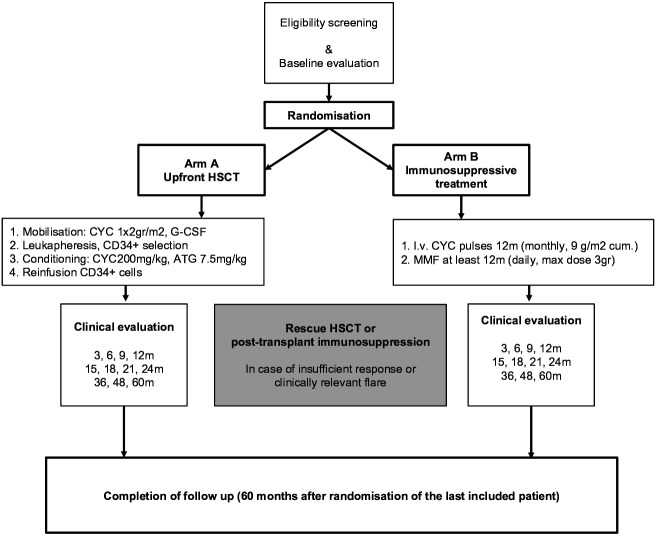
Systemic sclerosis (SSc) is a chronic, autoimmune connective tissue disease associated with high morbidity and mortality, especially in diffuse cutaneous SSc (dcSSc). Currently, there are several treatments available in early dcSSc that aim to change the disease course, including immunosuppressive agents and autologous haematopoietic stem cell transplantation (HSCT). HSCT has been adopted in international guidelines and is offered in current clinical care. However, optimal timing and patient selection for HSCT are still unclear. In particular, it is unclear whether HSCT should be positioned as upfront therapy or rescue treatment for patients refractory to immunosuppressive therapy. We hypothesise that upfront HSCT is superior and results in lower toxicity and lower long-term medical costs. Therefore, we propose this randomised trial aiming to determine the optimal treatment strategy for early dcSSc by comparing two strategies used in standard care: (1) upfront autologous HSCT versus (2) immunosuppressive therapy (intravenous cyclophosphamide pulse therapy followed by mycophenolate mofetil) with rescue HSCT in case of treatment failure.
The UPSIDE (front autologous hematopoietic tem cell transplantation vs mmunosuppressive medication in early iffus cutaneous systemic sclerosis) study is a multicentre, randomised, open-label, controlled trial. In total, 120 patients with early dcSSc will be randomised. The primary outcome is event-free survival at 2 years after randomisation. Secondary outcomes include serious adverse events, functional status and health-related quality of life. We will also evaluate changes in nailfold capillaroscopy pattern, pulmonary function, cardiac MR and high-resolution CT of the chest. Follow-up visits will be scheduled 3-monthly for 2 years and annually in the following 3 years.
The study was approved by the Dutch Central Committee on Research Concerning Human Subjects (NL72607.041.20). The results will be disseminated through patient associations and conventional scientific channels.
NCT04464434; NL 8720.
系统性硬化症(SSc)是一种慢性自身免疫性结缔组织疾病,发病率和死亡率都很高,尤其是弥漫性皮肤型 SSc(dcSSc)。目前,早期 dcSSc 有几种治疗方法,旨在改变疾病进程,包括免疫抑制剂和自体造血干细胞移植(HSCT)。HSCT 已被纳入国际指南,并在当前的临床治疗中提供。然而,HSCT 的最佳时机和患者选择仍不清楚。特别是,尚不清楚 HSCT 应该作为早期对免疫抑制剂治疗无反应的患者的一线治疗还是挽救性治疗。我们假设,早期 HSCT 更优,且毒性更低,长期医疗费用更低。因此,我们提出了这项随机试验,旨在通过比较标准治疗中两种策略来确定早期 dcSSc 的最佳治疗策略:(1)早期自体 HSCT 与(2)免疫抑制治疗(静脉环磷酰胺脉冲治疗后用吗替麦考酚酯),如果治疗失败则进行挽救性 HSCT。
UPSIDE(早期弥漫性皮肤系统性硬化症自体造血干细胞移植与免疫抑制药物治疗)研究是一项多中心、随机、开放标签、对照试验。总共将有 120 例早期 dcSSc 患者被随机分组。主要结局是随机分组后 2 年时无事件生存。次要结局包括严重不良事件、功能状态和健康相关生活质量。我们还将评估甲襞毛细血管镜模式、肺功能、心脏磁共振和胸部高分辨率 CT 的变化。随访安排为随机分组后 2 年内每 3 个月一次,随后 3 年内每年一次。
该研究得到了荷兰人体研究中央伦理委员会的批准(NL72607.041.20)。研究结果将通过患者协会和传统科学渠道进行传播。
NCT04464434;NL 8720.