School of Chemical Engineering Sungkyunkwan University Suwon Republic of Korea.
Department of Health Sciences and Technology SAIHST Sungkyunkwan University Suwon Republic of Korea.
J Extracell Vesicles. 2021 Mar;10(5):e12077. doi: 10.1002/jev2.12077. Epub 2021 Mar 12.
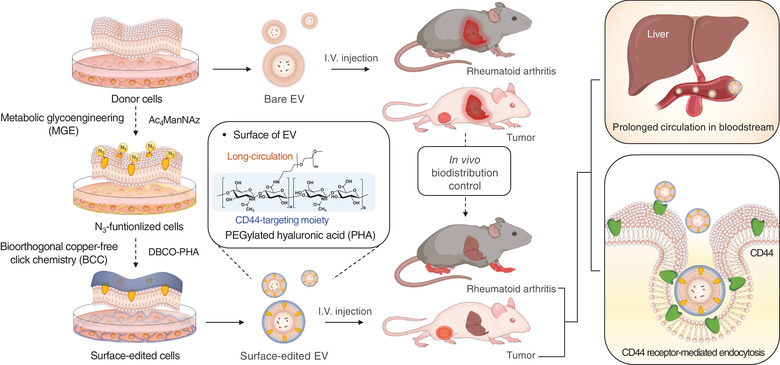
Extracellular vesicles (EVs) are essential mediators in intercellular communication that have emerged as natural therapeutic nanomedicines for the treatment of intractable diseases. Their therapeutic applications, however, have been limited by unpredictable in vivo biodistribution after systemic administration. To control the in vivo fate of EVs, their surfaces should be properly edited, depending on the target site of action. Herein, based on bioorthogonal copper-free click chemistry (BCC), surface-edited EVs were prepared by using metabolically glycoengineered cells. First, the exogenous azide group was generated on the cellular surface through metabolic glycoengineering (MGE) using the precursor. Next, PEGylated hyaluronic acid, capable of binding specifically to the CD44-expressing cells, was labelled as the representative targeting moiety onto the cell surface by BCC. The surface-edited EVs effectively accumulated into the target tissues of the animal models with rheumatoid arthritis and tumour, primarily owing to prolonged circulation in the bloodstream and the active targeting mechanism. Overall, these results suggest that BCC combined with MGE is highly useful as a simple and safe approach for the surface modification of EVs to modulate their in vivo fate.
细胞外囊泡 (EVs) 是细胞间通讯的重要介质,它们已成为治疗难治性疾病的天然治疗性纳米药物。然而,由于其在全身给药后体内生物分布不可预测,它们的治疗应用受到限制。为了控制 EVs 的体内命运,应根据作用靶点适当编辑其表面。在此,基于生物正交无铜点击化学 (BCC),使用代谢糖基化工程细胞制备了表面编辑的 EVs。首先,通过使用前体通过代谢糖基化工程 (MGE) 在细胞表面产生外源叠氮基团。接下来,通过 BCC 将能够特异性结合表达 CD44 的细胞的聚乙二醇化透明质酸标记为代表性靶向部分到细胞表面。表面编辑的 EVs 有效地积累到类风湿关节炎和肿瘤动物模型的靶组织中,主要是由于它们在血液中的循环时间延长和主动靶向机制。总之,这些结果表明,BCC 与 MGE 相结合,可作为一种简单、安全的 EV 表面修饰方法,用于调节其体内命运。