Institute of Molecular and Cell Biology, Agency for Science, Technology and Research, Singapore.
Genome Institute of Singapore, Agency for Science, Technology and Research, Singapore.
Hepatology. 2021 Sep;74(3):1395-1410. doi: 10.1002/hep.31812.
Recent development of multiple treatments for human hepatocellular carcinoma (HCC) has allowed for the selection of combination therapy to enhance the effectiveness of monotherapy. Optimal selection of therapies is based on both HCC and its microenvironment. Therefore, it is critical to develop and validate preclinical animal models for testing clinical therapeutic solutions.
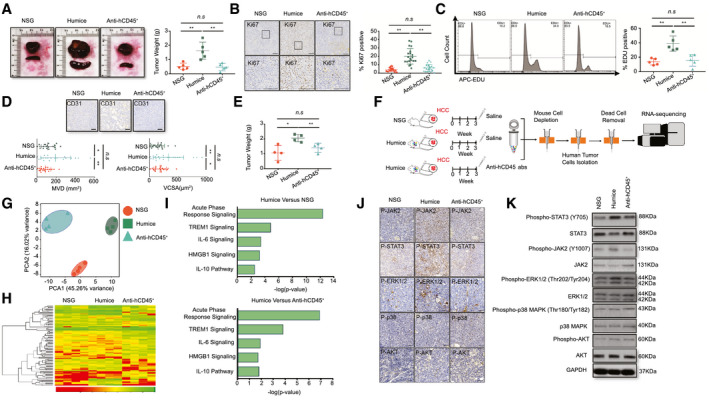
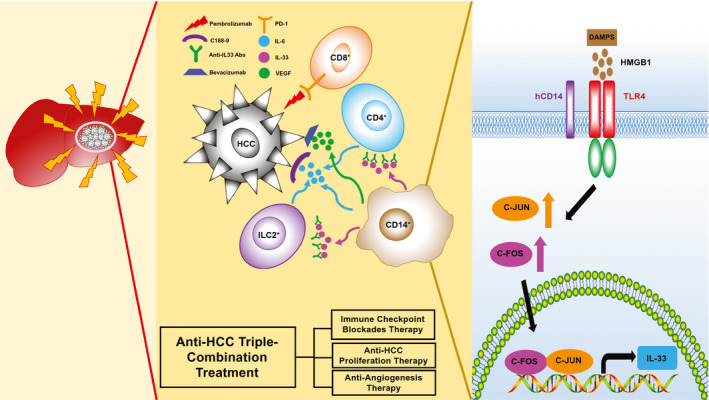
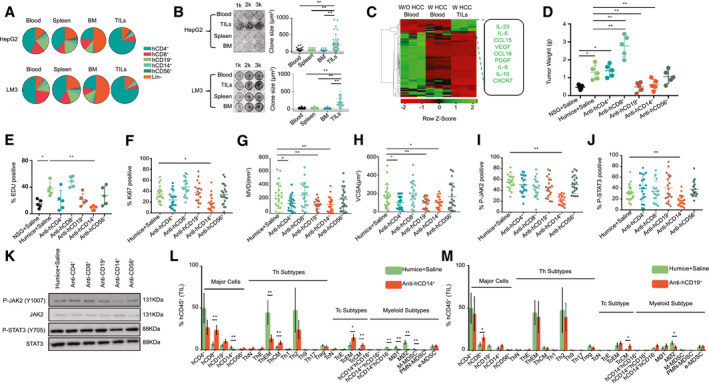
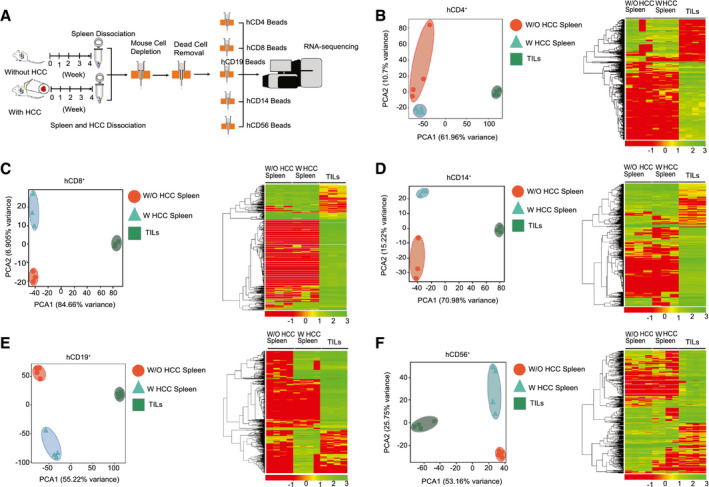
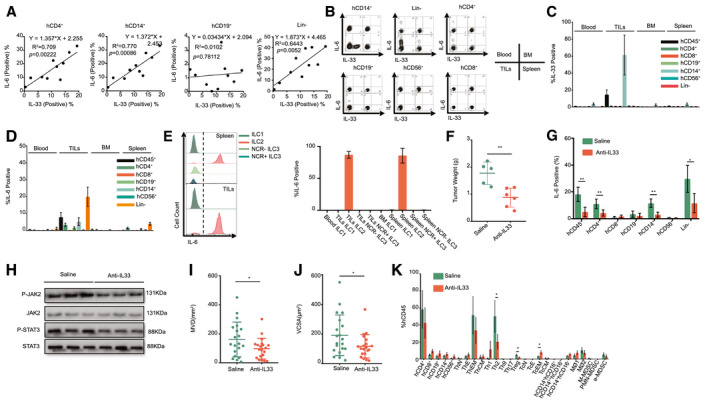
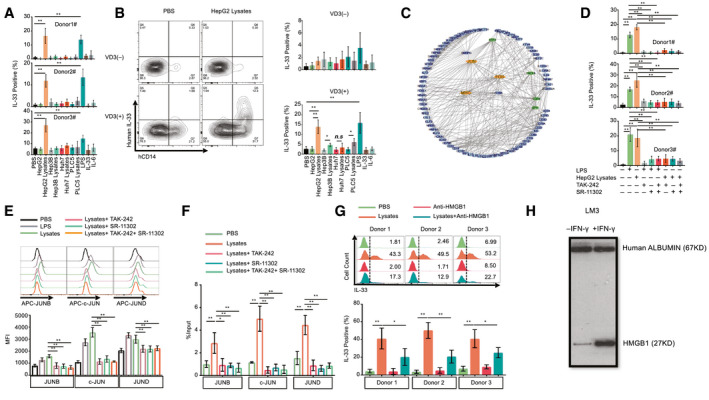
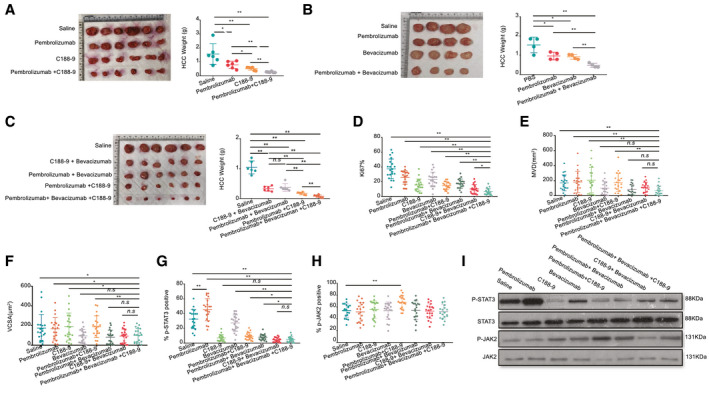
We established cell line-based or patient-derived xenograft-based humanized-immune-system mouse models with subcutaneous and orthotopic HCC. Mice were injected with human-specific antibodies (Abs) to deplete human immune cells. We analyzed the transcription profiles of HCC cells and human immune cells by using real-time PCR and RNA sequencing. The protein level of HCC tumor cells/tissues or human immune cells was determined by using flow cytometry, western blotting, and immunohistochemistry. The HCC tumor size was measured after single, dual-combination, and triple-combination treatment using N-(1',2-Dihydroxy-1,2'-binaphthalen-4'-yl)-4-methoxybenzenesulfonamide (C188-9), bevacizumab, and pembrolizumab. In this study, human immune cells in the tumor microenvironment were strongly selected and modulated by HCC, which promoted the activation of the IL-6/Janus kinase 2 (JAK2)/signal transducer and activator of transcription 3 (STAT3) signaling pathway in tumor cells and led to augmented HCC proliferation and angiogenesis by releasing angiogenic cytokines in humanized-immune-system mice with HCC. In particular, intratumor human cluster of differentiation-positive (hCD14 ) cells could produce IL-33 through damage-associated molecular pattern/Toll-like receptor 4/activator protein 1, which up-regulated IL-6 in other intratumor immune cells and activated the JAK2/STAT3 pathway in HCC. Specific knockdown of the CD14 gene in human monocytes could impair IL-33 production induced by cell lysates. Subsequently, we evaluated the in vivo anti-HCC effect of C188-9, bevacizumab, and pembrolizumab. The results showed that the anti-HCC effect of triple-combination therapy was superior to that of single or dual treatments.
Humanized-immune-system HCC mouse models are suitable for identifying targets from cancer and immune components and for testing combinational therapies.
近年来,针对人肝癌(HCC)的多种治疗方法的发展,使得人们可以选择联合治疗以增强单药治疗的效果。HCC 及其微环境的最佳治疗选择是基于这两个因素的。因此,开发和验证用于测试临床治疗方案的临床前动物模型至关重要。
我们建立了基于细胞系或患者来源的异种移植的人源化免疫系统小鼠模型,具有皮下和原位 HCC。用针对人特异性抗体(Abs)的注射来耗尽人免疫细胞。我们通过实时 PCR 和 RNA 测序分析 HCC 细胞和人免疫细胞的转录谱。使用流式细胞术、western blot 和免疫组织化学测定 HCC 肿瘤细胞/组织或人免疫细胞的蛋白水平。在使用 N-(1',2-二羟基-1,2'-联萘-4'-基)-4-甲氧基苯磺酰胺(C188-9)、贝伐珠单抗和 pembrolizumab 进行单药、双药和三药治疗后,测量 HCC 肿瘤大小。在这项研究中,肿瘤微环境中的人免疫细胞受到 HCC 的强烈选择和调节,这促进了肿瘤细胞中 IL-6/Janus 激酶 2(JAK2)/信号转导和转录激活因子 3(STAT3)信号通路的激活,并通过释放血管生成细胞因子在具有 HCC 的人源化免疫系统小鼠中增强 HCC 的增殖和血管生成。特别是,肿瘤内 CD14 阳性(hCD14)细胞可以通过损伤相关分子模式/Toll 样受体 4/激活蛋白 1 产生 IL-33,这上调了肿瘤内其他免疫细胞中的 IL-6,并激活了 HCC 中的 JAK2/STAT3 通路。在人单核细胞中特异性敲低 CD14 基因可破坏细胞裂解物诱导的 IL-33 产生。随后,我们评估了 C188-9、贝伐珠单抗和 pembrolizumab 的体内抗 HCC 效果。结果表明,三联治疗的抗 HCC 效果优于单药或双药治疗。
人源化免疫系统 HCC 小鼠模型适合从癌症和免疫成分中鉴定靶点,并测试联合治疗。