Department of Non-Communicable Diseases and Mental Health, Pan American Health Organization, Washington, DC, USA.
Center for Global Health, Centers for Disease Control and Prevention, Atlanta, GA, USA.
J Clin Hypertens (Greenwich). 2021 Apr;23(4):755-765. doi: 10.1111/jch.14157. Epub 2021 Mar 18.
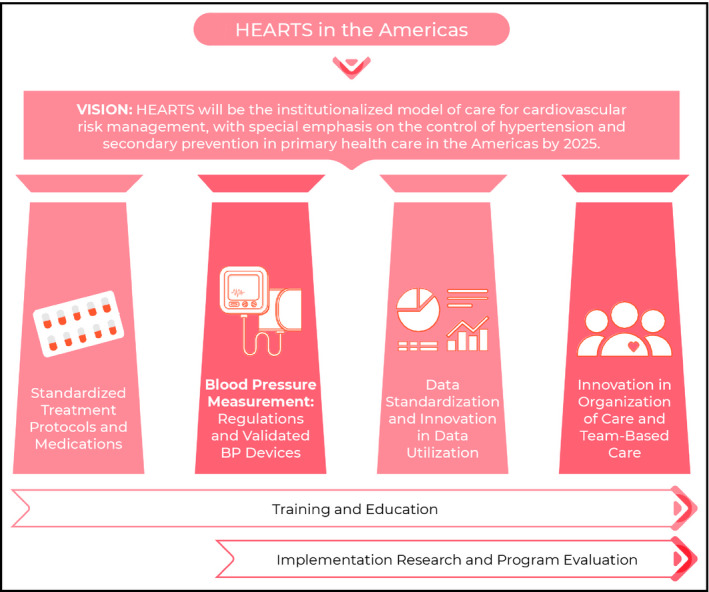
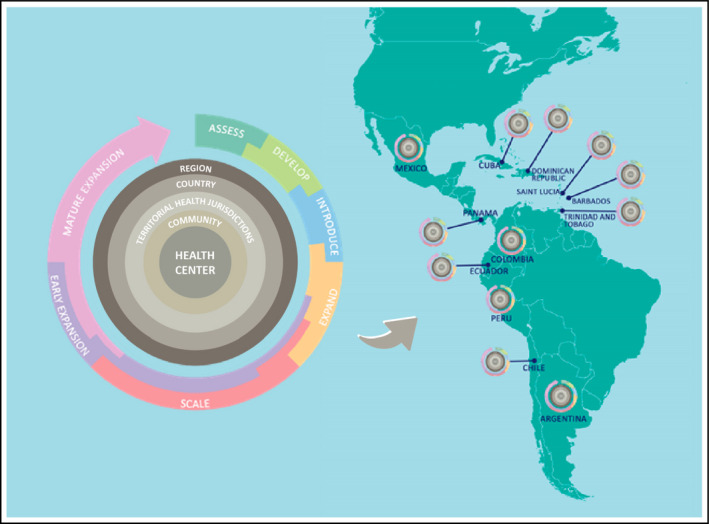
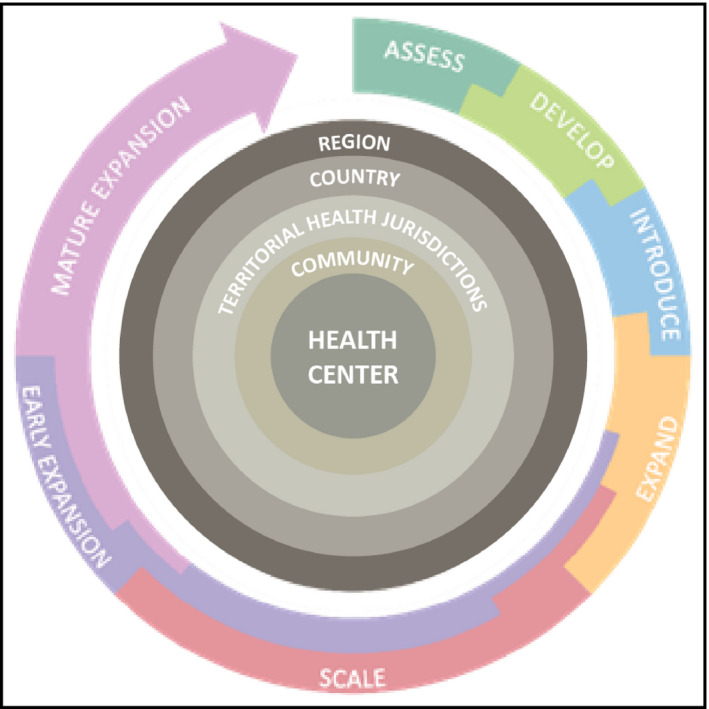
The World Health Organization (WHO) Global Hearts Initiative offers technical packages to reduce the burden of cardiovascular diseases through population-wide and targeted health services interventions. The Pan American Health Organization (PAHO) has led implementation of the HEARTS in the Americas Initiative since 2016. The authors mapped the developmental stages, barriers, and facilitators to implementation among the 371 primary health care centers in the participating 12 countries. The authors used the qualitative method of document review to examine cumulative country reports, technical meeting notes, and reports to regional stakeholders. Common implementation barriers include segmentation of health systems, overcoming health care professionals' scope of practice legal restrictions, and lack of health information systems limiting operational evaluation and quality improvement mechanisms. Main implementation facilitators include political support from ministries of health and leading scientific societies, PAHO's role as a regional catalyst to implementation, stakeholder endorsement demonstrated by incorporating HEARTS into official documents, and having a health system oriented to primary health care. Key lessons include the need for political commitment and cultivating on-the-ground leadership to initiate a shift in hypertension care delivery, accompanied by specific progress in the development of standardized treatment protocols and a set of high-quality medicines. By systematizing an implementation strategy to ease integration of interventions into delivery processes, the program strengthened technical leadership and ensured sustainability. These study findings will aid the regional approach by providing a staged planning model that incorporates lessons learned. A systematic approach to implementation will enhance equity, efficiency, scale-up, and sustainability, and ultimately improve population hypertension control.
世界卫生组织(世卫组织)全球心脏倡议提供技术方案,通过广泛的人口健康服务干预和有针对性的健康服务干预措施来减轻心血管疾病负担。泛美卫生组织(泛美卫生组织)自 2016 年以来一直领导在美洲实施“心脏行动”倡议。作者绘制了参与的 12 个国家的 371 个初级保健中心在实施过程中的发展阶段、障碍和促进因素。作者使用文件审查的定性方法来审查累积的国家报告、技术会议记录和向区域利益攸关方的报告。常见的实施障碍包括卫生系统的分割、克服医疗保健专业人员执业范围的法律限制以及缺乏卫生信息系统,限制了业务评估和质量改进机制。主要的实施促进因素包括来自卫生部和主要科学协会的政治支持、泛美卫生组织作为实施区域催化剂的作用、利益攸关方的认可,即通过将“心脏行动”纳入正式文件,以及建立以初级卫生保健为导向的卫生系统。关键经验包括需要政治承诺和培养实地领导,以启动高血压护理提供方式的转变,同时在制定标准化治疗方案和一整套高质量药物方面取得具体进展。通过系统地实施一项实施战略,使干预措施更容易融入提供过程,该方案加强了技术领导并确保了可持续性。这些研究结果将通过提供一个包含经验教训的分阶段规划模型,为区域方法提供帮助。实施的系统方法将提高公平性、效率、扩大规模和可持续性,并最终改善人口高血压控制。