• 文献检索
  • 文档翻译
  • 深度研究
  • 学术资讯
  • Suppr Zotero 插件Zotero 插件
  • 邀请有礼
  • 套餐&价格
  • 历史记录
应用&插件
Suppr Zotero 插件Zotero 插件浏览器插件Mac 客户端Windows 客户端微信小程序
定价
高级版会员购买积分包购买API积分包
服务
文献检索文档翻译深度研究API 文档MCP 服务
关于我们
关于 Suppr公司介绍联系我们用户协议隐私条款
关注我们

Suppr 超能文献

核心技术专利:CN118964589B侵权必究
粤ICP备2023148730 号-1Suppr @ 2026

文献检索

告别复杂PubMed语法,用中文像聊天一样搜索,搜遍4000万医学文献。AI智能推荐,让科研检索更轻松。

立即免费搜索

文件翻译

保留排版,准确专业,支持PDF/Word/PPT等文件格式,支持 12+语言互译。

免费翻译文档

深度研究

AI帮你快速写综述,25分钟生成高质量综述,智能提取关键信息,辅助科研写作。

立即免费体验

机器人辅助训练对脑卒中患者平衡功能的影响:系统评价和荟萃分析。

Effects of robot-assisted training on balance function in patients with stroke: A systematic review and meta-analysis.

机构信息

Rehabilitation Medicine, The First Affiliated Hospital of Nanjing Medical University, Nanjing, China.

出版信息

J Rehabil Med. 2021 Apr 1;53(4):jrm00174. doi: 10.2340/16501977-2815.

DOI:10.2340/16501977-2815
PMID:33739436
原文链接:https://pmc.ncbi.nlm.nih.gov/articles/PMC8814888/
Abstract

OBJECTIVE

To investigate the effectiveness of robot-assisted therapy on balance function in stroke survivors.

DATA SOURCES

PubMed, the Cochrane Library, Embase and China National Knowledge Infrastructure databases were searched systematically for relevant studies.

STUDY SELECTION

Randomized controlled trials reporting robot-assisted therapy on balance function in patients after stroke were included.

DATA EXTRACTION

Information on study characteristics, demographics, interventions strategies and outcome measures were extracted by 2 reviewers.

DATA SYNTHESIS

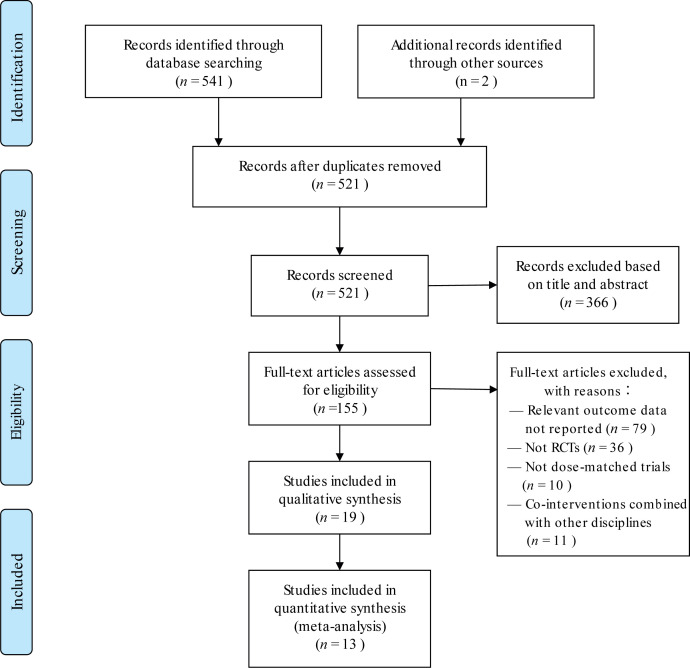
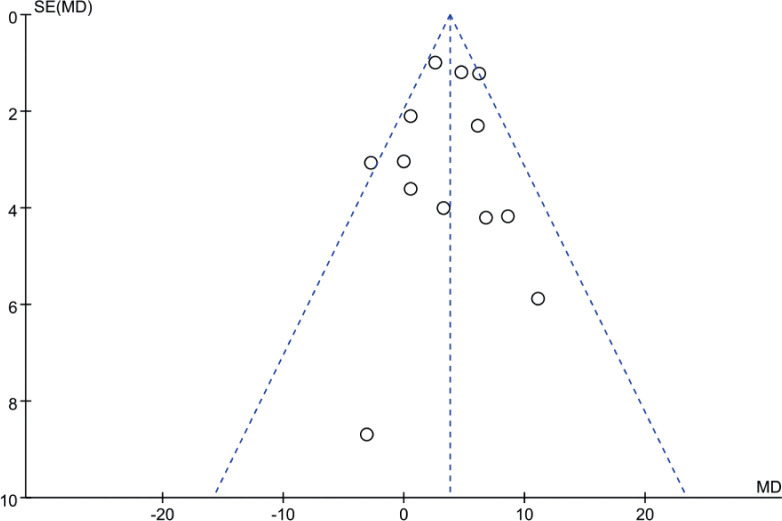
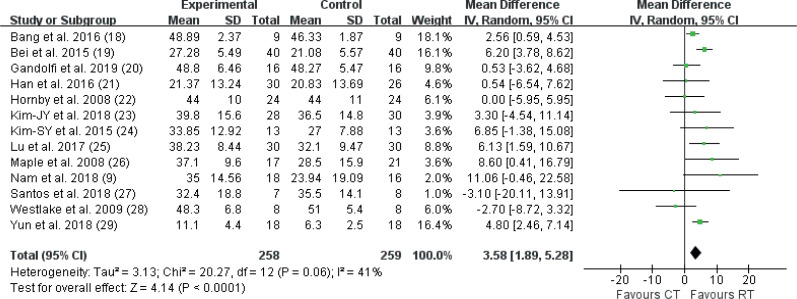
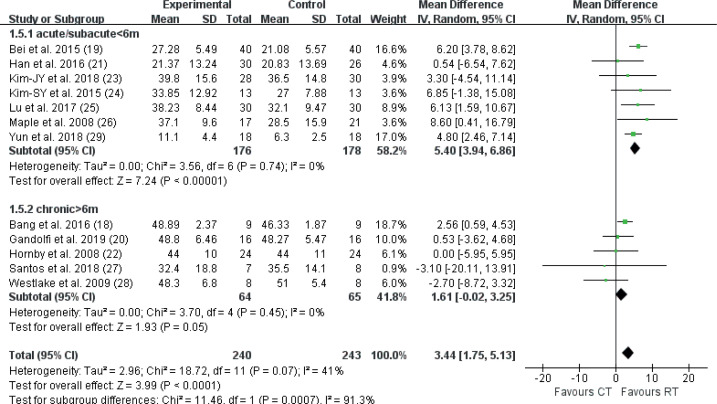
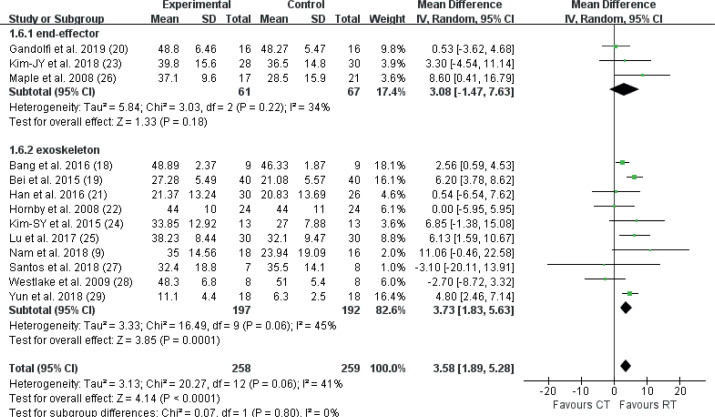
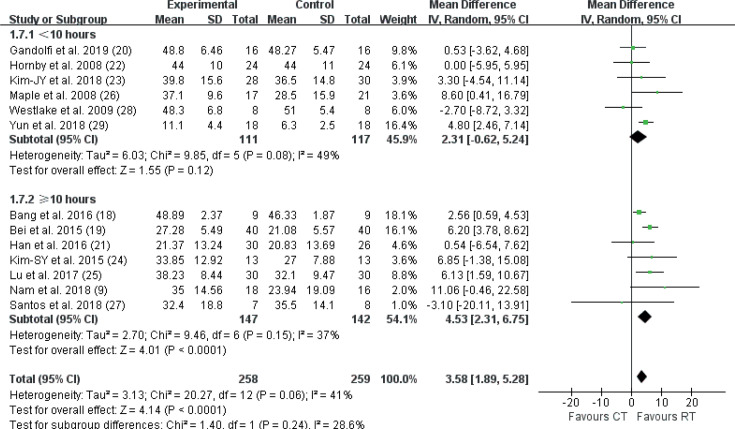
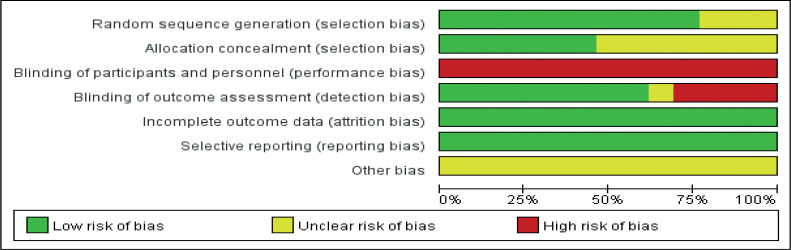
A total of 19 randomized trials fulfilled the inclusion criteria and 13 out of 19 were included in the meta-analysis. Analysis revealed that robot-assisted therapy significantly improved balance function assessed by berg balance scale (weighted mean difference (WMD) 3.58, 95% confidence interval (95% CI) 1.89-5.28, p < 0.001) compared with conventional therapy. Secondary analysis indicated that there was a significant difference in balance recovery between the conventional therapy and robot-assisted therapy groups in the acute/subacute stages of stroke (WMD 5.40, 95% CI 3.94-6.86, p < 0.001), while it was not significant in the chronic stages. With exoskeleton devices, the balance recovery in robot-assisted therapy groups was significantly better than in the conventional therapy groups (WMD 3.73, 95% CI 1.83-5.63, p < 0.001). Analysis further revealed that a total training time of more than 10 h can significantly improve balance function (WMD 4.53, 95% CI 2.31-6.75, p < 0.001). No publication bias or small study effects were observed according to the Cochrane Collaboration tool.

CONCLUSION

These results suggest that robot-assisted therapy is an effective intervention for improving balance function in stroke survivors.

摘要

目的

研究机器人辅助疗法对脑卒中幸存者平衡功能的疗效。

资料来源

系统检索 PubMed、Cochrane 图书馆、Embase 和中国知网数据库中有关脑卒中后患者应用机器人辅助疗法改善平衡功能的相关研究。

研究选择

纳入采用机器人辅助疗法治疗脑卒中后患者平衡功能的随机对照试验。

资料提取

由 2 位评价员提取研究特征、人口统计学、干预策略和结局测量指标等信息。

资料综合

共有 19 项随机试验符合纳入标准,其中 13 项纳入 meta 分析。分析结果显示,与常规疗法相比,机器人辅助疗法可显著改善平衡功能(Berg 平衡量表评分:加权均数差 3.58,95%置信区间 1.89-5.28,P<0.001)。进一步亚组分析显示,在脑卒中的急性期/亚急性期,常规疗法与机器人辅助疗法组间的平衡恢复差异有统计学意义(WMD 5.40,95% CI 3.94-6.86,P<0.001),而在慢性期差异无统计学意义。对于外骨骼设备,机器人辅助疗法组的平衡恢复明显优于常规疗法组(WMD 3.73,95% CI 1.83-5.63,P<0.001)。分析还显示,总训练时间超过 10 h 可显著改善平衡功能(WMD 4.53,95% CI 2.31-6.75,P<0.001)。根据 Cochrane 协作网工具,未发现发表偏倚或小样本研究效应。

结论

这些结果表明,机器人辅助疗法是改善脑卒中幸存者平衡功能的有效干预措施。
https://cdn.ncbi.nlm.nih.gov/pmc/blobs/f902/8814888/e07f362f1c37/JRM-53-4-2773-g008.jpg
https://cdn.ncbi.nlm.nih.gov/pmc/blobs/f902/8814888/ac7797aaf1bb/JRM-53-4-2773-g001.jpg
https://cdn.ncbi.nlm.nih.gov/pmc/blobs/f902/8814888/51e4470a036e/JRM-53-4-2773-g002.jpg
https://cdn.ncbi.nlm.nih.gov/pmc/blobs/f902/8814888/6f0576571dfb/JRM-53-4-2773-g003.jpg
https://cdn.ncbi.nlm.nih.gov/pmc/blobs/f902/8814888/fd40db27fe28/JRM-53-4-2773-g004.jpg
https://cdn.ncbi.nlm.nih.gov/pmc/blobs/f902/8814888/db6f19141a98/JRM-53-4-2773-g005.jpg
https://cdn.ncbi.nlm.nih.gov/pmc/blobs/f902/8814888/a4b86fede2e2/JRM-53-4-2773-g006.jpg
https://cdn.ncbi.nlm.nih.gov/pmc/blobs/f902/8814888/14530ecf5098/JRM-53-4-2773-g007.jpg
https://cdn.ncbi.nlm.nih.gov/pmc/blobs/f902/8814888/e07f362f1c37/JRM-53-4-2773-g008.jpg
https://cdn.ncbi.nlm.nih.gov/pmc/blobs/f902/8814888/ac7797aaf1bb/JRM-53-4-2773-g001.jpg
https://cdn.ncbi.nlm.nih.gov/pmc/blobs/f902/8814888/51e4470a036e/JRM-53-4-2773-g002.jpg
https://cdn.ncbi.nlm.nih.gov/pmc/blobs/f902/8814888/6f0576571dfb/JRM-53-4-2773-g003.jpg
https://cdn.ncbi.nlm.nih.gov/pmc/blobs/f902/8814888/fd40db27fe28/JRM-53-4-2773-g004.jpg
https://cdn.ncbi.nlm.nih.gov/pmc/blobs/f902/8814888/db6f19141a98/JRM-53-4-2773-g005.jpg
https://cdn.ncbi.nlm.nih.gov/pmc/blobs/f902/8814888/a4b86fede2e2/JRM-53-4-2773-g006.jpg
https://cdn.ncbi.nlm.nih.gov/pmc/blobs/f902/8814888/14530ecf5098/JRM-53-4-2773-g007.jpg
https://cdn.ncbi.nlm.nih.gov/pmc/blobs/f902/8814888/e07f362f1c37/JRM-53-4-2773-g008.jpg

相似文献

1
Effects of robot-assisted training on balance function in patients with stroke: A systematic review and meta-analysis.机器人辅助训练对脑卒中患者平衡功能的影响:系统评价和荟萃分析。
J Rehabil Med. 2021 Apr 1;53(4):jrm00174. doi: 10.2340/16501977-2815.
2
Robot-assisted therapy for balance function rehabilitation after stroke: A systematic review and meta-analysis.机器人辅助治疗脑卒中后平衡功能康复:系统评价和荟萃分析。
Int J Nurs Stud. 2019 Jul;95:7-18. doi: 10.1016/j.ijnurstu.2019.03.015. Epub 2019 Mar 28.
3
Efficacy of Robot-Assisted and Virtual Reality Interventions on Balance, Gait, and Daily Function in Patients With Stroke: A Systematic Review and Network Meta-analysis.机器人辅助和虚拟现实干预对脑卒中患者平衡、步态和日常功能的疗效:系统评价和网络荟萃分析。
Arch Phys Med Rehabil. 2023 Oct;104(10):1711-1719. doi: 10.1016/j.apmr.2023.04.005. Epub 2023 Apr 28.
4
Effect of exoskeleton robot-assisted training on gait function in chronic stroke survivors: a systematic review of randomised controlled trials.外骨骼机器人辅助训练对慢性脑卒中幸存者步态功能的影响:随机对照试验的系统评价。
BMJ Open. 2023 Sep 14;13(9):e074481. doi: 10.1136/bmjopen-2023-074481.
5
Robot-Assisted Therapy for Upper Extremity Motor Impairment After Stroke: A Systematic Review and Meta-Analysis.机器人辅助治疗脑卒中后上肢运动障碍:系统评价和荟萃分析。
Phys Ther. 2021 Apr 4;101(4). doi: 10.1093/ptj/pzab010.
6
Effects of robotic gait training after stroke: A meta-analysis.脑卒中后机器人步态训练的效果:一项荟萃分析。
Ann Phys Rehabil Med. 2020 Nov;63(6):518-534. doi: 10.1016/j.rehab.2020.02.008. Epub 2020 Mar 27.
7
Electromechanical and robot-assisted arm training for improving generic activities of daily living, arm function, and arm muscle strength after stroke.机电和机器人辅助手臂训练对改善中风后日常生活中的一般活动、手臂功能及手臂肌肉力量的作用
Cochrane Database Syst Rev. 2012 Jun 13(6):CD006876. doi: 10.1002/14651858.CD006876.pub3.
8
Electromechanical and robot-assisted arm training for improving arm function and activities of daily living after stroke.用于改善中风后手臂功能和日常生活活动的机电和机器人辅助手臂训练。
Cochrane Database Syst Rev. 2008 Oct 8(4):CD006876. doi: 10.1002/14651858.CD006876.pub2.
9
High Intensity Exercise for Walking Competency in Individuals with Stroke: A Systematic Review and Meta-Analysis.高强度运动对脑卒中患者步行能力的影响:系统评价和荟萃分析。
J Stroke Cerebrovasc Dis. 2019 Dec;28(12):104414. doi: 10.1016/j.jstrokecerebrovasdis.2019.104414. Epub 2019 Sep 27.
10
Robot-assisted gait training for balance and lower extremity function in patients with infratentorial stroke: a single-blinded randomized controlled trial.机器人辅助步态训练对幕下卒中患者平衡和下肢功能的影响:一项单盲随机对照试验。
J Neuroeng Rehabil. 2019 Jul 29;16(1):99. doi: 10.1186/s12984-019-0553-5.

引用本文的文献

1
Effectiveness of Robotic Devices for Medical Rehabilitation: An Umbrella Review.用于医学康复的机器人设备的有效性:一项系统综述。
J Clin Med. 2024 Nov 4;13(21):6616. doi: 10.3390/jcm13216616.
2
Efficacy and safety of using a unilateral lower limb exoskeleton combined with conventional treatment in post-stroke rehabilitation: a randomized controlled trial.在中风后康复中使用单侧下肢外骨骼结合传统治疗的疗效和安全性:一项随机对照试验。
Front Bioeng Biotechnol. 2024 Sep 18;12:1441986. doi: 10.3389/fbioe.2024.1441986. eCollection 2024.
3
Effect and optimal exercise prescription of robot-assisted gait training on lower extremity motor function in stroke patients: a network meta-analysis.

本文引用的文献

1
Enhancing Brain Plasticity to Promote Stroke Recovery.增强脑可塑性以促进中风恢复。
Front Neurol. 2020 Oct 30;11:554089. doi: 10.3389/fneur.2020.554089. eCollection 2020.
2
Robot-Assisted Stair Climbing Training on Postural Control and Sensory Integration Processes in Chronic Post-stroke Patients: A Randomized Controlled Clinical Trial.机器人辅助的慢性中风后患者姿势控制和感觉统合过程的爬楼梯训练:一项随机对照临床试验
Front Neurosci. 2019 Oct 24;13:1143. doi: 10.3389/fnins.2019.01143. eCollection 2019.
3
Robot-assisted gait training for balance and lower extremity function in patients with infratentorial stroke: a single-blinded randomized controlled trial.
机器人辅助步态训练对脑卒中患者下肢运动功能的影响及最佳运动处方:一项网状Meta分析
Neurol Sci. 2025 Mar;46(3):1151-1167. doi: 10.1007/s10072-024-07780-6. Epub 2024 Sep 23.
4
Efficacy of robot-assisted gait training on lower extremity function in subacute stroke patients: a systematic review and meta-analysis.机器人辅助步态训练对亚急性期脑卒中患者下肢功能的疗效:系统评价和荟萃分析。
J Neuroeng Rehabil. 2024 Sep 19;21(1):165. doi: 10.1186/s12984-024-01463-1.
5
The Effectiveness of Overground Robot Exoskeleton Gait Training on Gait Outcomes, Balance, and Motor Function in Patients with Stroke: A Systematic Review and Meta-Analysis of Randomized Controlled Trials.地面机器人外骨骼步态训练对中风患者步态结果、平衡和运动功能的有效性:随机对照试验的系统评价和荟萃分析
Brain Sci. 2024 Aug 19;14(8):834. doi: 10.3390/brainsci14080834.
6
Effect of robotic exoskeleton training on lower limb function, activity and participation in stroke patients: a systematic review and meta-analysis of randomized controlled trials.机器人外骨骼训练对脑卒中患者下肢功能、活动及参与度的影响:一项随机对照试验的系统评价与荟萃分析
Front Neurol. 2024 Aug 13;15:1453781. doi: 10.3389/fneur.2024.1453781. eCollection 2024.
7
Exoskeleton rehabilitation robot training for balance and lower limb function in sub-acute stroke patients: a pilot, randomized controlled trial.外骨骼康复机器人训练对亚急性期脑卒中患者平衡和下肢功能的影响:一项先导、随机对照试验。
J Neuroeng Rehabil. 2024 Jun 8;21(1):98. doi: 10.1186/s12984-024-01391-0.
8
The Effect of Robot-Assisted Training on Arm Function, Walking, Balance, and Activities of Daily Living After Stroke: A Systematic Review and Meta-Analysis.机器人辅助训练对中风后上肢功能、步行、平衡及日常生活活动的影响:一项系统评价与荟萃分析
Brain Neurorehabil. 2023 Sep 20;16(3):e24. doi: 10.12786/bn.2023.16.e24. eCollection 2023 Nov.
9
The effect of balance and gait training on specific balance abilities of survivors with stroke: a systematic review and network meta-analysis.平衡和步态训练对中风幸存者特定平衡能力的影响:一项系统评价和网状Meta分析
Front Neurol. 2023 Nov 2;14:1234017. doi: 10.3389/fneur.2023.1234017. eCollection 2023.
10
Effect of exoskeleton robot-assisted training on gait function in chronic stroke survivors: a systematic review of randomised controlled trials.外骨骼机器人辅助训练对慢性脑卒中幸存者步态功能的影响:随机对照试验的系统评价。
BMJ Open. 2023 Sep 14;13(9):e074481. doi: 10.1136/bmjopen-2023-074481.
机器人辅助步态训练对幕下卒中患者平衡和下肢功能的影响:一项单盲随机对照试验。
J Neuroeng Rehabil. 2019 Jul 29;16(1):99. doi: 10.1186/s12984-019-0553-5.
4
Global, regional, and national burden of stroke, 1990-2016: a systematic analysis for the Global Burden of Disease Study 2016.全球、区域和国家卒中负担,1990-2016 年:2016 年全球疾病负担研究的系统分析。
Lancet Neurol. 2019 May;18(5):439-458. doi: 10.1016/S1474-4422(19)30034-1. Epub 2019 Mar 11.
5
Feasibility and effectiveness of repetitive gait training early after stroke: A systematic review and meta-analysis.脑卒中后早期重复步态训练的可行性和有效性:系统评价和荟萃分析。
J Rehabil Med. 2019 Feb 1;51(2):78-88. doi: 10.2340/16501977-2505.
6
Robot-assisted gait training effectively improved lateropulsion in subacute stroke patients: a single-blinded randomized controlled trial.机器人辅助步态训练有效改善亚急性期脑卒中患者的侧方推动问题:一项单盲随机对照试验。
Eur J Phys Rehabil Med. 2018 Dec;54(6):827-836. doi: 10.23736/S1973-9087.18.05077-3. Epub 2018 Dec 3.
7
Effects of robot-(Morning Walk) assisted gait training for patients after stroke: a randomized controlled trial.机器人-(晨练)辅助步态训练对脑卒中后患者的影响:一项随机对照试验。
Clin Rehabil. 2019 Mar;33(3):516-523. doi: 10.1177/0269215518806563. Epub 2018 Oct 16.
8
Effects of Electromechanical Exoskeleton-Assisted Gait Training on Walking Ability of Stroke Patients: A Randomized Controlled Trial.电动助力外骨骼步态训练对脑卒中患者步行能力的影响:一项随机对照试验。
Arch Phys Med Rehabil. 2019 Jan;100(1):26-31. doi: 10.1016/j.apmr.2018.06.020. Epub 2018 Jul 25.
9
Effectiveness of robot therapy on body function and structure in people with limited upper limb function: A systematic review and meta-analysis.机器人疗法对上肢功能有限人群的身体功能和结构的有效性:系统评价和荟萃分析。
PLoS One. 2018 Jul 12;13(7):e0200330. doi: 10.1371/journal.pone.0200330. eCollection 2018.
10
Feasibility of a smartphone-based balance assessment system for subjects with chronic stroke.基于智能手机的慢性脑卒中患者平衡评估系统的可行性。
Comput Methods Programs Biomed. 2018 Jul;161:191-195. doi: 10.1016/j.cmpb.2018.04.027. Epub 2018 Apr 28.