Department of Plastic Surgery, Helsinki University Hospital and University of Helsinki, HUS, Helsinki, Finland.
Tampere University Hospital, Department of Orthopaedics and Traumatology, Unit of Musculoskeletal Surgery, Tampere, Finland.
Ann Surg Oncol. 2021 Oct;28(11):6892-6905. doi: 10.1245/s10434-021-09774-6. Epub 2021 Mar 19.
Few studies have focused on patient-related factors in analyzing long-term functional outcome and health-related quality of life (HRQoL) in patients with postoperative lower extremity soft tissue sarcoma (STS).
The purpose of this study was to investigate factors associated with postoperative functional outcome and HRQoL in patients with lower extremity STS.
This cross-sectional study was performed in a tertiary referral center using the Toronto Extremity Salvage Score (TESS), Quality-of-Life Questionnaire (QLQ)-C30 and 15 Dimension (15D) measures. Functional outcome and HRQoL data were collected prospectively. All patients were treated by a multidisciplinary team according to a written treatment protocol.
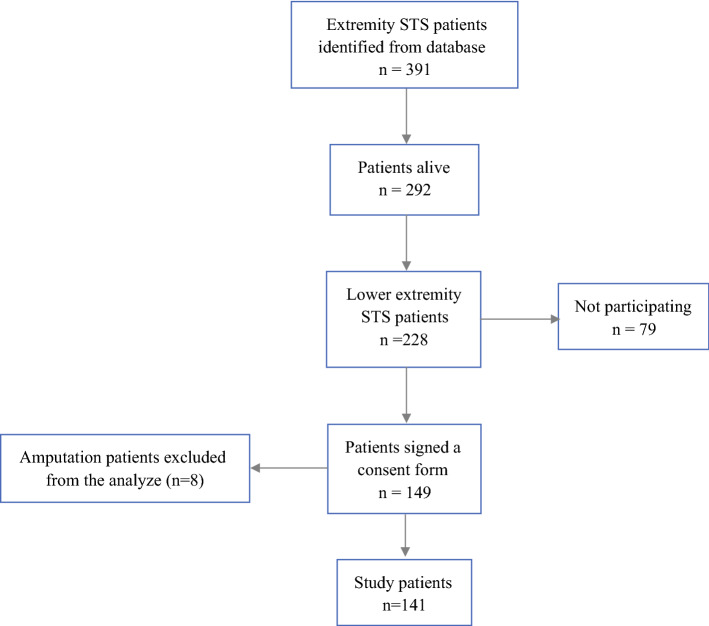
A total of 141 patients who had undergone limb-salvage surgery were included. Depending on the outcome measure used, 19-51% of patients were completely asymptomatic and 13-14% of patients had an unimpaired HRQoL. The mean score for TESS, 15D mobility score, and QLQ-C30 Physical Functioning scale were 86, 0.83, and 75, respectively, while the mean score for 15D was 0.88, and 73 for QLQ-C30 QoL. Lower functional outcome was statistically significantly associated with higher age, higher body mass index (BMI), and the need for reconstructive surgery and radiotherapy, while lower HRQoL was statistically significantly associated with higher age, higher BMI, and reconstructive surgery.
Functional outcome and HRQoL were generally high in this cross-sectional study of patients with STS in the lower extremity. Both tumor- and treatment-related factors had an impact but patient-related factors such as age and BMI were the major determinants of both functional outcome and HRQoL.
在分析下肢软组织肉瘤(STS)术后患者的长期功能结果和健康相关生活质量(HRQoL)时,很少有研究关注与患者相关的因素。
本研究旨在探讨与下肢 STS 患者术后功能结果和 HRQoL 相关的因素。
本横断面研究在一家三级转诊中心进行,使用多伦多肢体挽救评分(TESS)、生活质量问卷(QLQ)-C30 和 15 维度(15D)量表进行。前瞻性收集功能结果和 HRQoL 数据。所有患者均根据书面治疗方案由多学科团队进行治疗。
共纳入 141 例接受保肢手术的患者。根据使用的结果测量指标,19%-51%的患者完全无症状,13%-14%的患者 HRQoL 无受损。TESS、15D 活动能力评分和 QLQ-C30 身体功能评分的平均得分为 86、0.83 和 75,而 15D 的平均得分为 0.88,QLQ-C30 生活质量评分得分为 73。功能结果较差与年龄较大、体重指数(BMI)较高以及需要重建手术和放疗显著相关,而 HRQoL 较低与年龄较大、BMI 较高以及重建手术显著相关。
在本研究中,下肢 STS 患者的功能结果和 HRQoL 总体较高。肿瘤和治疗相关因素都有影响,但年龄和 BMI 等患者相关因素是功能结果和 HRQoL 的主要决定因素。