University of California Davis, Davis, CA, United States.
University of California Davis, Davis, CA, United States.
J Theor Biol. 2021 Jun 21;519:110619. doi: 10.1016/j.jtbi.2021.110619. Epub 2021 Mar 16.
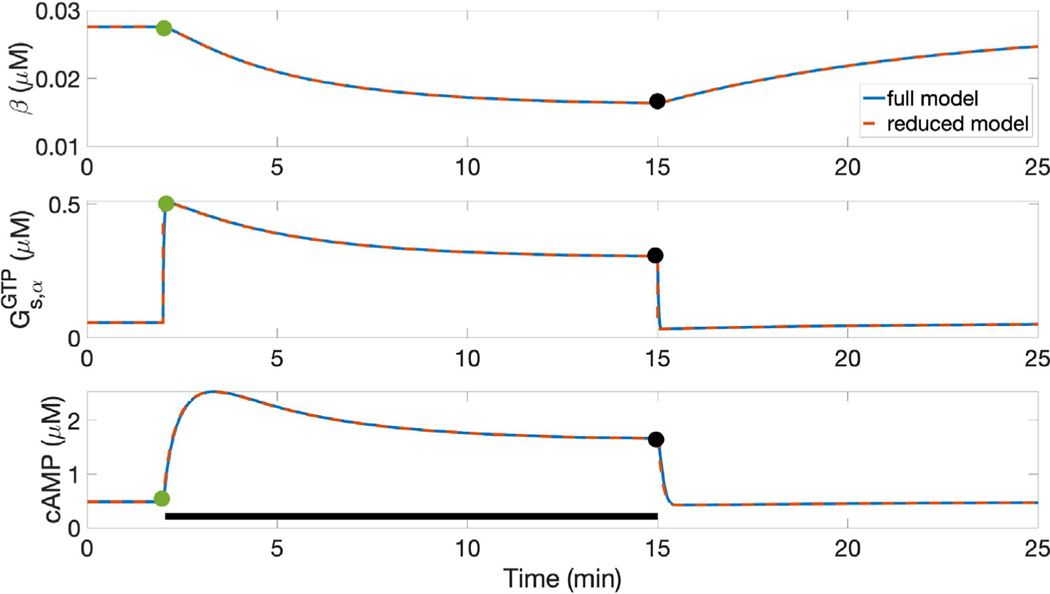
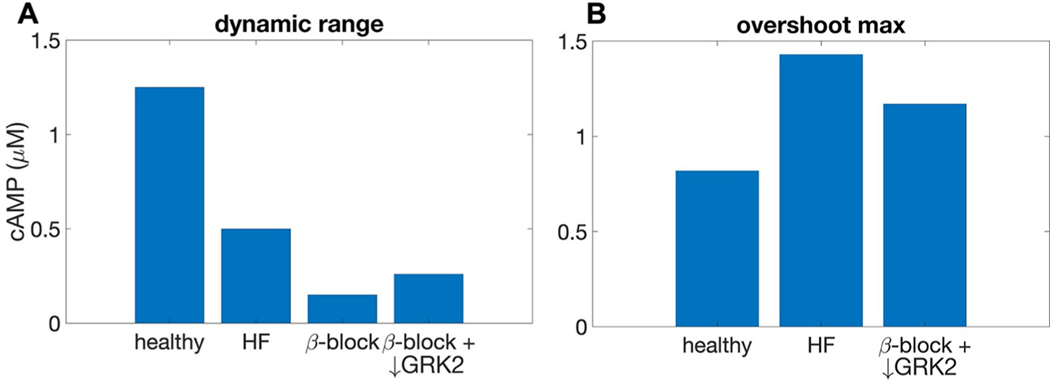
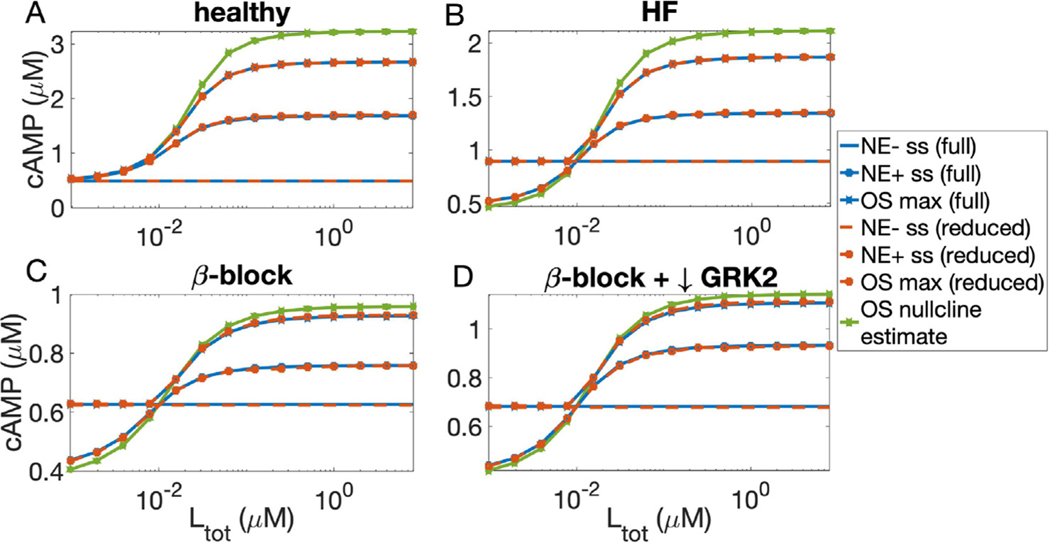
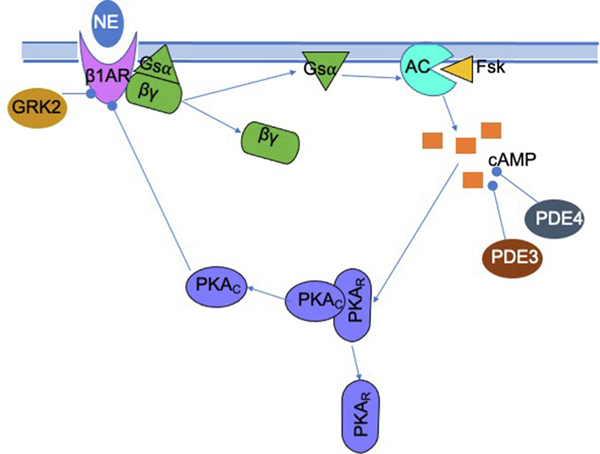
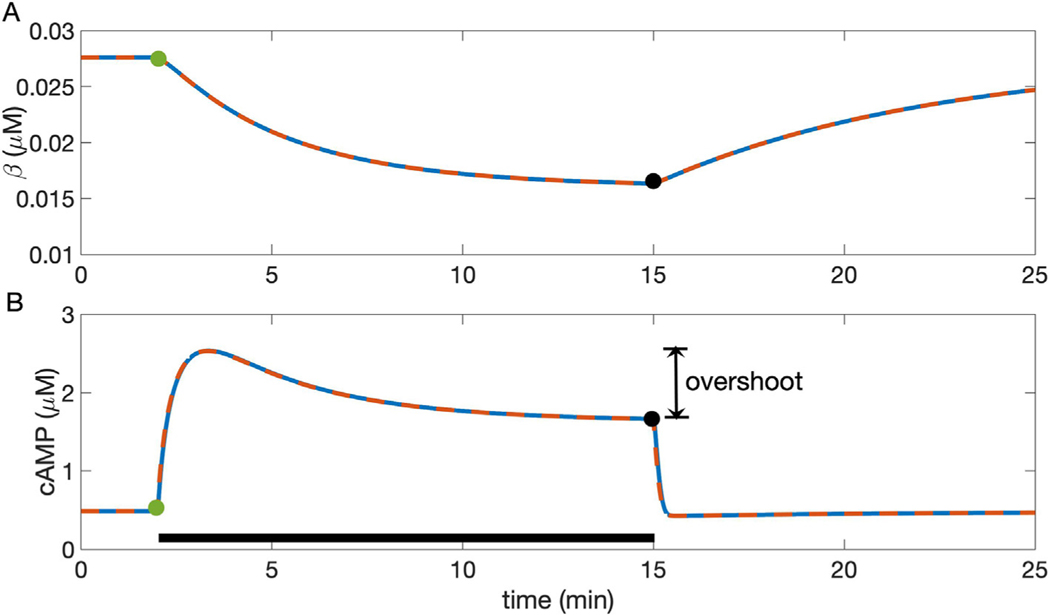
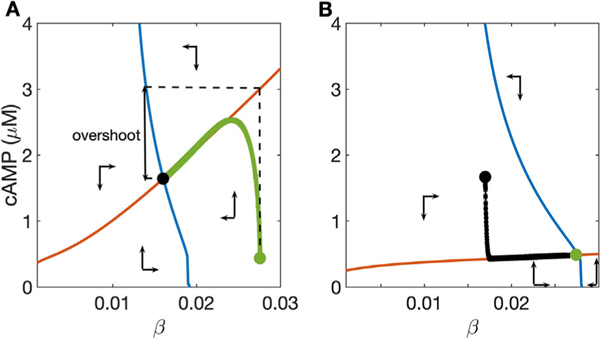
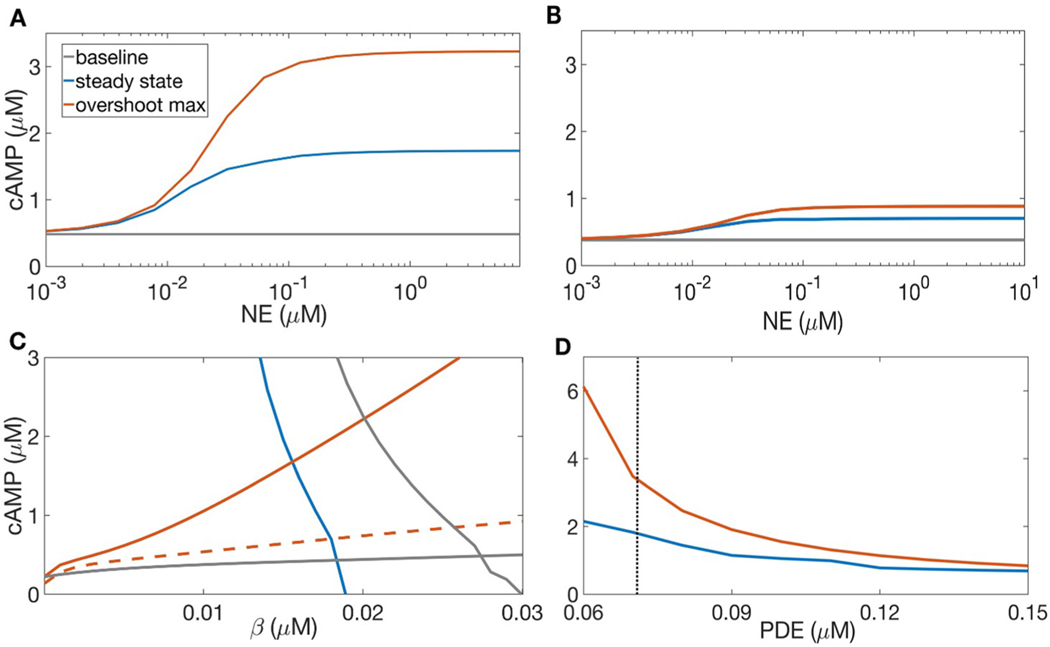
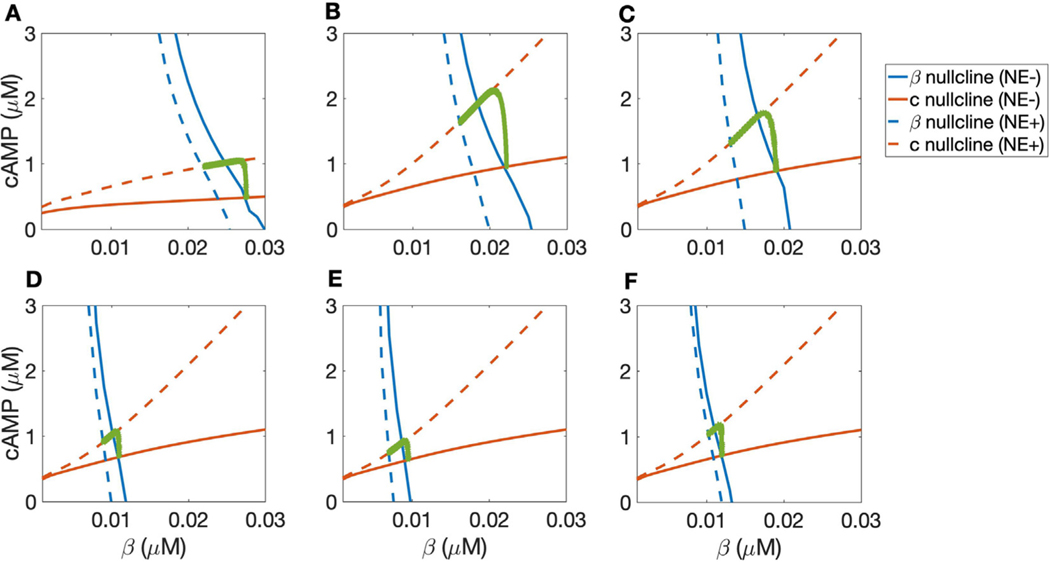
Dense innervation of the heart by the sympathetic nervous system (SNS) allows cardiac output to respond appropriately to the needs of the body under varying conditions, but occasionally the abrupt onset of SNS activity can trigger cardiac arrhythmias. Sympathetic activity leads to the release of norepinephrine (NE) onto cardiomyocytes, activating β-adrenergic receptors (β-ARs) and leading to the production of the second messenger cyclic AMP (cAMP). Upon sudden activation of β-ARs in experiments, intracellular cAMP can transiently rise to a high concentration before converging to a steady state level. Although changes to cellular cAMP concentration are important in modulating the overall cardiovascular response to sympathetic tone, the underlying mechanisms of the cAMP transients and the parameters that control their magnitude are unclear. We reduce a detailed computational model of the β-adrenergic signaling cascade to a system of two differential equations by eliminating extraneous variables and applying quasi-steady state approximation. The structure of the reduced model reveals that the large cAMP transients associated with abrupt β-AR activation are generated by the interplay of production/degradation of cAMP and desensitization/resensitization of β-ARs. The reduced model is used to predict how the dynamics of intracellular cAMP depend on the concentrations of norepinephrine (NE), phosphodiesterases 3 and 4 (PDE3,4), G-protein coupled receptor kinase 2 (GRK2), and β-AR, in healthy conditions and a simple model of early stages of heart failure. The key findings of the study are as follows: 1) Applying a reduced model of the dynamics of cardiac sympathetic signaling we show that the concentrations of two variables, cAMP and non-desensitized β-AR, capture the overall dynamics of sympathetic signaling; 2) The key factors influencing cAMP production are AC activity and PDE3,4 activity, while those that directly impact β-AR phosphorylation are GRK2 and PKA. Thus, disease states that affect sympathetic control of the heart can be thoroughly assessed by studying AC activity, PDE3,4, GRK2 and PKA activity, as these factors directly impact cAMP production/degradation and β-AR (de) phosphorylation and are therefore predicted to comprise the most effective pharmaceutical targets in diseases affecting cardiac β-adrenergic signaling.
心脏受交感神经系统(SNS)的密集神经支配,使心输出量能够根据身体在不同条件下的需要做出适当反应,但偶尔 SNS 活动的突然发作会引发心律失常。交感活动导致去甲肾上腺素(NE)释放到心肌细胞上,激活β-肾上腺素能受体(β-AR),导致第二信使环磷酸腺苷(cAMP)的产生。在实验中,β-AR 突然激活后,细胞内 cAMP 可以短暂上升到高浓度,然后收敛到稳定状态水平。尽管细胞内 cAMP 浓度的变化对调节整体心血管对交感神经张力的反应很重要,但 cAMP 瞬变的潜在机制和控制其幅度的参数尚不清楚。我们通过消除多余变量并应用准稳态近似,将β-肾上腺素能信号级联的详细计算模型简化为一个由两个微分方程组成的系统。简化模型的结构表明,与β-AR 突然激活相关的大 cAMP 瞬变是由 cAMP 的产生/降解和β-AR 的脱敏/再敏化的相互作用产生的。该简化模型用于预测细胞内 cAMP 的动力学如何取决于去甲肾上腺素(NE)、磷酸二酯酶 3 和 4(PDE3,4)、G 蛋白偶联受体激酶 2(GRK2)和β-AR 的浓度,在健康条件下和心力衰竭早期的一个简单模型。该研究的主要发现如下:1)应用心脏交感信号转导动力学的简化模型,我们表明,两个变量 cAMP 和非脱敏β-AR 的浓度可以捕获交感信号转导的整体动力学;2)影响 cAMP 产生的关键因素是 AC 活性和 PDE3,4 活性,而直接影响β-AR 磷酸化的关键因素是 GRK2 和 PKA。因此,通过研究 AC 活性、PDE3,4、GRK2 和 PKA 活性,可以全面评估影响心脏交感神经控制的疾病状态,因为这些因素直接影响 cAMP 的产生/降解和β-AR(去)磷酸化,因此预计它们将构成影响心脏β-肾上腺素能信号转导的疾病的最有效药物靶点。