Chen Ying, Sun Xiaojuan, Du Jiahao, Hu Jingjie, Bao Zhenmin, Qu Zhe
Key Laboratory of Tropical Aquatic Germplasm of Hainan Province, Sanya Oceanographic Institution, Ocean University of China, Sanya 572000, China.
MOE Key Laboratory of Marine Genetics and Breeding, and Shandong Key Laboratory of Marine Seed Industry (preparatory), Ocean University of China, Qingdao 266003, China.
Antioxidants (Basel). 2025 May 25;14(6):635. doi: 10.3390/antiox14060635.
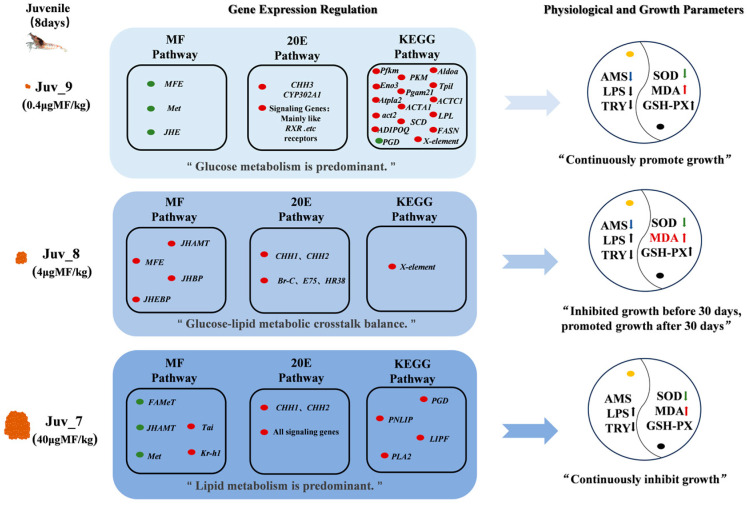
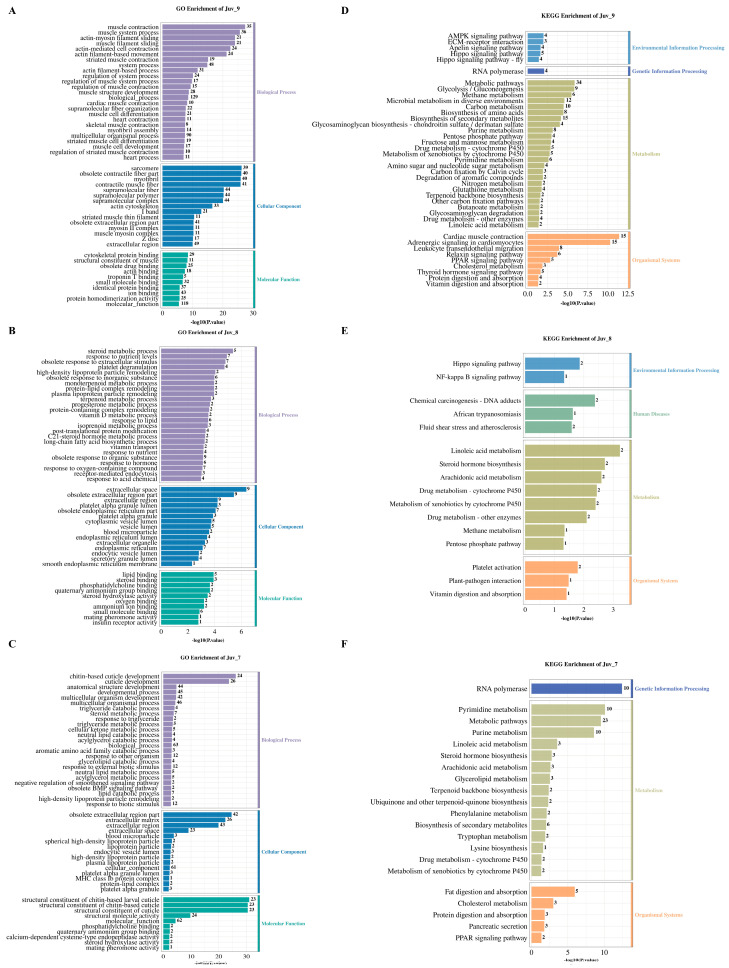
Sesquiterpenoid hormones are widely present in arthropods and play crucial roles in growth, molting and reproduction. Methyl farnesoate (MF) functions similarly to juvenile hormone (JH) in crustaceans, playing a broad regulatory role in their growth and development. However, compared to insects, systematic studies on the mechanisms of sesquiterpenoid hormones in crustaceans are still lacking. , a small freshwater shrimp known for its fast growth, high reproductive capacity and ease of maintenance, is an ideal model organism for crustacean research. To investigate the effects of MF on the growth and development of juvenile , MF feeding experiments were conducted and the changes at the phenotypic and molecular levels were examined. In this experiment, the basal diet was used as a control, with 40 μg/kg, 4 μg/kg and 0.4 μg/kg of MF added to the feed. The MF-enriched diets were fed to juvenile and the growth in body length was measured every 10 days. After 40 days of feeding experiment, the activities of amylase (AMS), lipase (LPS), trypsin (Try), superoxide dismutase (SOD), malondialdehyde (MDA) and glutathione peroxidase (GSH-PX) were assessed, and transcriptome analysis was performed. We found that MF showed an initial inhibitory effect on body length (day 30), but by day 40, the low-concentration group exhibited significantly enhanced growth compared to the control, indicating a dose- and time-dependent effect. Activities of AMS, LPS, Try and SOD generally decreased, whereas MDA levels and GSH-PX activity increased after 40 days of MF exposure. Moreover, transcriptomic analysis revealed that MF regulated various biological processes including growth, metabolism and immune responses. High concentration group appeared to restrict growth via modulation of exoskeleton-related and cellular stress genes. Medium concentration group enhanced growth by optimizing metabolic and signaling pathways. Low concentration group preferentially up-regulated genes related to muscle function, potentially supporting locomotion and competitive ability. This study provides new insights into the regulatory mechanism of sesquiterpenoid hormones in crustaceans and their potential applications in aquaculture in the future.
倍半萜类激素广泛存在于节肢动物中,在生长、蜕皮和繁殖过程中发挥着关键作用。法尼酸甲酯(MF)在甲壳类动物中的功能与保幼激素(JH)相似,在其生长和发育过程中发挥着广泛的调节作用。然而,与昆虫相比,关于倍半萜类激素在甲壳类动物中的作用机制的系统性研究仍然缺乏。[具体物种名称]是一种小型淡水虾,以其生长速度快、繁殖能力高和易于饲养而闻名,是甲壳类动物研究的理想模式生物。为了研究MF对[具体物种名称]幼体生长发育的影响,进行了MF投喂实验,并检测了表型和分子水平的变化。在本实验中,以基础饲料作为对照,在饲料中添加40μg/kg、4μg/kg和0.4μg/kg的MF。将添加MF的饲料投喂给[具体物种名称]幼体,每10天测量一次体长。在进行40天的投喂实验后,评估淀粉酶(AMS)、脂肪酶(LPS)、胰蛋白酶(Try)、超氧化物歧化酶(SOD)、丙二醛(MDA)和谷胱甘肽过氧化物酶(GSH-PX)的活性,并进行转录组分析。我们发现,MF在第30天时对体长表现出初步的抑制作用,但到第40天时,低浓度组与对照组相比生长显著增强,表明存在剂量和时间依赖性效应。在MF暴露40天后,AMS、LPS、Try和SOD的活性普遍下降,而MDA水平和GSH-PX活性增加。此外,转录组分析表明,MF调节包括生长、代谢和免疫反应在内的各种生物学过程。高浓度组似乎通过调节外骨骼相关基因和细胞应激基因来限制生长。中浓度组通过优化代谢和信号通路促进生长。低浓度组优先上调与肌肉功能相关的基因,可能支持运动和竞争能力。本研究为倍半萜类激素在甲壳类动物中的调节机制及其未来在水产养殖中的潜在应用提供了新的见解。