Department of Clinical Laboratory, Peking University People's Hospital, Xizhimen South Avenue No. 11, Beijing, 100044, China.
Department of Infectious Diseases and Immunology, Sydney Medical School, The University of Sydney, Sydney, 2006, Australia.
BMC Pulm Med. 2021 Mar 19;21(1):95. doi: 10.1186/s12890-021-01459-w.
Pleural effusion (PE) is a common clinical manifestation, and millions of people suffer from pleural disease. Herein, this retrospective study was performed to evaluate the biomarkers and ratios in serum and pleural fluid (PF) for the differential diagnosis of the multiple types of PE and search for a new diagnostic strategy for PE.
In-patients, who developed tuberculous PE (TPE), malignant PE (MPE), complicated parapneumonic effusion (CPPE), uncomplicated PPE (UPPE), or PE caused by connective tissue diseases (CTDs) and underwent thoracentesis at Peking University People's Hospital from November 2016 to April 2019, were included in this study. Eleven biomarkers and their ratios in serum and PF were investigated and compared between pairs of the different PE groups, and a decision-tree was developed.
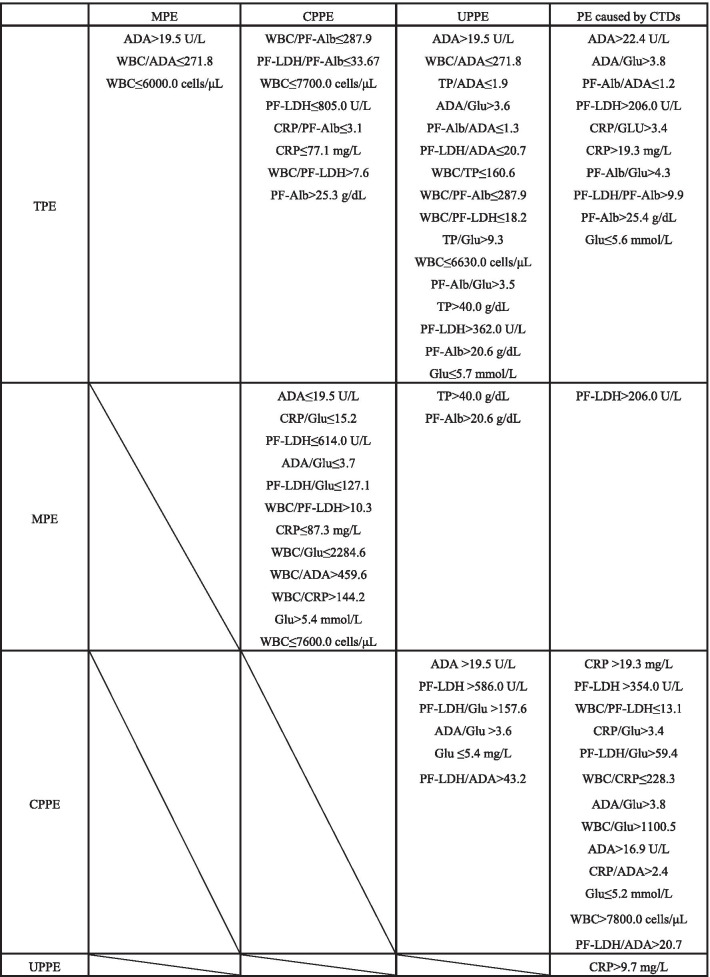
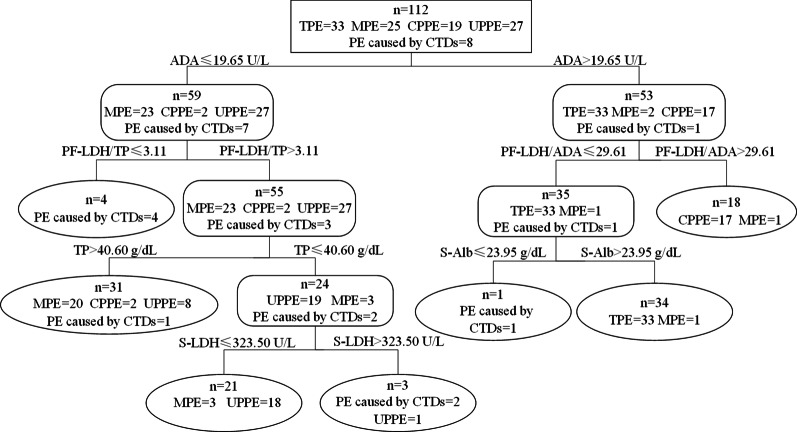
Totally 112 PE cases, including 25 MPE, 33 TPE, 19 CPPE, 27 UPPE, and 8 PE caused by CTDs, were reviewed. Biomarkers and ratios showed good diagnostic performance with high area under the curve values, sensitivities, and specificities for the differential diagnosis of the multiple types of PE. According to the decision-tree analysis, the combination of adenosine deaminase (ADA), serum albumin, serum lactate dehydrogenase, total protein, PF-LDH/ADA, and PF-LDH/TP provided the best predictive capacity with an overall accuracy of 84.8%; the sensitivity and specificity for TPE diagnosis were 100% and 98.7%, respectively.
The biomarkers and ratios showed good diagnostic performance, and a decision-tree with an overall accuracy of 84.8% was developed to differentiate the five types of PE in clinical settings.
胸腔积液(PE)是一种常见的临床症状,数百万人患有胸膜疾病。本回顾性研究旨在评估血清和胸腔积液(PF)中的生物标志物及其比值,用于鉴别多种类型的胸腔积液,并寻找胸腔积液的新诊断策略。
本研究纳入了 2016 年 11 月至 2019 年 4 月期间在北京大学人民医院因结核性胸腔积液(TPE)、恶性胸腔积液(MPE)、复杂性类肺炎性胸腔积液(CPPE)、单纯性胸腔积液(UPPE)或结缔组织疾病相关性胸腔积液(CTD)而接受胸腔穿刺的住院患者。比较了不同类型胸腔积液组之间血清和 PF 中 11 种生物标志物及其比值,并建立决策树。
本研究共纳入 112 例胸腔积液患者,其中 25 例为 MPE,33 例为 TPE,19 例为 CPPE,27 例为 UPPE,8 例为 CTD 相关性胸腔积液。生物标志物及其比值对多种类型胸腔积液的鉴别诊断具有良好的诊断性能,曲线下面积、敏感度和特异度较高。根据决策树分析,腺苷脱氨酶(ADA)、血清白蛋白、血清乳酸脱氢酶、总蛋白、PF-LDH/ADA 和 PF-LDH/TP 的联合检测具有最佳预测能力,总准确率为 84.8%;TPE 的诊断敏感度和特异度分别为 100%和 98.7%。
生物标志物及其比值具有良好的诊断性能,本研究建立的决策树可用于区分五种类型的胸腔积液,准确率为 84.8%。