Department of Environmental and Occupational Health Sciences, School of Public Health and Information Sciences, University of Louisville, 485 E. Gray Street, Louisville, KY, 40202, USA.
Part Fibre Toxicol. 2021 Mar 19;18(1):13. doi: 10.1186/s12989-021-00405-2.
The increasing use of metal nanoparticles in industry and biomedicine raises the risk for unintentional exposure. The ability of metal nanoparticles to penetrate the skin ranges from stopping at the stratum corneum to passing below the dermis and entering the systemic circulation. Despite the potential health risks associated with skin exposure to metal nanoparticles, the mechanisms underlying the toxicity of metal nanoparticles on skin keratinocytes remain unclear. In this study, we proposed that exposure of human epidermal keratinocytes (HaCaT) to metal nanoparticles, such as nickel nanoparticles, dysregulates tight-junction associated proteins by interacting with the HIF-1α/miR-29b/MMPs axis.
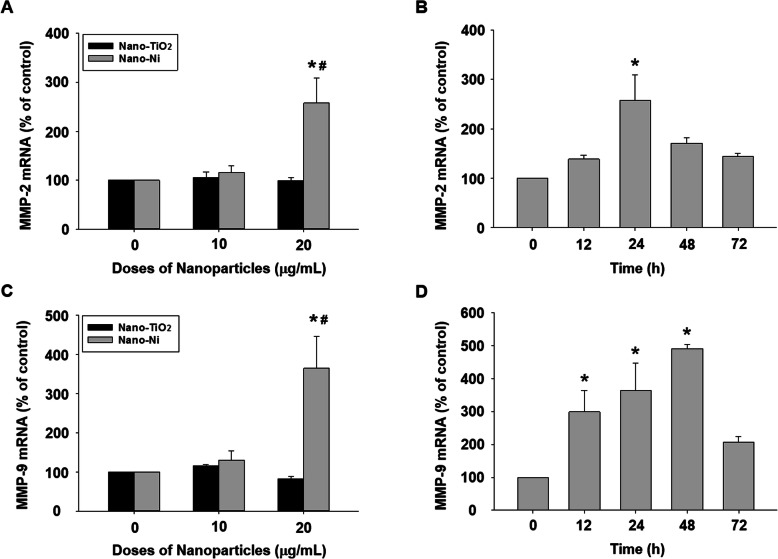
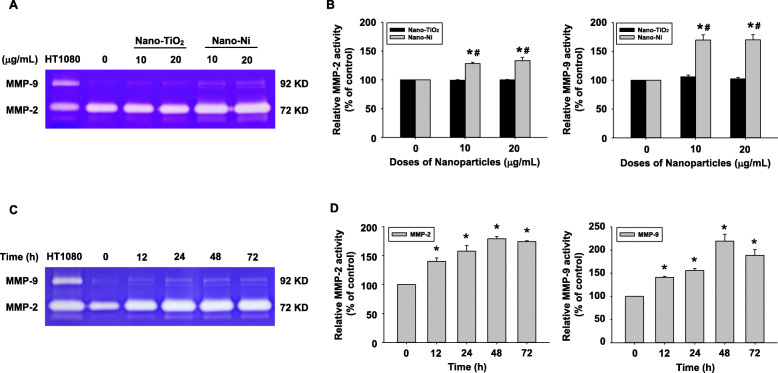
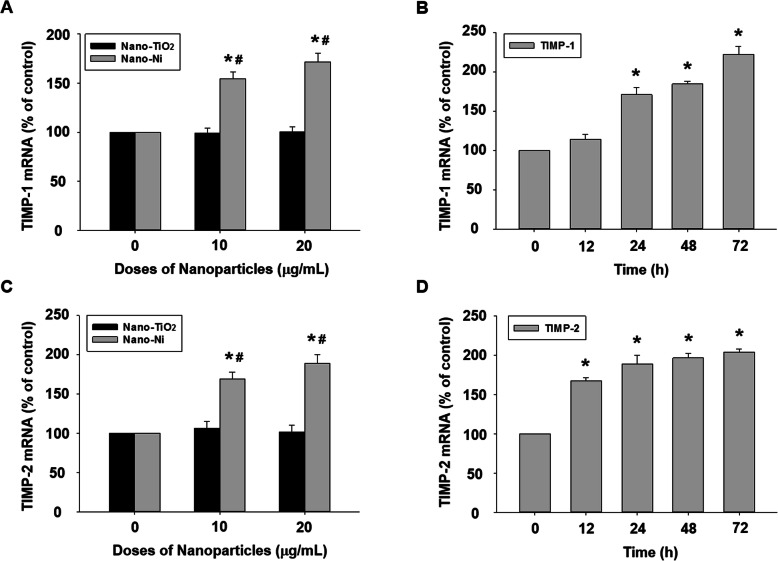
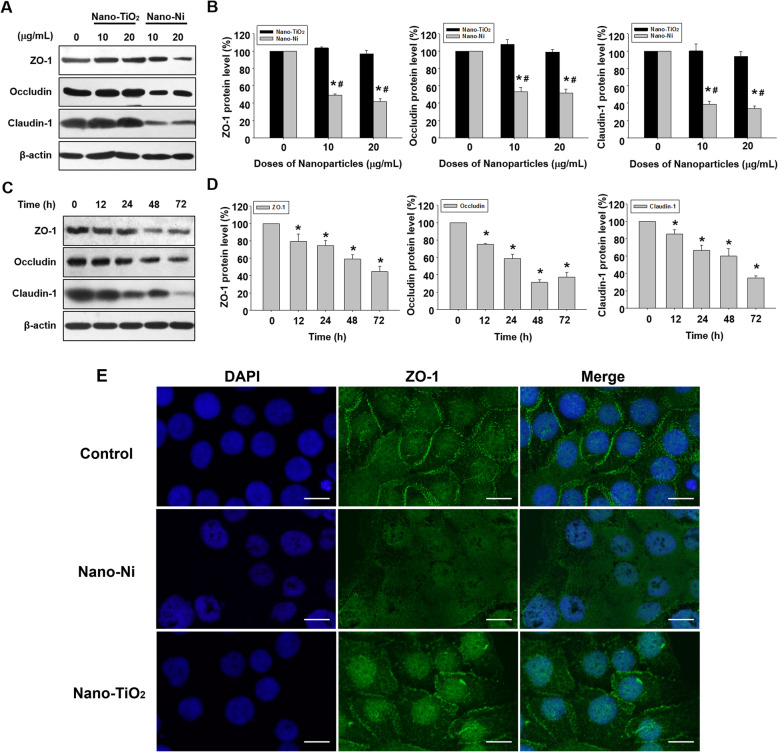
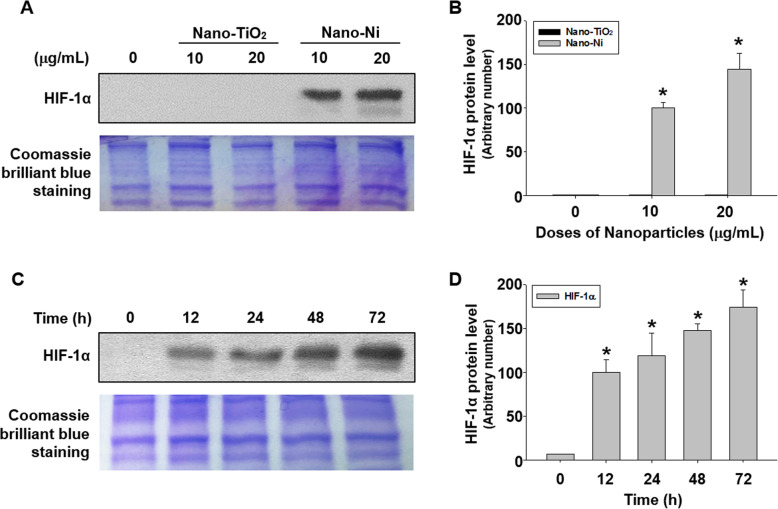
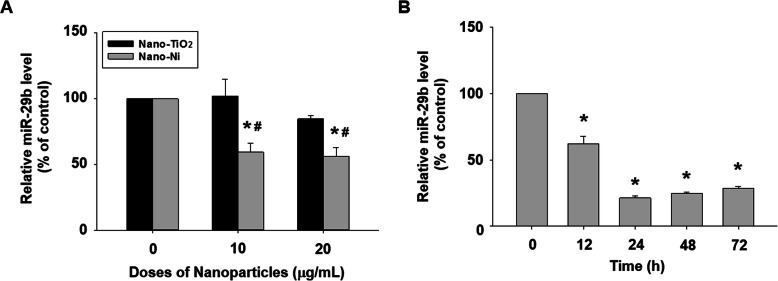
We performed dose-response and time-response studies in HaCaT cells to observe the effects of Nano-Ni or Nano-TiO on the expression and activity of MMP-2 and MMP-9, and on the expression of tight junction-associated proteins, TIMP-1, TIMP-2, miR-29b, and HIF-1α. In the dose-response studies, cells were exposed to 0, 10, or 20 μg/mL of Nano-Ni or Nano-TiO for 24 h. In the time-response studies, cells were exposed to 20 μg/mL of Nano-Ni for 12, 24, 48, or 72 h. After treatment, cells were collected to either assess the expression of mRNAs and miR-29b by real-time PCR or to determine the expression of tight junction-associated proteins and HIF-1α nuclear accumulation by Western blot and/or immunofluorescent staining; the conditioned media were collected to evaluate the MMP-2 and MMP-9 activities by gelatin zymography assay. To further investigate the mechanisms underlying Nano-Ni-induced dysregulation of tight junction-associated proteins, we employed a HIF-1α inhibitor, CAY10585, to perturb HIF-1α accumulation in one experiment, and transfected a miR-29b-3p mimic into the HaCaT cells before Nano-Ni exposure in another experiment. Cells and conditioned media were collected, and the expression and activities of MMPs and the expression of tight junction-associated proteins were determined as described above.
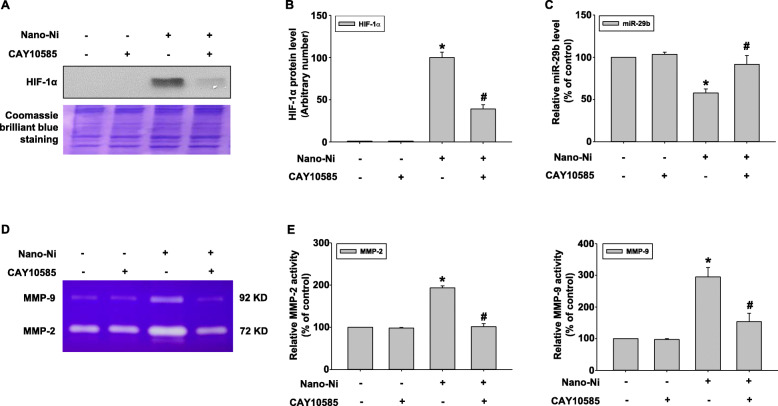
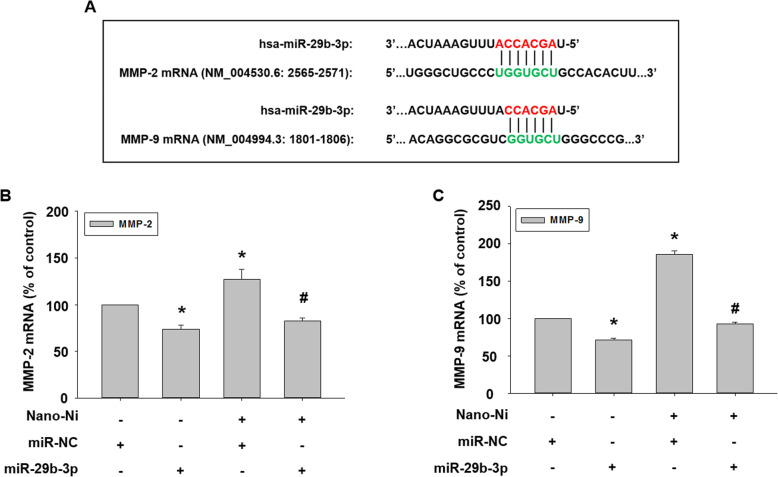
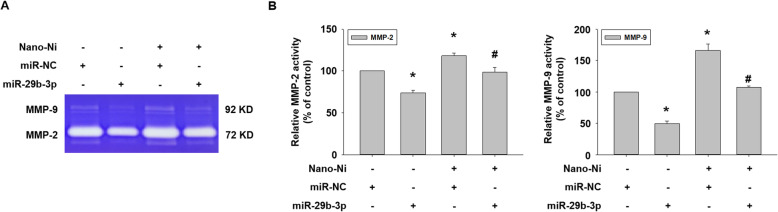
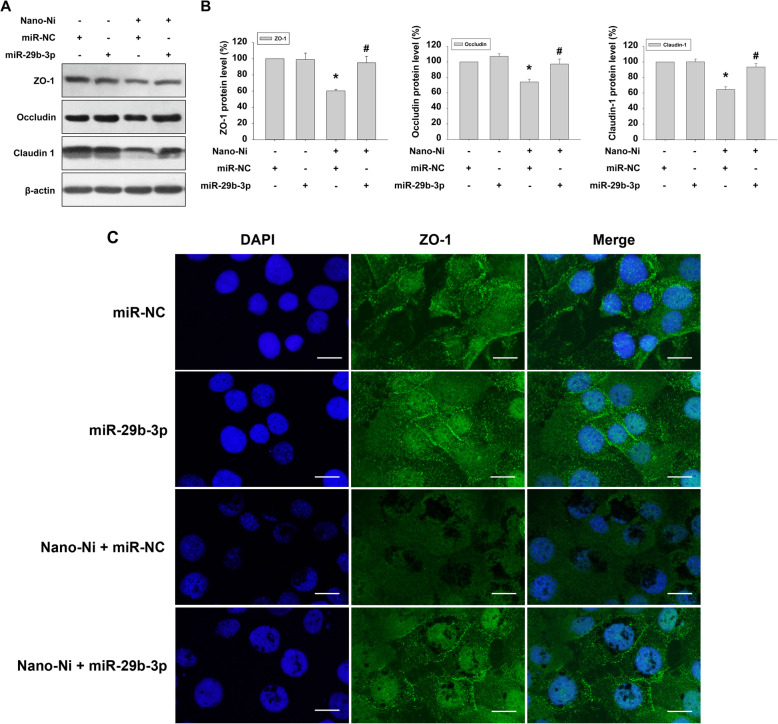
Exposure of HaCaT cells to Nano-Ni resulted in a dose-dependent increase in the expression of MMP-2, MMP-9, TIMP-1, and TIMP-2 and the activities of MMP-2 and MMP-9. However, exposure of cells to Nano-TiO did not cause these effects. Nano-Ni caused a dose-dependent decrease in the expression of miR-29b and tight junction-associated proteins, such as ZO-1, occludin, and claudin-1, while Nano-TiO did not. Nano-Ni also caused a dose-dependent increase in HIF-1α nuclear accumulation. The time-response studies showed that Nano-Ni caused significantly increased expressions of MMP-2 at 24 h, MMP-9 at 12, 24, and 48 h, TIMP-1 from 24 to 72 h, and TIMP-2 from 12 to 72 h post-exposure. The expression of miR-29b and tight junction-associated proteins such as ZO-1, occludin, and claudin-1 decreased as early as 12 h post-exposure, and their levels declined gradually over time. Pretreatment of cells with a HIF-1α inhibitor, CAY10585, abolished Nano-Ni-induced miR-29b down-regulation and MMP-2/9 up-regulation. Introduction of a miR-29b-3p mimic into HaCaT cells by transfection before Nano-Ni exposure ameliorated Nano-Ni-induced increased expression and activity of MMP-2 and MMP-9 and restored Nano-Ni-induced down-regulation of tight junction-associated proteins.
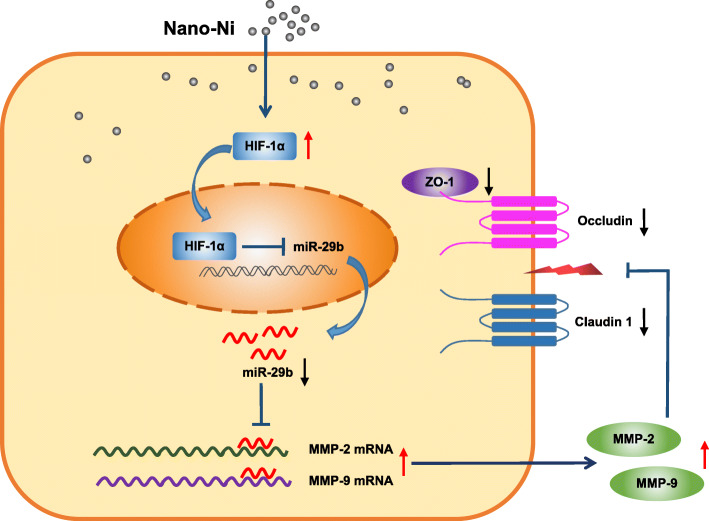
Our study herein demonstrated that exposure of human epidermal keratinocytes to Nano-Ni caused increased HIF-1α nuclear accumulation and increased transcription and activity of MMP-2 and MMP-9 and down-regulation of miR-29b and tight junction-associated proteins. Nano-Ni-induced miR-29b down-regulation was through Nano-Ni-induced HIF-1α nuclear accumulation. Restoration of miR-29b level by miR-29b-3p mimic transfection abolished Nano-Ni-induced MMP-2 and MMP-9 activation and down-regulation of tight junction-associated proteins. In summary, our results demonstrated that Nano-Ni-induced dysregulation of tight junction-associated proteins in skin keratinocytes was via HIF-1α/miR-29b/MMPs pathway.
金属纳米粒子在工业和生物医学中的应用日益广泛,增加了无意暴露的风险。金属纳米粒子穿透皮肤的能力范围从停留在角质层到穿透真皮并进入全身循环。尽管皮肤接触金属纳米粒子存在潜在的健康风险,但金属纳米粒子对皮肤角质形成细胞毒性的机制仍不清楚。在这项研究中,我们提出,暴露于金属纳米粒子(如镍纳米粒子)会通过与 HIF-1α/miR-29b/MMPs 轴相互作用,扰乱紧密连接相关蛋白。
我们在 HaCaT 细胞中进行了剂量反应和时间反应研究,以观察 Nano-Ni 或 Nano-TiO 对 MMP-2 和 MMP-9 的表达和活性以及紧密连接相关蛋白 TIMP-1、TIMP-2、miR-29b 和 HIF-1α 的表达的影响。在剂量反应研究中,细胞暴露于 0、10 或 20μg/mL 的 Nano-Ni 或 Nano-TiO 24 小时。在时间反应研究中,细胞暴露于 20μg/mL 的 Nano-Ni 12、24、48 或 72 小时。处理后,收集细胞以通过实时 PCR 评估 mRNA 和 miR-29b 的表达,或通过 Western blot 和/或免疫荧光染色来确定紧密连接相关蛋白和 HIF-1α 核积累的表达;收集条件培养基以通过明胶酶谱法评估 MMP-2 和 MMP-9 的活性。为了进一步研究 Nano-Ni 诱导的紧密连接相关蛋白失调的机制,我们在一项实验中使用 HIF-1α 抑制剂 CAY10585 扰乱 HIF-1α 的积累,在另一项实验中在暴露于 Nano-Ni 之前转染 HaCaT 细胞 miR-29b-3p 模拟物。收集细胞和条件培养基,如上所述确定 MMPs 的表达和活性以及紧密连接相关蛋白的表达。
暴露于 HaCaT 细胞的 Nano-Ni 导致 MMP-2、MMP-9、TIMP-1 和 TIMP-2 的表达以及 MMP-2 和 MMP-9 的活性呈剂量依赖性增加。然而,暴露于细胞的 Nano-TiO 没有引起这些效应。Nano-Ni 导致 miR-29b 和紧密连接相关蛋白(如 ZO-1、occludin 和 claudin-1)的表达呈剂量依赖性降低,而 Nano-TiO 则没有。Nano-Ni 还导致 HIF-1α 核积累呈剂量依赖性增加。时间反应研究表明,Nano-Ni 在 24 小时引起 MMP-2 的表达显著增加,在 12、24 和 48 小时引起 MMP-9 的表达增加,在 24 至 72 小时引起 TIMP-1 的表达增加,在 12 至 72 小时引起 TIMP-2 的表达增加。暴露于细胞的 miR-29b 和紧密连接相关蛋白(如 ZO-1、occludin 和 claudin-1)的表达早在 12 小时后就开始下降,并且随着时间的推移逐渐下降。用 HIF-1α 抑制剂 CAY10585 预处理细胞可消除 Nano-Ni 诱导的 miR-29b 下调和 MMP-2/9 的上调。在暴露于 Nano-Ni 之前通过转染将 miR-29b-3p 模拟物引入 HaCaT 细胞可改善 Nano-Ni 诱导的 MMP-2 和 MMP-9 的表达和活性增加,并恢复 Nano-Ni 诱导的紧密连接相关蛋白的下调。
本研究表明,暴露于人类表皮角质形成细胞的 Nano-Ni 导致 HIF-1α 核积累增加,MMP-2 和 MMP-9 的转录和活性增加,以及 miR-29b 和紧密连接相关蛋白的下调。Nano-Ni 诱导的 miR-29b 下调是通过 Nano-Ni 诱导的 HIF-1α 核积累引起的。通过 miR-29b-3p 模拟物转染恢复 miR-29b 水平可消除 Nano-Ni 诱导的 MMP-2 和 MMP-9 激活和紧密连接相关蛋白的下调。总之,我们的结果表明,Nano-Ni 诱导的皮肤角质形成细胞中紧密连接相关蛋白的失调是通过 HIF-1α/miR-29b/MMPs 途径实现的。