South China University of Technology, 381 Wushan Road, Tianhe District, Guangzhou, 510641, China.
Jinan University, 601 Huangpu Dadao Xi, Tianhe District, Guangzhou, 510632, China.
Reprod Health. 2021 Mar 19;18(1):64. doi: 10.1186/s12978-021-01120-z.
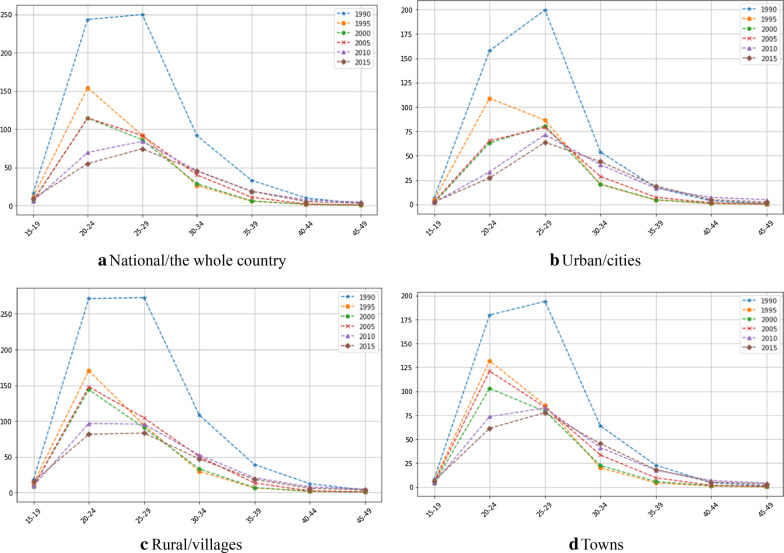
Under the one-child policy of birth control, total fertility rates (TFRs) declined rapidly among women in China. TFRs dropped from 2.29 in 1990 to 1.18 in 2010 and to 1.05 in 2015. However, little is known about the evolution of fertility patterns in China during 1990-2015.
We used population data from 1990 to 2015 and applied age-period-cohort (APC) models to examine temporal changes and used regression models to analyze the effect of education on fertility across periods and cohorts in China.
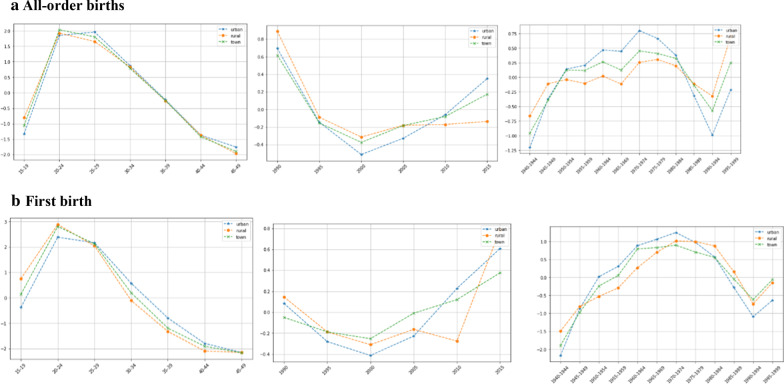
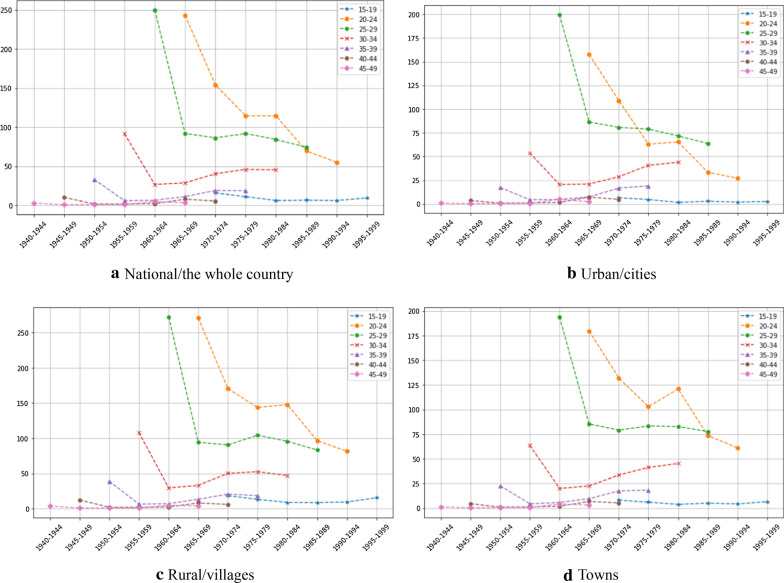
Age effects assume an inverted U-shaped curve, which increase and then decline across ages, with a peak value in age groups 20-24 or 25-29. Period effects show a U-shaped curve, which first decline and then increase. Cohort effects show an inverted U-shaped plus V-shaped curve, which first increase, then decline and rebound with different age effects and period effects. The APC effect curves of all-order births are similar to those of first birth, but with different magnitudes.
We revealed the evolutionary trends in fertility patterns among Chinese women from 1990 to 2015. The one-child policy exerted a crowding out effect on education. Even if the well-educated women had an intense fertility intention, the fertility policy offset their desire for more children.
在中国实行计划生育的一孩政策下,妇女的总和生育率(TFR)迅速下降。TFR 从 1990 年的 2.29 降至 2010 年的 1.18,再降至 2015 年的 1.05。然而,对于 1990 年至 2015 年期间中国生育模式的演变,人们知之甚少。
我们使用了 1990 年至 2015 年的人口数据,并应用年龄时期队列(APC)模型来检查时间变化,并用回归模型来分析教育在中国各时期和队列中对生育的影响。
年龄效应呈倒 U 形曲线,随年龄增长先增加后下降,在 20-24 岁或 25-29 岁年龄组达到峰值。时期效应呈 U 形曲线,先下降后上升。队列效应呈倒 U 形加 V 形曲线,先增加,然后下降并随不同的年龄效应和时期效应而反弹。所有顺序出生的 APC 效应曲线与第一胎出生的曲线相似,但幅度不同。
我们揭示了 1990 年至 2015 年期间中国妇女生育模式的演变趋势。一孩政策对教育产生了挤出效应。即使受过良好教育的妇女有强烈的生育意愿,生育政策也会抵消她们对更多孩子的渴望。