Biostatistics Research Group.
Stroke Research Group, Population Health Sciences Institute, Newcastle University, Newcastle upon Tyne, UK.
Int J Rehabil Res. 2021 Jun 1;44(2):166-169. doi: 10.1097/MRR.0000000000000466.
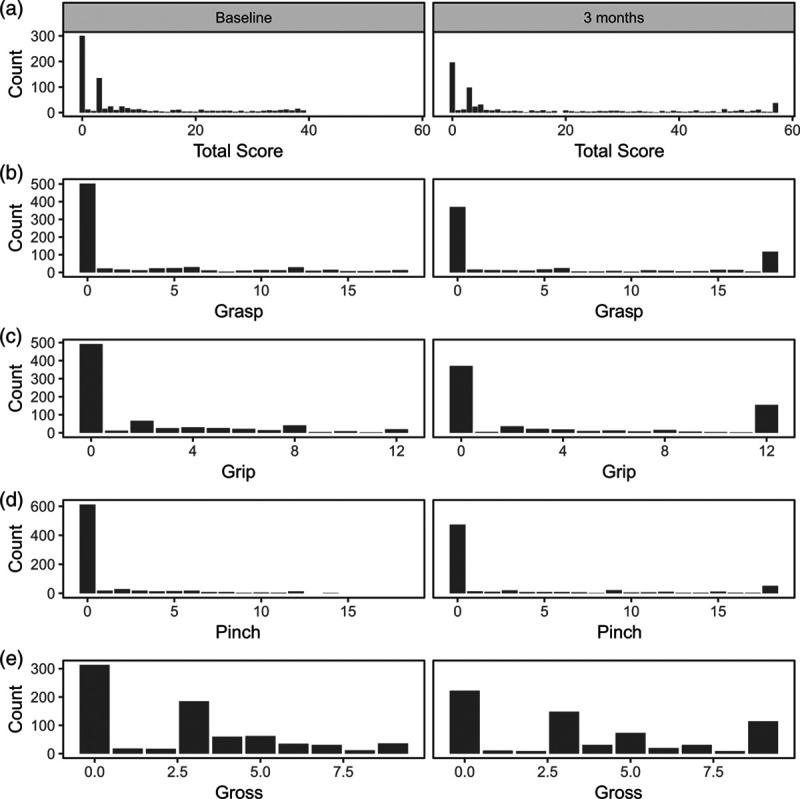
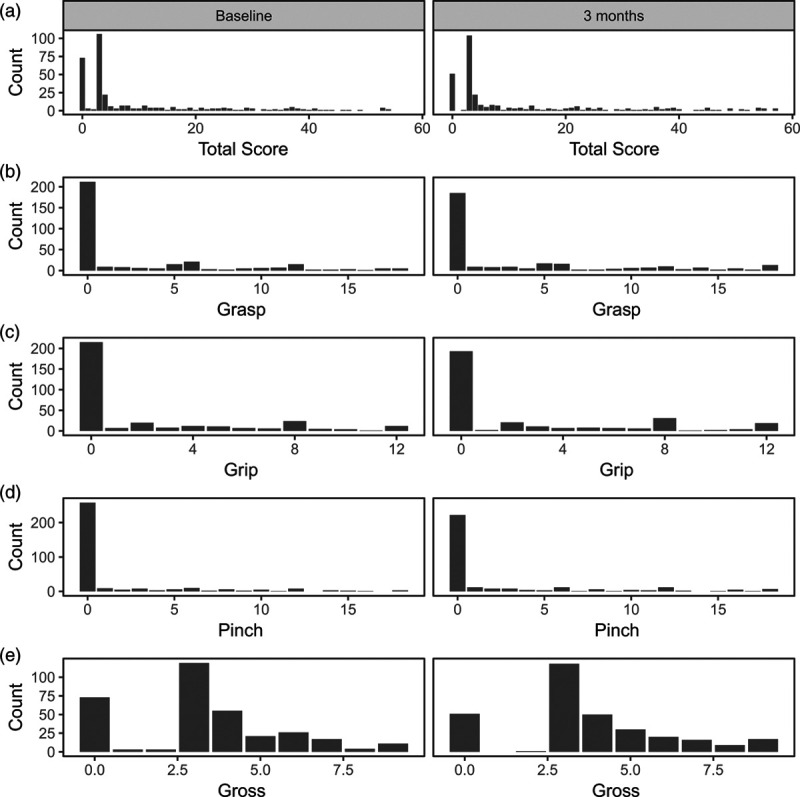
Many studies of stroke rehabilitation use the Action Research Arm Test (ARAT) as an outcome, which measures upper limb function by scoring the ability to complete functional tasks. This report describes an issue encountered when analysing the ARAT subscales in a trial of upper limb therapies after stroke. The subscales of the ARAT at three months followed a 'U-shaped' distribution, and therefore, comparing means or medians was not appropriate. A simple alternative approach was chosen that dichotomised the subscales. When analysing the ARAT, the shape of the distributions must be checked in order to choose the most appropriate descriptive and inferential statistical techniques. In particular, if the data follows a 'U-shaped' distribution, a simple dichotomising or a more sophisticated approach is needed. These should also be considered for heavily skewed distributions, often arising from substantial floor or ceiling effects. Inappropriate analyses can lead to misleading conclusions.
许多中风康复研究使用动作研究上肢测试(ARAT)作为结果,该测试通过评估完成功能性任务的能力来衡量上肢功能。本报告描述了在中风后上肢治疗试验中分析 ARAT 分量表时遇到的问题。ARAT 的分量表在三个月后呈现出“U 形”分布,因此,比较平均值或中位数并不合适。选择了一种简单的替代方法,将分量表二值化。在分析 ARAT 时,必须检查分布的形状,以选择最合适的描述性和推论统计技术。特别是,如果数据遵循“U 形”分布,则需要使用简单的二分法或更复杂的方法。对于严重偏态分布,通常由于存在实质性的下限或上限效应,也需要考虑这些方法。不适当的分析可能导致误导性的结论。