Yang Gege, Zhu Jiawei, Yuan Pengfei, Hu Yongfeng, Qu Gan, Lu Bang-An, Xue Xiaoyi, Yin Hengbo, Cheng Wenzheng, Cheng Junqi, Xu Wenjing, Li Jin, Hu Jinsong, Mu Shichun, Zhang Jia-Nan
College of Materials Science and Engineering, Zhengzhou University, Zhengzhou, 450001, PR China.
State Key Laboratory of Advanced Technology for Materials Synthesis and Processing, Wuhan University of Technology, Wuhan, 430070, PR China.
Nat Commun. 2021 Mar 19;12(1):1734. doi: 10.1038/s41467-021-21919-5.
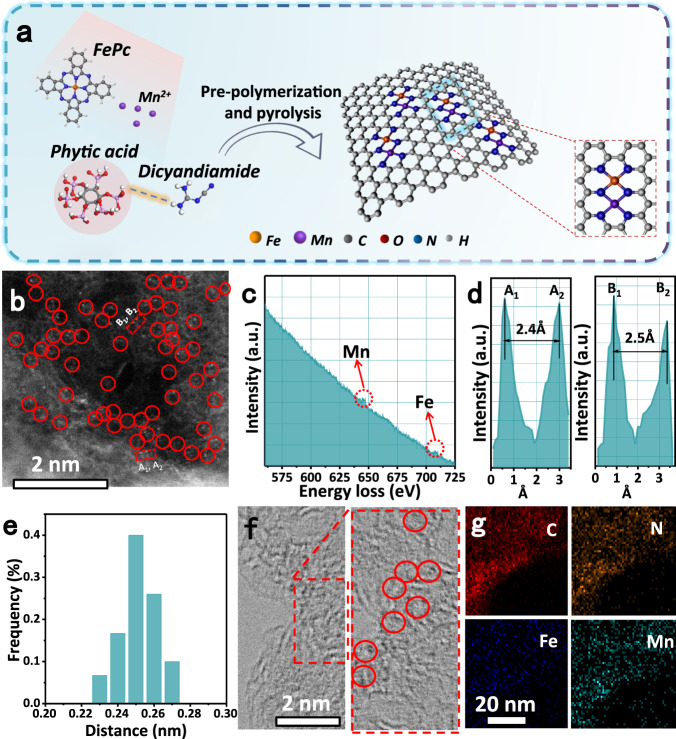
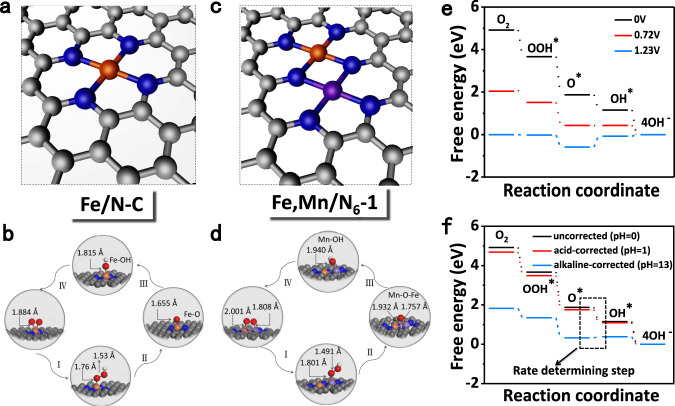
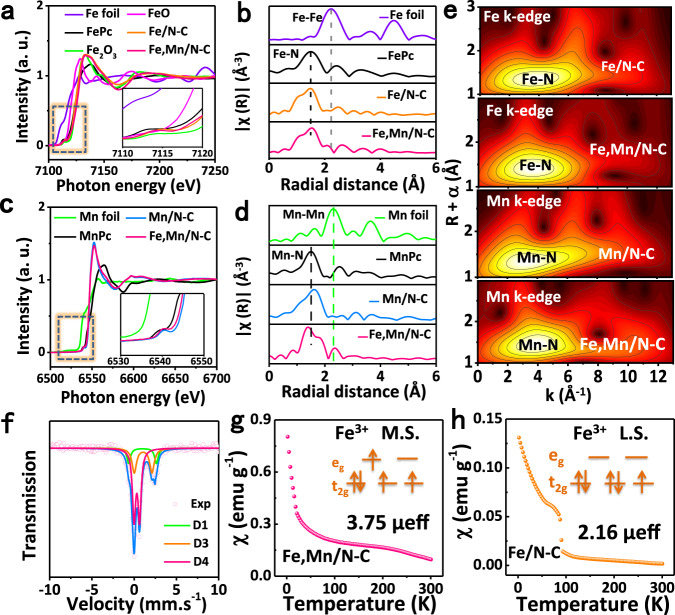
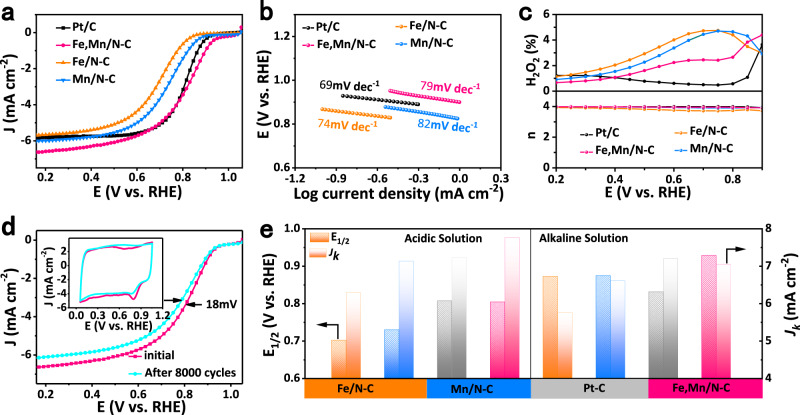
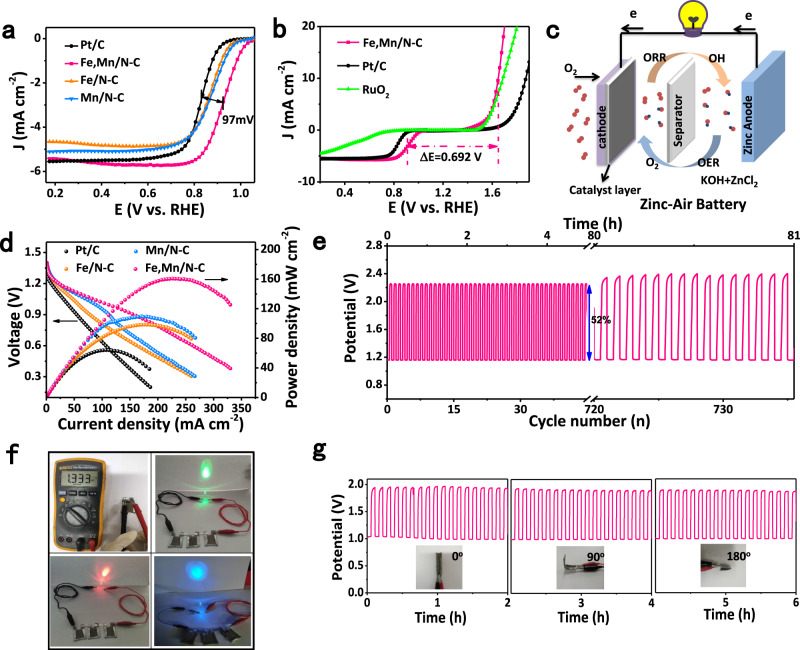
As low-cost electrocatalysts for oxygen reduction reaction applied to fuel cells and metal-air batteries, atomic-dispersed transition metal-nitrogen-carbon materials are emerging, but the genuine mechanism thereof is still arguable. Herein, by rational design and synthesis of dual-metal atomically dispersed Fe,Mn/N-C catalyst as model object, we unravel that the O reduction preferentially takes place on Fe in the FeN /C system with intermediate spin state which possesses one e electron (t4e1) readily penetrating the antibonding π-orbital of oxygen. Both magnetic measurements and theoretical calculation reveal that the adjacent atomically dispersed Mn-N moieties can effectively activate the Fe sites by both spin-state transition and electronic modulation, rendering the excellent ORR performances of Fe,Mn/N-C in both alkaline and acidic media (halfwave positionals are 0.928 V in 0.1 M KOH, and 0.804 V in 0.1 M HClO), and good durability, which outperforms and has almost the same activity of commercial Pt/C, respectively. In addition, it presents a superior power density of 160.8 mW cm and long-term durability in reversible zinc-air batteries. The work brings new insight into the oxygen reduction reaction process on the metal-nitrogen-carbon active sites, undoubtedly leading the exploration towards high effective low-cost non-precious catalysts.
作为应用于燃料电池和金属空气电池的氧还原反应低成本电催化剂,原子分散的过渡金属 - 氮 - 碳材料正在兴起,但其真正机制仍存在争议。在此,通过合理设计和合成双金属原子分散的Fe,Mn/N-C催化剂作为模型对象,我们揭示了在具有中间自旋态的FeN/C体系中,氧还原优先在Fe上发生,该体系具有一个容易穿透氧反键π轨道的e电子(t4e1)。磁性测量和理论计算均表明,相邻的原子分散的Mn-N部分可以通过自旋态转变和电子调制有效地激活Fe位点,使Fe,Mn/N-C在碱性和酸性介质中均具有优异的氧还原反应性能(在0.1 M KOH中的半波电位为0.928 V,在0.1 M HClO中的半波电位为0.804 V),并且具有良好的耐久性,分别优于商业Pt/C且活性几乎相同。此外,它在可逆锌空气电池中表现出160.8 mW cm的优异功率密度和长期耐久性。这项工作为金属 - 氮 - 碳活性位点上的氧还原反应过程带来了新的见解,无疑引领了对高效低成本非贵金属催化剂的探索。