Department of Circulation and Medical Imaging, Norwegian University of Science and Technology, Trondheim, Norway.
The Women's Clinic, St.Olav Hospital, Trondheim, Norway.
BMC Public Health. 2021 Mar 20;21(1):549. doi: 10.1186/s12889-021-10503-7.
Although it is known that winter inclusive of the Christmas holiday period is associated with an increased risk of dying compared to other times of the year, very few studies have specifically examined this phenomenon within a population cohort subject to baseline profiling and prospective follow-up. In such a cohort, we sought to determine the specific characteristics of mortality occuring during the Christmas holidays.
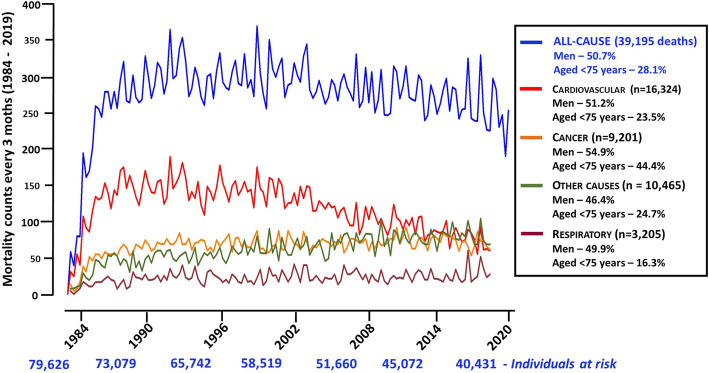
Baseline profiling and outcome data were derived from a prospective population-based cohort with longitudinal follow-up in Central Norway - the Trøndelag Health (HUNT) Study. From 1984 to 1986, 88% of the target population comprising 39,273 men and 40,353 women aged 48 ± 18 and 50 ± 18 years, respectively, were profiled. We examined the long-term pattern of mortality to determine the number of excess (all-cause and cause-specific) deaths that occurred during winter overall and, more specifically, the Christmas holidays.
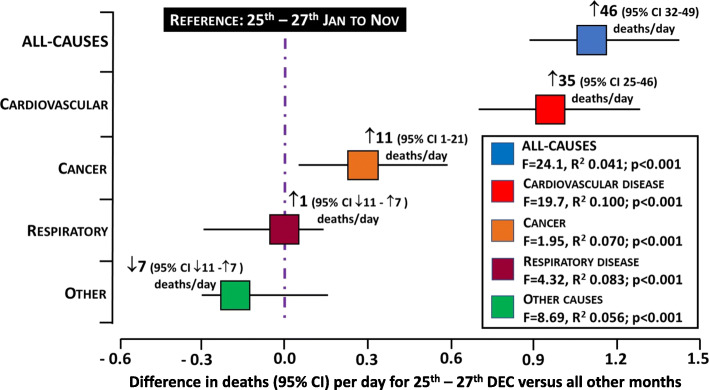
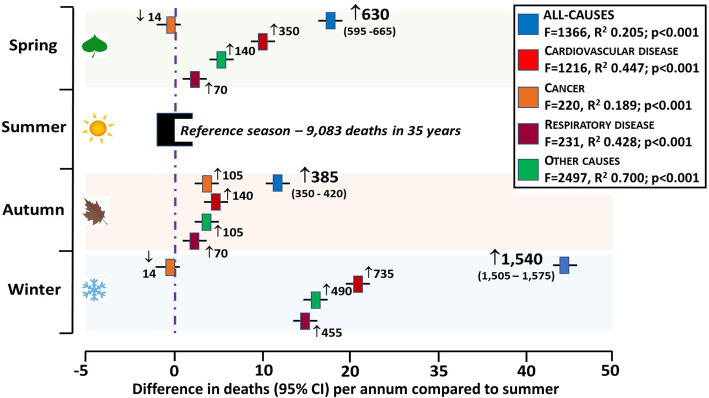
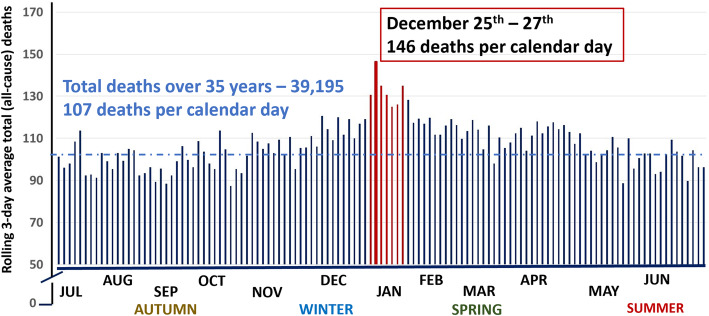
During 33.5 (IQR 17.1-34.4) years follow-up, 19,879 (50.7%) men and 19,316 (49.3%) women died at age-adjusted rate of 5.3 and 4.6 deaths per 1000/annum, respectively. Overall, 1540 (95% CI 43-45 deaths/season) more all-cause deaths occurred in winter (December to February) versus summer (June to August), with 735 (95% CI 20-22 deaths per season) of these cardiovascular-related. December 25th-27th was the deadliest 3-day period of the year; being associated with 138 (95% CI 96-147) and 102 (95% CI 72-132) excess all-cause and cardiovascular-related deaths, respectively. Accordingly, compared to 1st-21st December (equivalent winter conditions), the incidence rate ratio of all-cause mortality increased to 1.22 (95% CI 1.16-1.27) and 1.17 (95% 1.11-1.22) in men and women, respectively, during the next 21 days (Christmas/New Year holidays). All observed differences were highly significant (P < 0.001). A less pronounced pattern of mortality due to respiratory illnesses (but not cancer) was also observed.
Beyond a broader pattern of seasonally-linked mortality characterised by excess winter deaths, the deadliest time of year in Central Norway coincides with the Christmas holidays. During this time, the pattern and frequency of cardiovascular-related mortality changes markedly; contrasting with a more stable pattern of cancer-related mortality. Pending confirmation in other populations and climates, further research to determine if these excess deaths are preventable is warranted.
尽管已知冬季(包括圣诞节假期)与一年中其他时间相比,死亡风险增加,但很少有研究专门在接受基线分析和前瞻性随访的人群队列中研究这一现象。在这样的队列中,我们试图确定在圣诞节假期期间发生的特定死亡特征。
从挪威特隆赫姆的一项前瞻性基于人群的队列中获得基线分析和结果数据——特隆赫姆健康(HUNT)研究。1984 年至 1986 年,目标人群的 88%(男性 39273 人,女性 40353 人)接受了年龄在 48±18 岁和 50±18 岁的基线分析。我们检查了长期死亡率模式,以确定在整个冬季(总体而言)以及更具体地在圣诞节假期期间发生的超额(全因和病因特异性)死亡人数。
在 33.5 年(IQR 17.1-34.4)的随访中,19879 名男性(50.7%)和 19316 名女性(49.3%)在调整年龄后的死亡率分别为每 1000 人/年 5.3 和 4.6 例死亡。总体而言,冬季(12 月至 2 月)比夏季(6 月至 8 月)多发生 1540 例(95%CI 43-45 例/季节)全因死亡,其中 735 例(95%CI 20-22 例/季节)与心血管疾病有关。12 月 25 日至 27 日是一年中最致命的三天;与 138 例(95%CI 96-147)和 102 例(95%CI 72-132)全因和心血管疾病相关的超额死亡有关。相应地,与 12 月 1 日至 21 日(相当于冬季条件)相比,男性和女性的全因死亡率的发病率比分别增加到 1.22(95%CI 1.16-1.27)和 1.17(95% 1.11-1.22),在接下来的 21 天(圣诞节/新年假期)内。所有观察到的差异均具有高度显著性(P<0.001)。还观察到与呼吸系统疾病(但不是癌症)相关的死亡率呈下降趋势。
除了与季节性相关的死亡率模式外,挪威中部一年中最致命的时间恰逢圣诞节假期。在此期间,心血管疾病相关死亡率的模式和频率发生了明显变化;与癌症相关死亡率更为稳定的模式形成对比。在其他人群和气候中进一步证实之前,有必要进行进一步的研究,以确定这些超额死亡是否可以预防。