Department of Physiology and Pathophysiology, Rady Faculty of Health Sciences, Max Rady College of Medicine, University of Manitoba, 419-745 Bannatyne Avenue, Winnipeg, MB, R3E 0J9, Canada.
Department of Community Health Sciences, Rady Faculty of Health Sciences, Max Rady College of Medicine, University of Manitoba, 408-727 McDermot Avenue, Winnipeg, MB, R3E 2P5, Canada.
BMC Womens Health. 2021 Mar 20;21(1):117. doi: 10.1186/s12905-021-01261-0.
Studies have found an association between obesity and an increased risk for peripartum depression, which has also been linked to decreased placental lactogen levels. In addition, women with obesity treated for gestational diabetes with insulin were found to have increased levels of placental lactogen. Treatment options exist for perinatal and postpartum depression however they pose a risk to the developing offspring. Thus, prevention as well as markers for early identification of peripartum depression are needed. Therefore, our study objective is to identify the association between insulin treatment in pregnancy and the risk of postpartum psychological distress (abbreviated here as PPD) among cohorts of women with and without obesity.
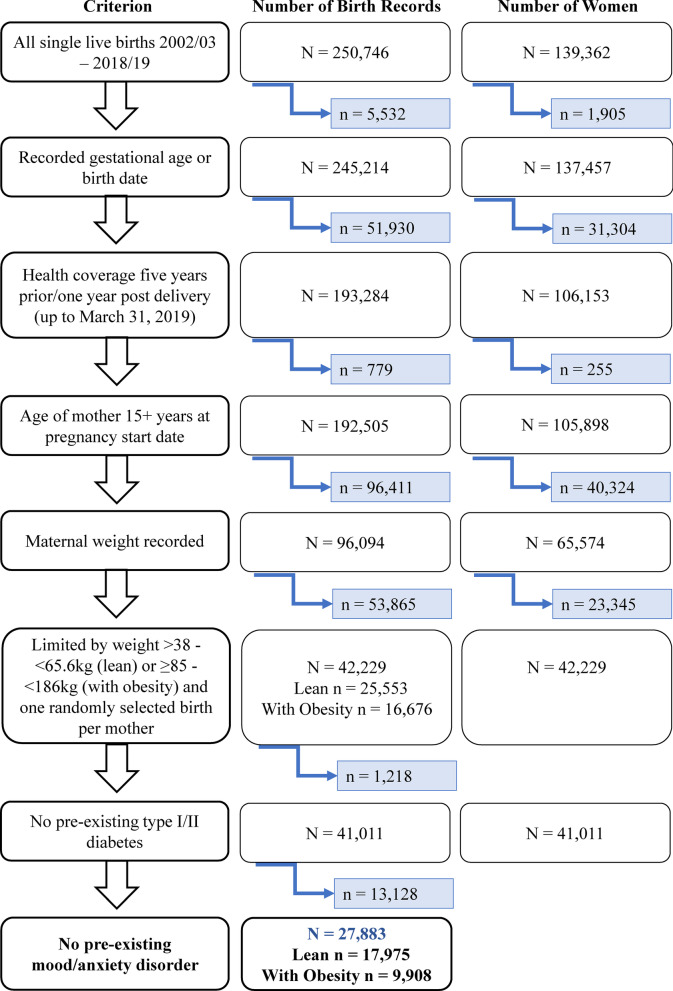
Administrative health data (2002/03-2018/19) were used to identify a cohort of women (age 15+ years) who gave birth (N = 250,746) and had no pre-existing mood/anxiety disorders or diabetes (N = 222,863 excluded). Women were then divided into two groups: lean (N = 17,975) and with obesity (N = 9908), which was identified by a recorded maternal weight of > 38 to < 65.6 kg and ≥ 85 to < 186 kg (respectively). The risk of PPD within one year after delivery with and without insulin treatment was assessed by Poisson regression analysis. Models were adjusted for maternal age group (at pregnancy start date) and area-level income (at delivery).
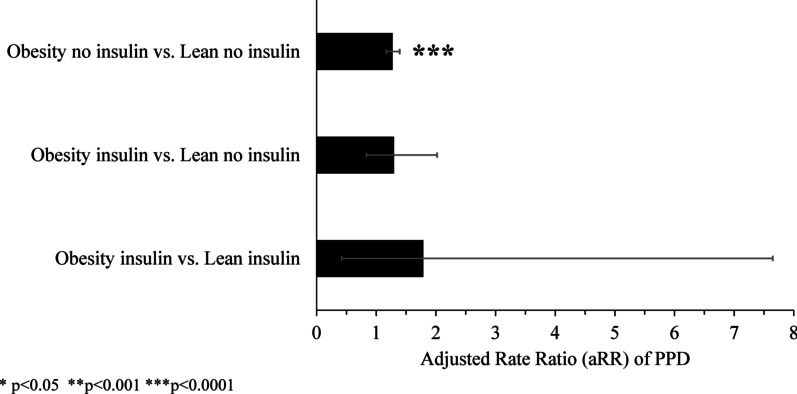
The unadjusted risk of PPD was higher in the obesity group (8.56%; 95% CI 8.00-9.15) than in the lean group (6.93%; 95% CI 6.56-7.33). When no insulin treatment was given during pregnancy, mothers with obesity had a significantly higher risk of PPD than the lean group (aRR 1.27; 95% CI 1.17-1.39; p < 0.0001). However, when women with obesity and insulin treatment were compared to the lean group with no insulin treatment, no significant difference in the risk of PPD was observed between the groups (aRR 1.30; 95% CI 0.83-2.02; p = 0.248).
This is the first study to demonstrate a positive association between insulin treatment in pregnancy among women with obesity and reduced PPD rates, suggesting insulin as a possible preventative measure. However, the biological mechanism behind the observed positive effect of insulin on PPD rates remains to be investigated.
研究发现肥胖与围产期抑郁症风险增加之间存在关联,而围产期抑郁症也与胎盘催乳素水平降低有关。此外,患有妊娠糖尿病并接受胰岛素治疗的肥胖女性的胎盘催乳素水平升高。然而,针对围产期和产后抑郁症有多种治疗选择,但这些选择对发育中的后代存在风险。因此,需要预防措施以及早期识别围产期抑郁症的标志物。因此,我们的研究目的是确定妊娠期间胰岛素治疗与肥胖和非肥胖女性队列中产后心理困扰(简称 PPD)风险之间的关联。
使用行政健康数据(2002/03-2018/19 年)确定了一组分娩的女性队列(年龄 15 岁以上)(N=250746),且无先前存在的情绪/焦虑障碍或糖尿病(N=222863 例排除在外)。然后,女性被分为两组:瘦组(N=17975)和肥胖组(N=9908),通过记录的母亲体重>38 至<65.6kg 和≥85 至<186kg 来确定肥胖组(分别)。通过泊松回归分析评估产后一年内有无胰岛素治疗的 PPD 风险。模型根据母亲的年龄组(妊娠开始日期)和区域收入水平(分娩时)进行了调整。
未调整的 PPD 风险在肥胖组(8.56%;95%CI 8.00-9.15)高于瘦组(6.93%;95%CI 6.56-7.33)。当怀孕期间未给予胰岛素治疗时,肥胖母亲发生 PPD 的风险明显高于瘦母亲(ARR 1.27;95%CI 1.17-1.39;p<0.0001)。然而,当比较肥胖且接受胰岛素治疗的女性与未接受胰岛素治疗的瘦女性时,两组之间 PPD 风险无显著差异(ARR 1.30;95%CI 0.83-2.02;p=0.248)。
这是第一项研究表明,肥胖女性怀孕期间胰岛素治疗与降低 PPD 率之间存在正相关,表明胰岛素可能是一种预防措施。然而,胰岛素对 PPD 率观察到的积极影响背后的生物学机制仍有待研究。