Lu Jiajun, Zhang Xiaoyi, Wu Yichao, Sheng Yuebiao, Li Wenfei, Wang Wei
Department of Physics, National Laboratory of Solid State Microstructure, Collaborative Innovation Center of Advanced Microstructures, Nanjing University, Nanjing, China.
Department of Physics, National Laboratory of Solid State Microstructure, Collaborative Innovation Center of Advanced Microstructures, Nanjing University, Nanjing, China.
Biophys J. 2021 May 18;120(10):1971-1983. doi: 10.1016/j.bpj.2021.03.013. Epub 2021 Mar 19.
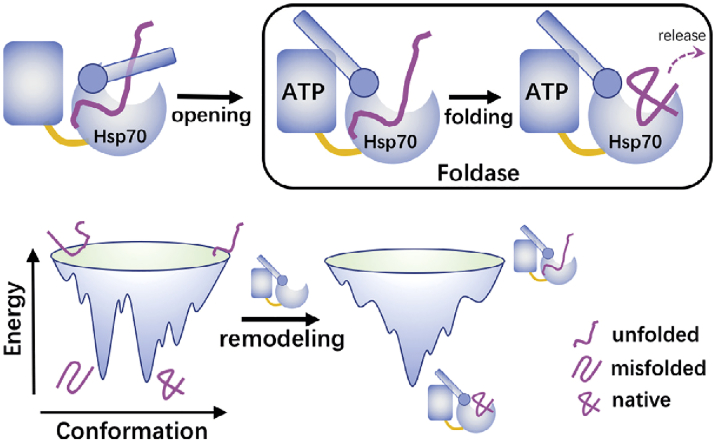
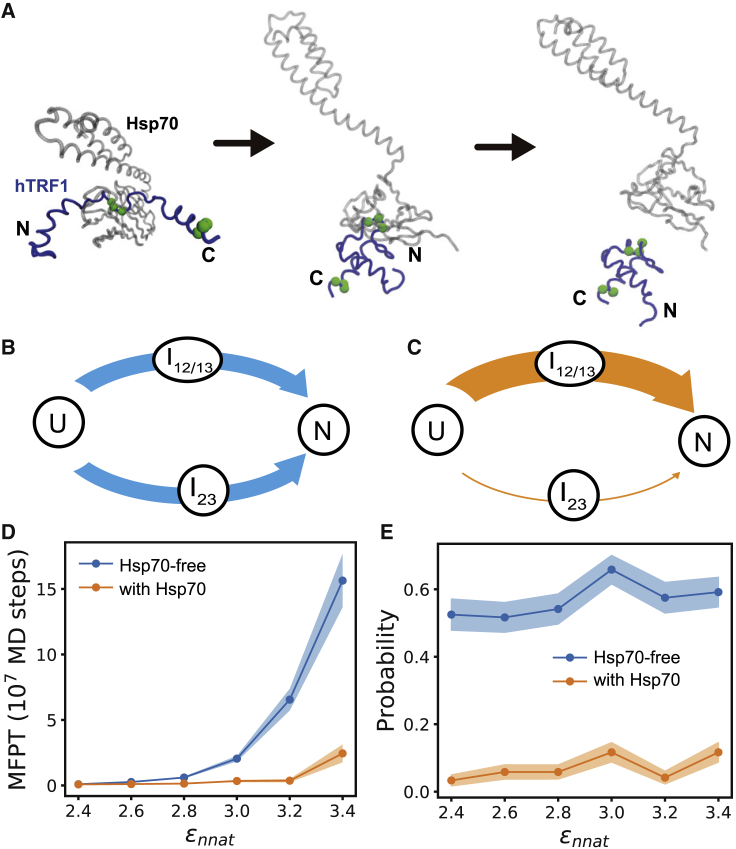
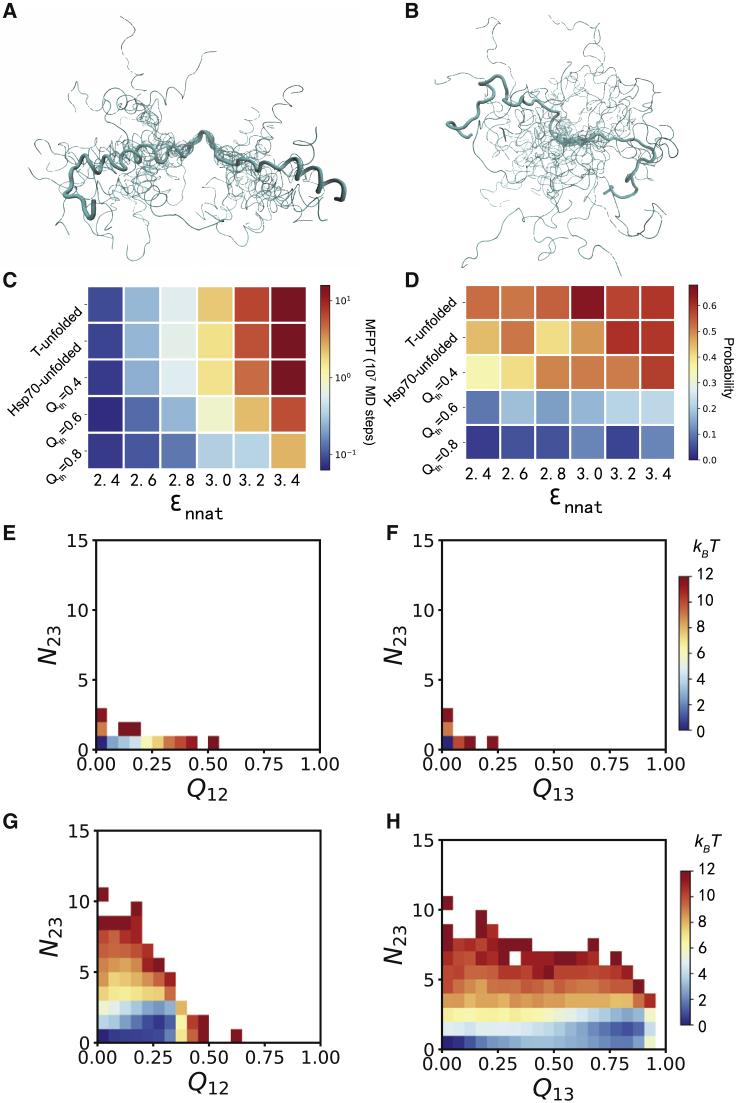
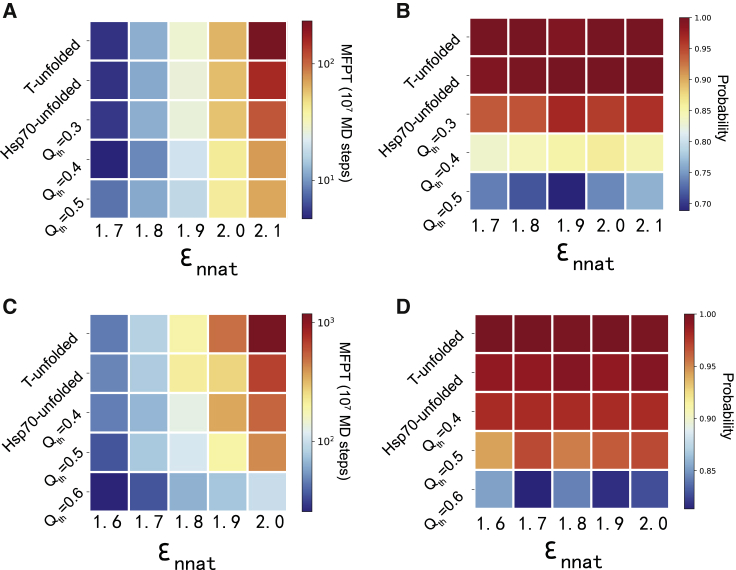
Hsp70 chaperone is one of the key protein machines responsible for the quality control of protein production in cells. Facilitating in vivo protein folding by counteracting misfolding and aggregation is the essence of its biological function. Although the allosteric cycle during its functional actions has been well characterized both experimentally and computationally, the mechanism by which Hsp70 assists protein folding is still not fully understood. In this work, we studied the Hsp70-mediated folding of model proteins with rugged energy landscape by using molecular simulations. Different from the canonical scenario of Hsp70 functioning, which assumes that folding of substrate proteins occurs spontaneously after releasing from chaperones, our results showed that the substrate protein remains in contacts with the chaperone during its folding process. The direct chaperone-substrate interactions in the open conformation of Hsp70 tend to shield the substrate sites prone to form non-native contacts, which therefore avoids the frustrated folding pathway, leading to a higher folding rate and less probability of misfolding. Our results suggest that in addition to the unfoldase and holdase functions widely addressed in previous studies, Hsp70 can facilitate the folding of its substrate proteins by remodeling the folding energy landscape and directing the folding processes, demonstrating the foldase scenario. These findings add new, to our knowledge, insights into the general molecular mechanisms of chaperone-mediated protein folding.
热休克蛋白70(Hsp70)伴侣蛋白是负责细胞内蛋白质生产质量控制的关键蛋白质机器之一。通过对抗错误折叠和聚集来促进体内蛋白质折叠是其生物学功能的本质。尽管其功能作用期间的变构循环在实验和计算方面都已得到充分表征,但Hsp70协助蛋白质折叠的机制仍未完全了解。在这项工作中,我们通过分子模拟研究了Hsp70介导的具有崎岖能量景观的模型蛋白质的折叠。与Hsp70功能的典型情况不同,后者假设底物蛋白质从伴侣蛋白释放后会自发折叠,我们的结果表明,底物蛋白质在其折叠过程中仍与伴侣蛋白保持接触。Hsp70开放构象中的直接伴侣蛋白-底物相互作用倾向于屏蔽易于形成非天然接触的底物位点,从而避免了受挫的折叠途径,导致更高的折叠速率和更低的错误折叠概率。我们的结果表明,除了先前研究中广泛涉及的解折叠酶和保持酶功能外,Hsp70还可以通过重塑折叠能量景观和指导折叠过程来促进其底物蛋白质的折叠,这证明了折叠酶的情况。据我们所知,这些发现为伴侣蛋白介导的蛋白质折叠的一般分子机制增添了新的见解。