ArunKumar K E, Kalaga Dinesh V, Kumar Ch Mohan Sai, Kawaji Masahiro, Brenza Timothy M
Department of Chemical and Biological Engineering, South Dakota School of Mines and Technology, Rapid City, SD 57701, United States.
Mechanical Engineering Department, City College of New York, New York, NY 10031, United States.
Chaos Solitons Fractals. 2021 May;146:110861. doi: 10.1016/j.chaos.2021.110861. Epub 2021 Mar 14.
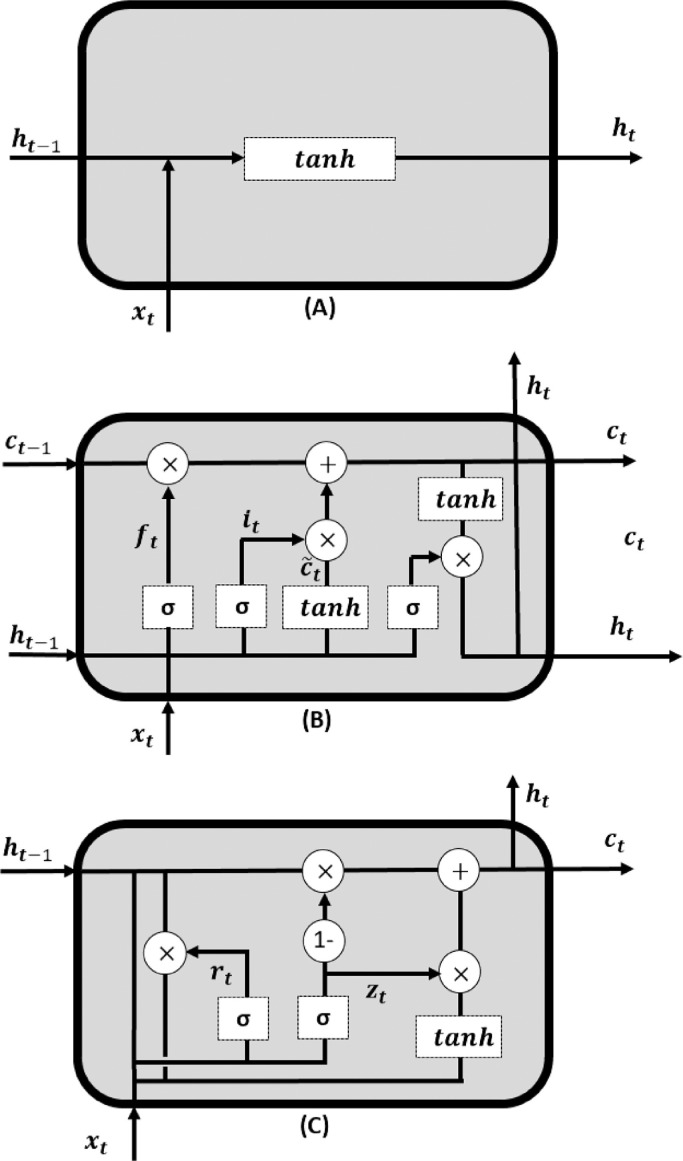
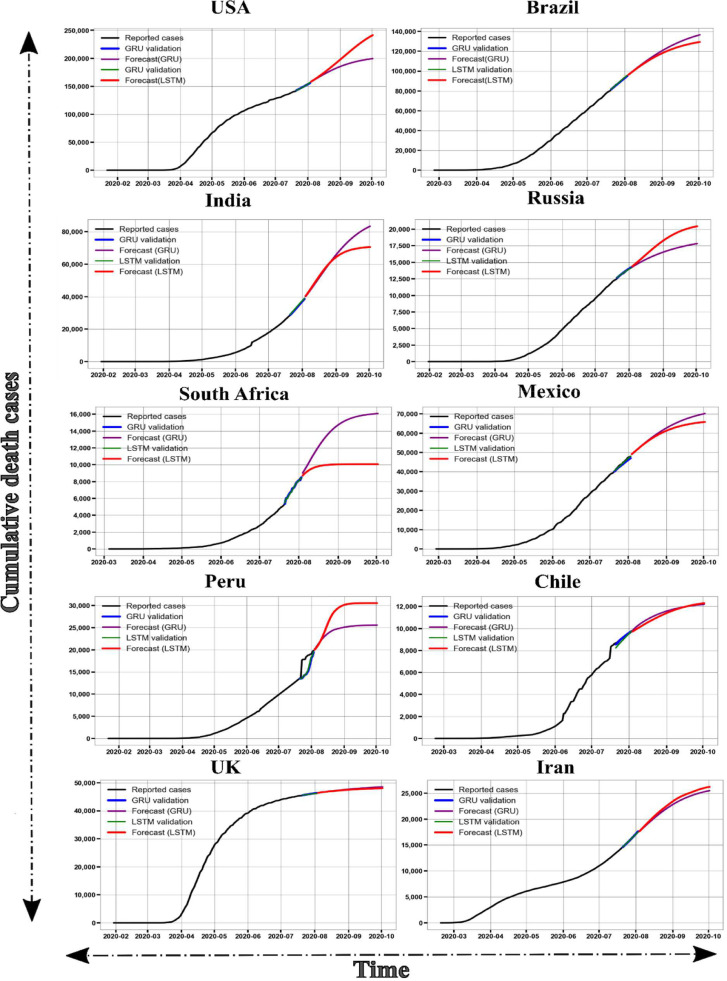
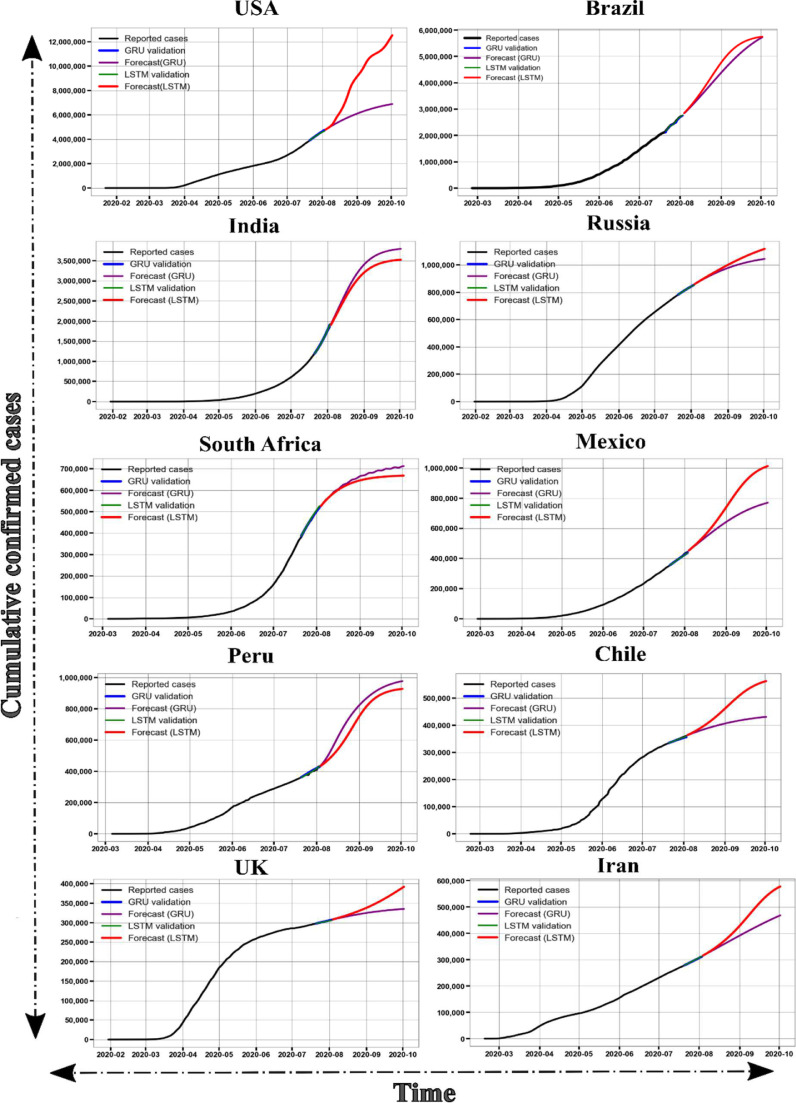
In December 2019, first case of the COVID-19 was reported in Wuhan, Hubei province in China. Soon world health organization has declared contagious coronavirus disease (a.k.a. COVID-19) as a global pandemic in the month of March 2020. Over the span of eleven months, it has rapidly spread out all over the world with total confirmed cases of ~ 41.39 M and causing a total fatality of ~1.13 M. At present, the entire mankind is facing serious threat and it is believed that COVID-19 may have been around for quite some time. Therefore, it has become imperative to forecast the global impact of COVID-19 in the near future. The present work proposes state-of-art deep learning Recurrent Neural Networks (RNN) models to predict the country-wise cumulative confirmed cases, cumulative recovered cases and the cumulative fatalities. The Gated Recurrent Units (GRUs) and Long Short-Term Memory (LSTM) cells along with Recurrent Neural Networks (RNN) were developed to predict the future trends of the COVID-19. We have used publicly available data from John Hopkins University's COVID-19 database. In this work, we emphasize the importance of various factors such as age, preventive measures, and healthcare facilities, population density, etc. that play vital role in rapid spread of COVID-19 pandemic. Therefore, our forecasted results are very helpful for countries to better prepare themselves to control the pandemic.
2019年12月,中国湖北省武汉市报告了首例新型冠状病毒肺炎病例。很快,世界卫生组织在2020年3月宣布传染性冠状病毒病(即新型冠状病毒肺炎)为全球大流行病。在短短十一个月的时间里,它迅速蔓延至全球,累计确诊病例约4139万例,造成约113万人死亡。目前,全人类都面临着严重威胁,据信新型冠状病毒肺炎可能已经存在了相当一段时间。因此,预测新型冠状病毒肺炎在不久的将来对全球的影响变得势在必行。目前的工作提出了最先进的深度学习循环神经网络(RNN)模型,以预测各国的累计确诊病例、累计康复病例和累计死亡人数。开发了门控循环单元(GRU)和长短期记忆(LSTM)细胞以及循环神经网络(RNN)来预测新型冠状病毒肺炎的未来趋势。我们使用了来自约翰·霍普金斯大学新型冠状病毒肺炎数据库的公开数据。在这项工作中,我们强调了年龄、预防措施、医疗设施、人口密度等各种因素在新型冠状病毒肺炎大流行快速传播中所起的至关重要的作用。因此,我们的预测结果对各国更好地准备控制疫情非常有帮助。