Hörnsten Carl, Littbrand Håkan, Boström Gustaf, Rosendahl Erik, Lundin-Olsson Lillemor, Nordström Peter, Gustafson Yngve, Lövheim Hugo
Department of Community Medicine and Rehabilitation, Geriatric Medicine, Umeå University, Umeå, Sweden.
Department of Community Medicine and Rehabilitation, Physiotherapy and Geriatric Medicine, Umeå University, Umeå, Sweden.
Eur J Ageing. 2020 Jun 3;18(1):109-115. doi: 10.1007/s10433-020-00572-9. eCollection 2021 Mar.
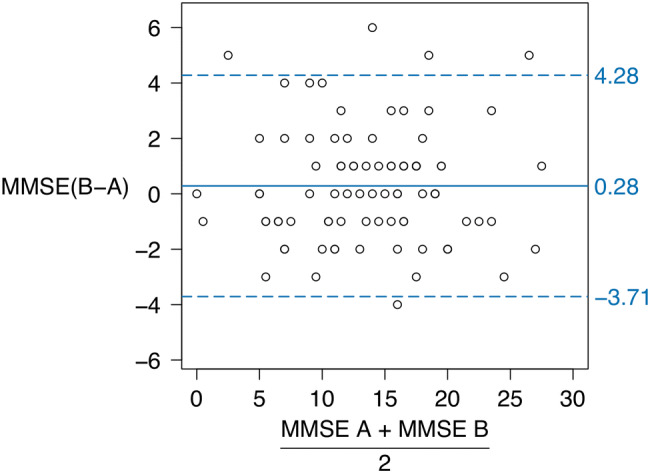
Few studies have investigated the measurement error of the Mini-Mental State Examination (MMSE) in the same unit of measurement, also known as absolute reliability. This measurement can help determine whether an observed score change for an individual is likely to represent true change. The aim of this study was to investigate the absolute reliability of the MMSE among individuals with dementia that reside in nursing homes. Among 88 participants, 19 (21.6%) were men, 35 (39.8%) had Alzheimer's disease, 35 (39.8%) had vascular dementia, and the mean age was 84.0 years (range 65-98). The participants were tested and retested with the MMSE within 1-6 days. Both tests were administered by the same assessor at the same time of day. The mean MMSE score was 13.7 (range 0-28). The absolute difference between MMSE scores varied from 0 to 6 points, and the differences did not correlate with the corresponding score means ( = 0.874). The smallest detectable change (SDC) between two measurements was 4.00. The SDC was independent of depression, impaired vision and hearing, delirium within the last week, dementia type and age. However, the SDC was 5.56 among men and 3.50 among women ( = 0.003). In conclusion, for individuals with dementia that reside in nursing homes, it seems like their MMSE score needs to change by four or more points between two measurements in order for their score change to be reliably higher than the measurement error.
很少有研究在相同的测量单位下,即所谓的绝对信度,调查简易精神状态检查表(MMSE)的测量误差。这种测量有助于确定个体观察到的分数变化是否可能代表真实变化。本研究的目的是调查居住在养老院的痴呆症患者中MMSE的绝对信度。88名参与者中,19名(21.6%)为男性,35名(39.8%)患有阿尔茨海默病,35名(39.8%)患有血管性痴呆,平均年龄为84.0岁(范围65 - 98岁)。参与者在1 - 6天内接受了MMSE测试和复测。两次测试均由同一名评估者在一天中的同一时间进行。MMSE平均得分为13.7(范围0 - 28)。MMSE分数的绝对差异在0至6分之间,且这些差异与相应的分数均值不相关(r = 0.874)。两次测量之间的最小可检测变化(SDC)为4.00。SDC与抑郁、视力和听力受损、上周的谵妄、痴呆类型和年龄无关。然而,男性的SDC为5.56,女性为3.50(p = 0.003)。总之,对于居住在养老院的痴呆症患者,两次测量之间他们的MMSE分数似乎需要变化4分或更多,其分数变化才会可靠地高于测量误差。